

Table of Contents
In this post, we want to tell you what to see in Cahors based on our own experience in the capital of the Lot department. As always, we'll share everything exactly as we experienced it, with opinions, anecdotes, and tips. On our blog, you won't find anything other than our personal experiences; we try to stay true to the essence of a blog. Therefore, if you're looking for more tourist-oriented information without opinions or personal experiences, we always recommend visiting the official tourism websites, in this case, the Lot Tourism website or the Cahors Tourism website , where you'll find all the official, reliable information.
To stay connected with you, follow us on our social media channels: YouTube and Instagram
Our experience in Cahors Lot
We begin our journey through the Lot department in Cahors, its capital, within the Lot Valley, an area that we will totally fall in love with and that we recommend you visit without missing a single detail.
Our visit was during Easter week , and we were on a family road trip along the Lot River in a campervan, so we're sharing our experience outside of the peak summer season, but we imagine it's exactly the same. The only difference is that in summer you won't find a boat offering excursions on the Lot River.
In France, Easter is a rather low season, they only have Easter Monday as a holiday, so they don't have as many days as the Spanish.

How to get to Cahors France
In our case, we arrived in our own vehicle , a motorhome, from near a town in Barcelona where we live.
The AP-7 to Narbonne, then the A61 towards Toulouse, and finally the A20 are the highways that take us to Cahors in under 5 hours of driving , comfortably and safely. Perhaps the worst part, as is always the case when traveling in France, is the cost of the highways. In this case, between gas and tolls, a round trip to Cahors costs around 400 euros.
If you want to go by public transport, the nearest airports are Toulouse and Bordeaux , and from there you will have to look at train and bus options, which are not a panacea, but they are an option.
A tip: Don't travel without travel insurance . Avoid medical co-payments, have a doctor just a click away on your app, have a lawyer specializing in any issues that might arise during your trip, and avoid unpleasant surprises like cancellations or incidents along your route. The travel insurance that has convinced us the most for family travel so far is Iati Familia. Its price and coverage are ideal for traveling within Spain, Europe, and beyond. It covers everything on your trip, not just essential medical needs with 24-hour access to a doctor and pediatrician via the app's chat . I've included a discount they'll give you at the end of your quote request.
Park in Cahors to visit the best things to see in Cahors
In Cahors, the best place to park, as we did, is the city's park & ride . It's a free and very convenient parking area for any vehicle, and it also offers water filling and emptying services for campervans.
A free shuttle bus to the city center departs from this parking lot . From here, you can also reach the center in a 15-minute walk.
In short, whatever the case, I advise you to park in this park and ride if you're driving to visit the city; it's very practical, otherwise parking is impossible within the old town.
Sleep in Cahors
Accommodation in Cahors
In the case of hotel accommodation in Cahors or apartments, we cannot honestly guide you much. Our experience was in a motorhome and we cannot tell you about any hotel or apartment in particular.
Of course, here we have done a search for you in case you are interested in finishing seeing the options to stay in Cahors:
Cahors by motorhome
Here we can tell you about where to stay overnight in Cahors in a motorhome , as this was our experience.
In Cahors we are fortunate to have motorhomes welcome and we have a very large, free motorhome area , divided into two parts.
Firstly, the motorhome area has a section with water and waste disposal facilities, along with three designated motorhome pitches shaded by trees, which are great. However, these three pitches are clearly too small for the city, and recognizing this, they've created a much larger area for motorhomes to park and stay overnight in the adjacent parking lot, which is the same as the Park & Ride lot.
Right in front of this second parking lot you will find the free bus to the center , or you can reach the center of Cahors in less than 15 minutes on foot.

Cahors what to see in one day at the pace of our visit and experience
From the motorhome, park and ride area, where we spent the night, the next day we set out to visit Cahors on foot quietly. First, we went to the center on foot, crossing a beautiful bridge with views of the cliffs of the Causas Quercy Regional Park in the background.
Our visit to Cahors is just for one day, so we'll tell you what to see in Cahors in a day . In fact, we believe you can see everything perfectly well in one day, and nothing more is necessary.
If you have more days, what we recommend is taking a route through the Lot around Cahors.
What to see near Cahors on a route through the Lot
Regarding what to see near Cahors or what to see around Cahors, we recommend visiting the Lot Valley with beautiful villages such as Saint Cirq Lapopie and Capdenac le Haut, then visiting the incredible medieval city of Figeac, discovering the history of Champollion who deciphered the Egyptian hieroglyphs, and finally discovering the incredible and little-known Cele Valley that runs through the cliffs with troglodyte houses of the Caussas Quercy.
Cahors France Tourist Office
We began our visit to Cahors, France. The first thing we saw shortly after crossing the bridge that separates the city from where we parked our car was a large, spacious square with a fountain, where we found the tourist office. A must-see first stop if you're traveling to Cahors.
Ruins of the ancient Roman amphitheater of Cahors what to see
Before the tourist office, there's also a must-see stop. It's on a street where, at the end, you'll find a private parking lot called the Amphitheater Parking . That's precisely where you should go to visit the ruins of the ancient amphitheater.
The remains of a 1st-century Gallo-Roman amphitheater lie hidden beneath the Fénelon alleyways, on the first floor of the Amphitheater parking garage . Access is free, so take advantage of the opportunity to see the ruins of this Roman-era amphitheater in Cahors, France. They were discovered in 2007 during the construction of the parking garage and, ironically, remained there.
Medieval old town, a must see in Cahors France
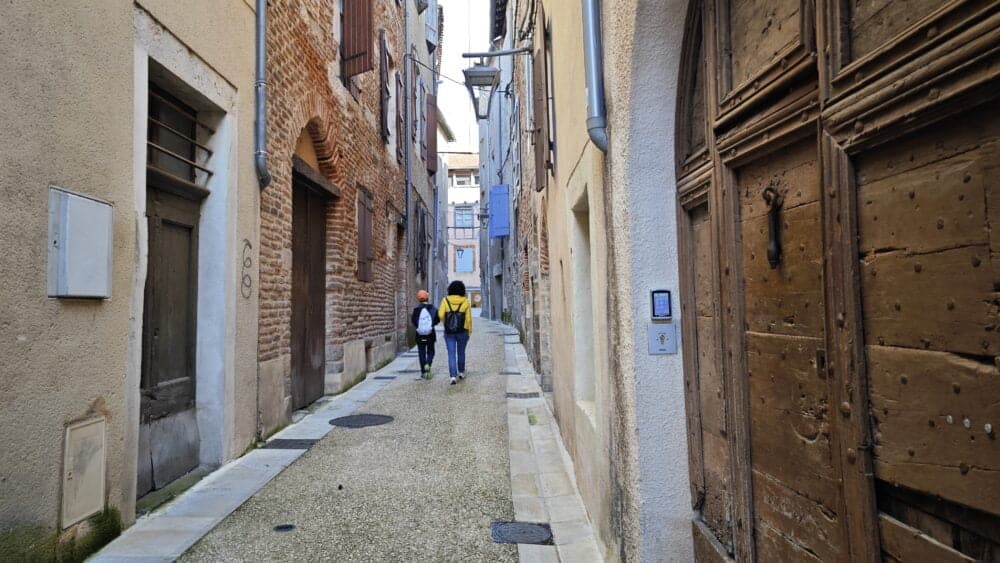
From the Cahors Tourist Office, right in front, across the street began the medieval cobbled streets of Cahors' historic center , our next stop in the city.
There isn't a single alleyway in Cahors, France, that isn't worth getting lost in. The medieval essence and the small details of the historic streets are truly captivating. Don't miss these details, because you might suddenly discover treasures like secret gardens tucked away in the narrow lanes.
The medieval houses, walls, towers and medieval gates of Cahors are beautiful, worth admiring and photographing for hours. You'll see.
Near the La Barre district, next to the walls of Cahors, stands a large open tower, the St-Jean Tower , facing the cliff, sometimes nicknamed the Hanged Men's Tower. Nearby is a 16th-century watchtower, inaccurately called the Barbican—don't miss it!

The Cahors market to see and taste
In front of the Cathedral this Saturday there was one of those markets that everyone raves about in Cahors. Flowers, cheeses, olives, salted fish, foie gras, vegetables, fruits, and the typical market wares kept us busy for quite a while, allowing us to do some shopping for fresh produce that we needed.

The Santa Sofia of Cahors, the essential cathedral to see in Cahors World Heritage Site
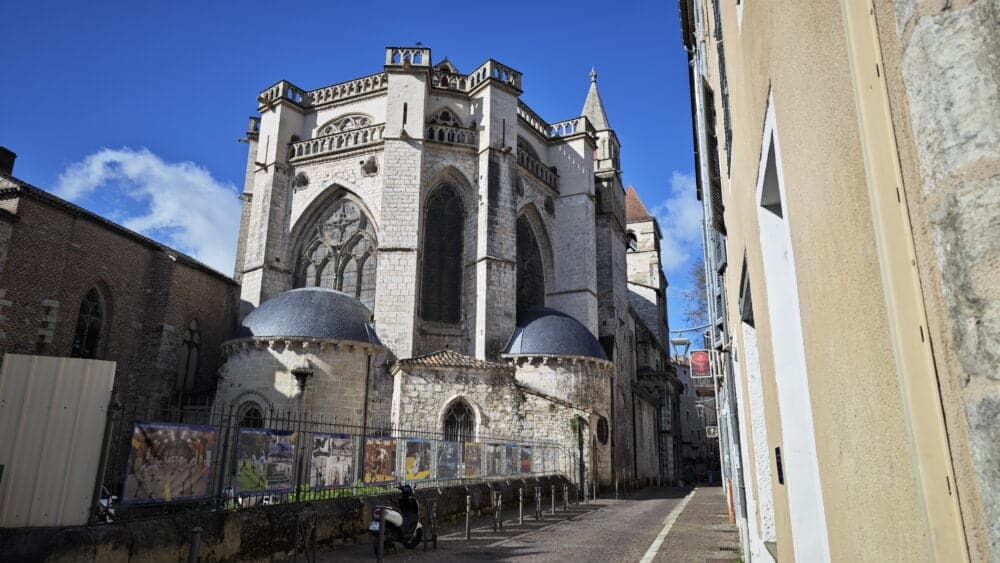
The Cathedral of Saint-Étienne in Cahors is a majestic 12th-century Gothic cathedral, located just behind the market. Its architecture and stained-glass windows are breathtaking; it's a UNESCO World Heritage Site and definitely worth a visit. The cathedral's rounded domes are reminiscent of Hagia Sophia in Istanbul—how beautiful!
The French Way of St. James passes through Cahors, so this cathedral is a must-see pilgrimage site for pilgrims on the route. So stop and observe; you're sure to see some pilgrims marveling at the Romanesque art of this cathedral, its spectacular Gothic cloister , and perhaps visiting the relics of the Holy Shroud kept here.

The secret gardens and parks of Cahors that are essential to see with Malbec vines
After wandering around and discovering some secret gardens among alleyways, we strolled through larger parks, full of Malbec vineyards , famous for their good wine.
Next to the Pont Valentré, we even found a garden with Malbec vines that they call the beautiful Garden of Drunkenness.
We can say that what surprised us most about Cahors are these gardens and parks. We find them beautiful, and beyond their beauty, discovering secret gardens , as they call them, while strolling through the narrow streets of the old town was something that captivated us during our visit.
These gardens are all different, each with its own story, theme, flowers and plants. Everyone has their own explanatory panel and their curiosities, there is something for everyone!
An example of a secret garden: just behind the Cathedral, in a narrow alley you will find an entrance to a house with an archway, enter there and marvel at the secret garden.
If you'd like, the Cahors tourism website has a 4-hour route through all the secret gardens of Cahors. You'll see how impressive Cahors is in taking care of these gardens, and from May to October they are truly beautiful and a must-see.
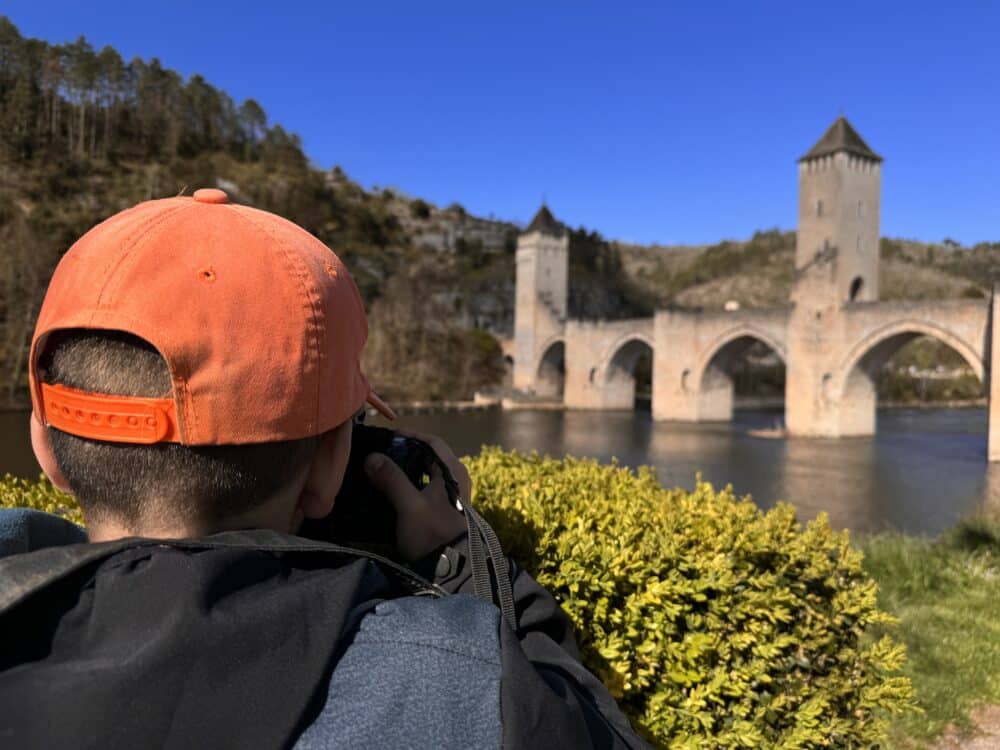
The must-see in Cahors: The Pont de Valentré, UNESCO Heritage Site
At the end of the visit to the old town we arrived at the Lot River , where there are usually boats that take you for a ride, but in the low season everything is completely calm.
We went up and crossed the Valentré Bridge, an iconic medieval bridge with fortified towers, a UNESCO World Heritage Site . It surprised us. Access is free ; the Pont d'Avignon, which is very similar, requires a fee, so the surprise was doubly pleasant.
The Valentré Bridge is a symbol of Cahors , built from 1308 onwards on the initiative of the city's consuls.
Built entirely of carved stone, it consists of eight arches and three towers , the latter rising more than 40 meters above the water.
It was completed around 1380 and has survived to this day. In 1998, the bridge that passes under the Camino de Santiago de Compostela was included in the UNESCO World Heritage List.
It is also called the devil's bridge , and the little devil that can be seen on the central tower is reminiscent of the legend of this magnificent bridge.

The Water House of Cahors what to see
After crossing the Valentré bridge, we found the Casa del Agua (Water House ) on the left, a one-minute walk down alongside the river . We found it closed when we passed by, but it's usually open; we were just unlucky.
The old 19th-century Cabazat pumping station, near Pont Valentre, retains its original machinery. It now houses a small museum and interpretation center about Cahors and its surrounding area, focusing on the waterways of the Lot River.
This place hosts permanent and special exhibitions on the theme of water, and they are usually free. It's a shame we couldn't go in during our visit.
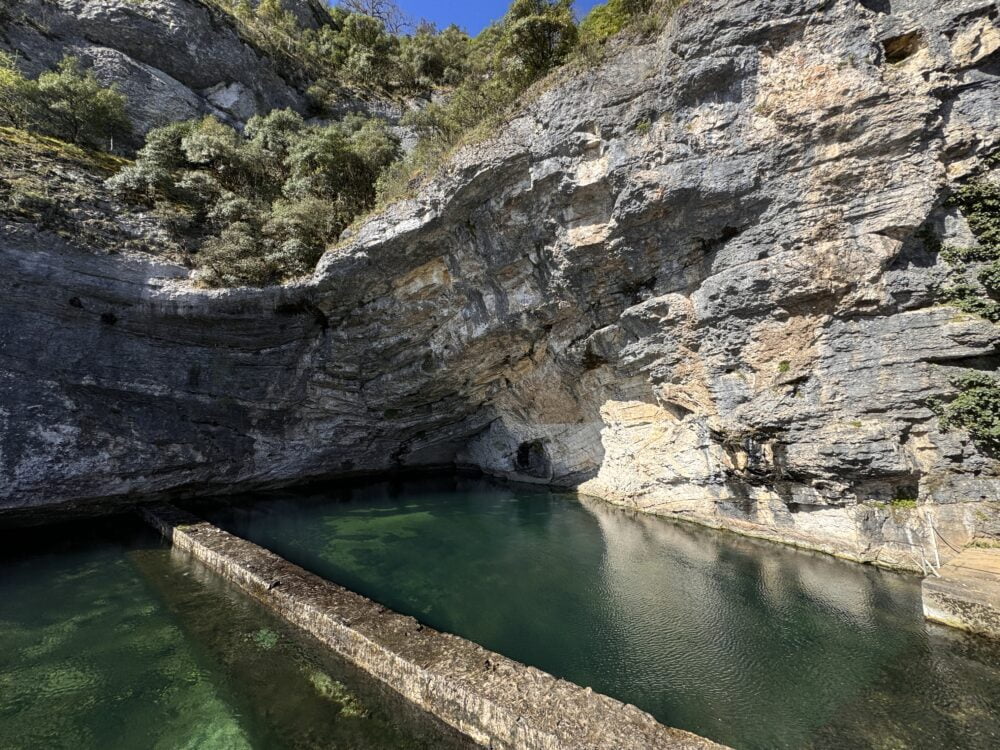
Roman fountains at Chartreaux Cahors France
After visiting the water house, we continued walking along the banks of the Lot River and in 3 minutes we arrived to marvel at the turquoise Roman pools under some rocks . This was our last visit, and we returned to the motorhome, strolling along the banks of the Lot on the greenway in the city of Cahors.
The Chartreux Fountain of Cahors is a limestone spring that was once the place of worship of Divona, the Celtic water goddess after whom Cahors is named (Divona Cadulcorum). By the way, in the city you can also find an arch called Divona in the old Roman baths area of the city, although it is in quite poor condition.
The discovery in 1989 of a large number of Roman coins attests to the cult of wells in the XNUMXst century BC and XNUMXst century AD and that this source is already of Roman origin.
In the Middle Ages and Modern Age, factories used the water from this spring on the banks of the Lot and currently it can also be said that its waters are used by the municipality of Cahors. Whatever the color of the waters under the limestone rocks, they make it a beautiful place.
End of our visit to Cahors what to see for its essential for a day
And that concludes our visit to Cahors. In our case, we returned to the motorhome by strolling along the banks of the Lot River on the greenway in the city of Cahors.
We wanted to go to Saint Cirq Lapopie, our next stop on the Lot Valley route, and we didn't take the bikes to do the greenway along the river, but we really wanted to, it looked great.
We hope that our experience visiting Cahors has been useful to you and that you enjoy your visit as much as we did.
If you have questions, we will read them below in the comments, hugs Kucavaneros friends!

Latest posts from our blog
-

Definitive manual for traveling by motorhome【2026】
Super complete manual for traveling by motorhome with all the answers to your questions.
-

Switzerland at Christmas: our family adventure between lights, snow and hot chocolate
If you're thinking of spending a magical Christmas in a fairytale destination, Switzerland at Christmas should be on your list. This year we took the plunge (and skis) and set off to explore Switzerland at Christmas with the kids, a plan we knew couldn't fail. Spoiler alert: everything we…
-
Guide to traveling to Alsace at Christmas: costs, map, route, tips and the 20 essential plans
Enjoy our guide to travelling to Alsace at Christmas. With this post we want to share our experience and learnings at the destination and help you prepare your next trip to Alsace at Christmas on your own. We are Kucavana, a family with two children and two dogs who love to travel. And if you want…
-

Guide to traveling to the Dolomites at Christmas: costs, map, route, tips, 7 Christmas markets and 19 other essential plans
Enjoy our guide to travelling to the Dolomites at Christmas. With this post we want to share our experience and learnings at the destination and help you prepare your next trip to the Dolomites at Christmas on your own. About us We are Kucavana, a family with two little ones and a dog who love to travel. We want to share our experience and learnings at the destination and help you prepare your next trip to the Dolomites at Christmas on your own.
Ethical code:
On our blog you will find affiliate links. These are always placed with our highest ethics. We never publish any service or product that we have not used before and that we are sincerely happy with. That is why our recommendations are always ethical. In addition, there is no additional cost for you to book through our links and, on the other hand, it means a small commission for us that helps us maintain this blog so that you can continue enjoying it for free.