


Table of Contents
If you're planning a trip to Namibia, there's one place that's probably already marked in red on your itinerary: Etosha Namibia.
And if you're not already convinced, let me tell you something after traveling over 5.000 kilometers through Namibia in a 4x4 with two children, tents on the roof, and 24 days of adventure: Etosha is one of those places that alone justifies a trip to Namibia.
If you're planning your trip, we recommend starting with our complete guide to traveling to Namibia , where you'll find all the trip planning, budgeting, safety, 4x4 rental, accommodations, and our complete 24-day itinerary for the country.
And if you're still planning your trip, you can also check out our guide to what to see in Namibia , where we've compiled all the must-see destinations we visited during our trip.
IMPORTANT TIP : Don't travel to Namibia without good travel insurance . Seriously. The distances there are enormous, private healthcare is expensive, and if something happens in the middle of a national park or in a remote area, helicopter evacuation can cost a fortune. After thoroughly comparing different options, we chose IATI Estrella , which is the only one with over one million euros of medical coverage—crucial in destinations where any unforeseen event can multiply the costs. IATI also offers 24/7 Spanish-language support and an app for online medical consultations, which was incredibly useful during our trip. Here's our link with a 5% discount on any IATI travel insurance policy. If you're going to Namibia, it's truly worth traveling with peace of mind.
Etosha Namibia: our experience exploring the country's most spectacular park
We arrived in Etosha after exploring Waterberg National Park , the Caprivi Strip, and Bwabwata National Park , convinced we had already experienced some of the best safaris of the trip. But just a few hours inside the park were enough to understand why Etosha is considered one of the best places in Africa for independent wildlife viewing.
Here you don't need to book expensive organized safaris. In Etosha you can drive your own vehicle , travel hundreds of kilometers of perfectly marked tracks , and stop in front of herds of elephants, giraffes, zebras, oryx, or rhinos as they drink at the waterholes scattered throughout the park.
During our visit we slept in three different camps , explored much of the park from east to west, saw hundreds of animals, enjoyed some of the best sunsets of the trip, and experienced moments that still remain some of the most special memories of our Namibian adventure.
In this guide we tell you everything you need to know to visit Etosha Namibia independently : how to plan your route, where to sleep, what animals to see, which are the best waterholes, how much the visit costs and all the tips we learned while exploring one of the most impressive national parks in Africa.
Etosha Namibia in 30 seconds
| Date | Information |
| Location | Northern Namibia |
| Size | 22.270 km² |
| Type of visit | Self-drive safari in your own vehicle |
| Recommended days | 3 days and 2 or 3 nights |
| Best time | May to October |
| Star animals | Elephants, rhinoceroses, lions, giraffes and zebras |
| Main entrances | Andersson Gate, Von Lindequist Gate and Galton Gate |
| Ideal for | Families, nature lovers and independent travelers |
| Essential | Sleep inside the park and visit the waterholes at sunset |
Is Etosha National Park worth visiting? If you're looking for a quick answer, here it is: yes, Etosha is absolutely worth it and is one of the must-see destinations on any trip to Namibia.
What is Etosha Namibia and why is it so special?
Etosha is Namibia's most famous national park and one of the best places in Africa for a self-drive safari.
Its name means "great white place" in the Oshindonga language and refers to the huge central salt pan known as Etosha Pan , an immense salt depression visible even from space that dominates much of the park's landscape.
With an area of over 22.000 square kilometers , Etosha is larger than entire countries like Slovenia or Israel and is home to more than 100 species of mammals and around 340 species of birds.
But what really makes Etosha special is not its size.
What makes this park unique are its permanent pools of water, known as waterholes.
During the dry season, when much of the territory becomes extremely arid, animals congregate around these pools to drink. This allows for the observation of vast quantities of wildlife without having to travel long distances or rely on luck.
Within a few kilometers you can find elephants, giraffes, zebras, wildebeest, oryx, kudus, jackals, hyenas and even lions or rhinoceroses sharing the same water source.
And the best part is that you can do it on your own, driving leisurely along the park's tracks and enjoying a much more flexible and economical experience than organized safaris in other African destinations.
For us, after visiting other parks in the country such as Bwabwata National Park , Etosha remains the place where we saw the greatest concentration of wildlife on the entire trip and one of the best self-drive safaris we have ever done.
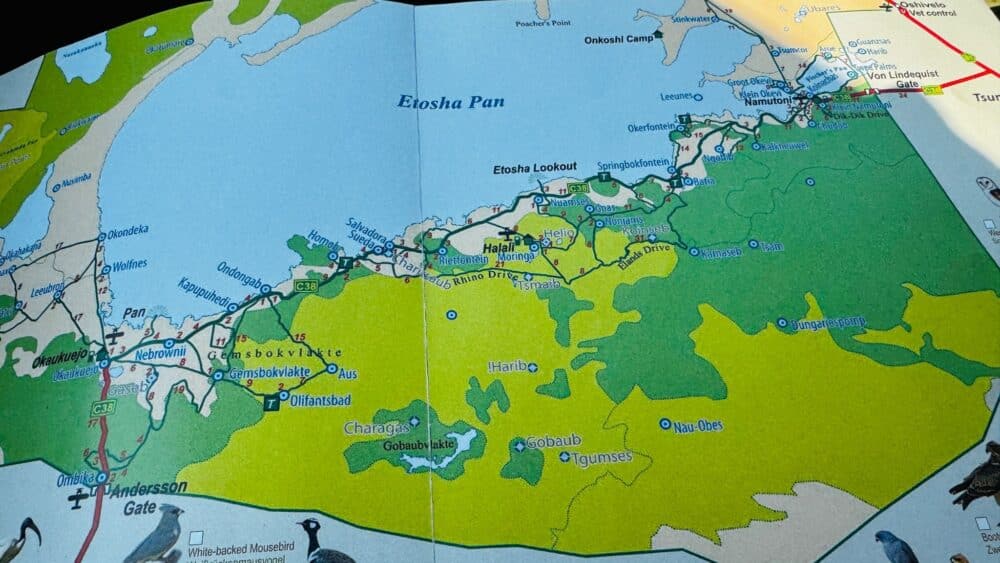
Map of Etosha Namibia and main areas
One of the keys to enjoying Etosha is understanding that we are not talking about a small park where you can see everything in a few hours.
With an area of over 22.000 km², Etosha is enormous . To give you an idea, driving from east to west involves more than 300 kilometers from end to end . That's why it's so important to plan your route and overnight stays within the park, as well as your fuel.
During our trip we crossed Etosha practically from east to west, entering through the Namutoni Gate after visiting the Caprivi region and leaving days later through Galton Gate towards Damaraland.
The main areas of the park are:
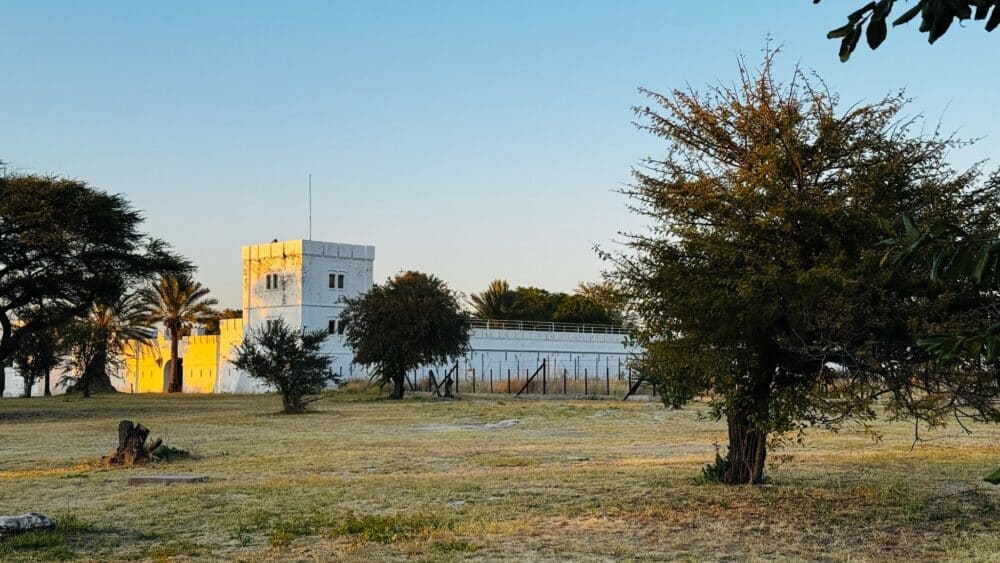
Namutoni (east area)
The Von Lindequist gate provides access to the eastern part of Etosha.
Here we find the historic Namutoni Camp, built around a former German military fort . It's an excellent area to start your visit if you're coming from the Caprivi region and Bwabwata National Park.
We spent our first night inside the park here and it was a magnificent introduction to Etosha.

Halali (central zone)
Located roughly in the center of the park , Halali is probably the best base for exploring Etosha.
From here you can easily access many of the best-known pools, and its famous nighttime waterhole offers some of the best sightings in the park.
It was precisely here where we experienced some of the most spectacular moments of our trip, observing elephants, zebras, and rhinoceroses at sunset.
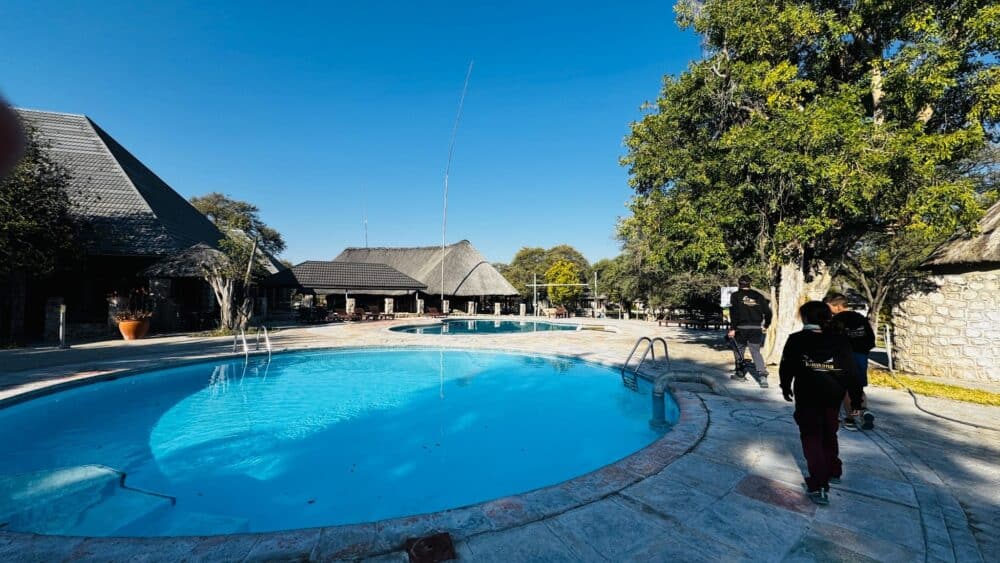
Okaukuejo (southern area)
It is the most famous camp in Etosha.
Its illuminated pool is probably the most famous spot in the park and one of the best places in Africa to observe black rhinos at night.
Although we couldn't get a place to sleep there, we did visit it during our trip and fully understood why it's so famous.
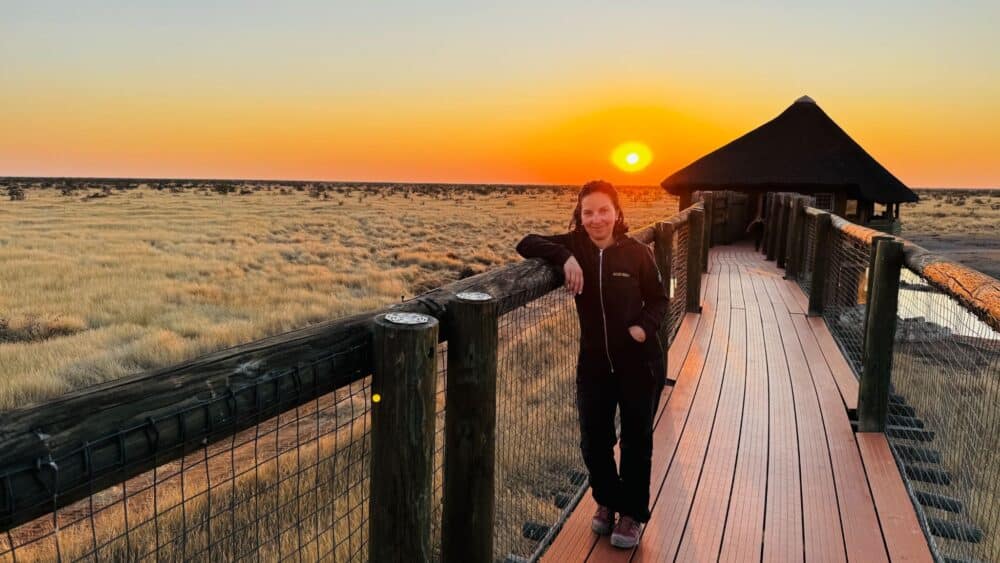
Olifantsrus (west zone)
Much less known than the previous ones.
It is a small, quiet campsite located in one of the most remote areas of Etosha.
That's precisely why it was one of our favorites.
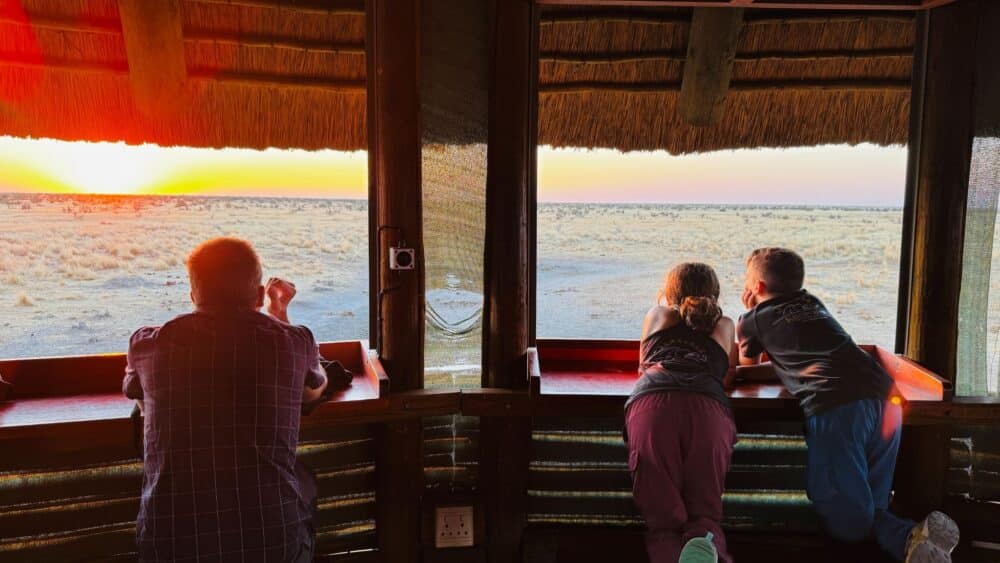
Its elevated platform next to the waterhole offers spectacular views for observing wildlife without leaving the enclosure, although I should warn you that we saw very little wildlife.
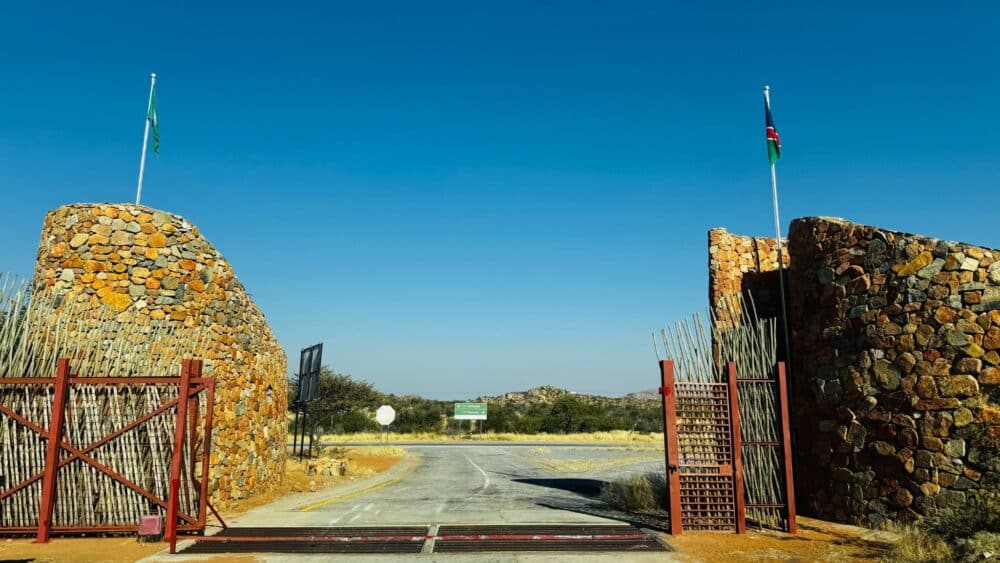
Gallon Gate
Located at the western end of the park.
It is the ideal gateway if you continue the route towards Damaraland, Twyfelfontein or Palmwag or the Skeleton Coast.
We exited here to continue our journey through Namibia heading south.
How many days do you need to visit Etosha Namibia
One of the most common questions when organizing a trip to Namibia is how many days to dedicate to Etosha.
Based on our experience, the answer is simple:
Less than two nights seems like a mistake to us.
Etosha is one of Namibia's most breathtaking destinations and deserves ample time to be fully appreciated. Ideally, stay 3 nights, but 2 is the minimum.
Etosha in 1 day
Only recommended if you have very little time.
You'll be able to see wildlife and go on a small safari, but you'll miss out on a large part of the experience.
Furthermore, you won't be able to enjoy the waterholes at sunrise and sunset, which are precisely the most magical times of the day.
Etosha in 2 days
It's the minimum we would recommend.
It allows you to spend one night inside the park and take several safaris on your own.
If your schedule is tight, this option can work reasonably well.
Etosha in 3 days (our recommendation)
The perfect option.
We spent three full days exploring the park and still felt like we could have stayed one more.
Three days allow:
- Sleeping in different camps.
- Explore various areas of the park.
- Visit numerous ponds.
- Go on safaris at sunrise and sunset.
- Enjoy the pools and campsites at your leisure.
For most travelers, this is the ideal duration.
Etosha in 4 days or more
Perfect for photography enthusiasts or wildlife observers.
The longer you spend in Etosha, the more likely you are to see elusive animals like lions, leopards, or rhinos.
If you have enough time during your trip through Namibia, it's an investment you'll hardly regret making.
We visited Etosha during our 24-day Namibia tour and, looking back, we'd probably add an extra night rather than take one away.
Self-drive safari in Etosha: everything you need to know
One of the great advantages of Etosha is that you don't need to book an organized safari to enjoy a spectacular experience.
In fact, for us, one of the reasons why Etosha is so special is precisely that it allows you to have an authentic self-drive safari in a simple, safe and accessible way for any traveler.
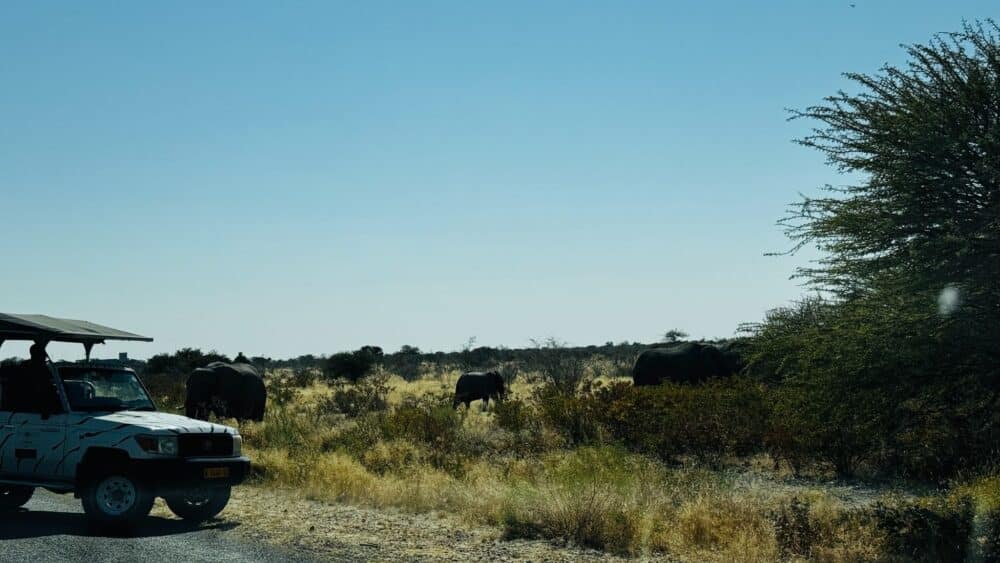
Unlike other African parks where safaris are usually done with a guide, in Etosha you can drive your own vehicle along an extensive network of perfectly marked tracks and explore the park at your own pace.
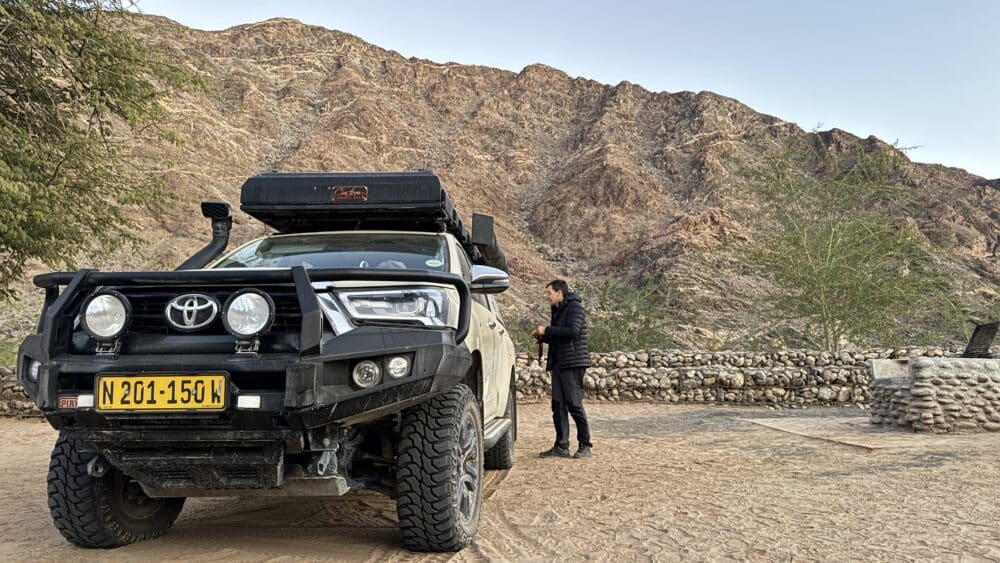
We explored Etosha in our rented, fully equipped Toyota Hilux with two rooftop tents, and the experience was fantastic. However, unlike other areas of Namibia such as Sossusvlei or some tracks in Damaraland, a 4x4 isn't essential here.
Many of the park's roads are in very good condition and can be easily traveled with a conventional car.
However, traveling in a tall vehicle has several advantages:
- Improved visibility over vegetation.
- Greater comfort during many hours of driving.
- Easier access to some secondary tracks.
- Better photography experience.
🚙 Our advice: rent a 4x4 with a rooftop tent
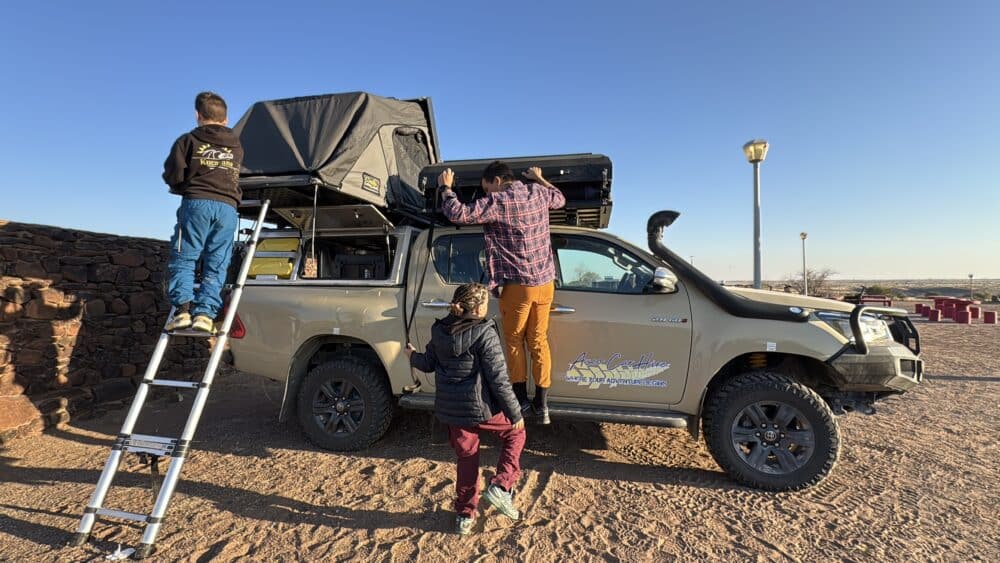
After traveling over 5.000 kilometers through Namibia for 24 days , we have a very clear recommendation: if your budget allows, rent a 4x4 equipped with a rooftop tent.
Not only will you gain the freedom to sleep in some of the most spectacular places in the country, but you will also be able to easily access areas where a conventional vehicle may have difficulties.
We traveled in a Toyota Hilux from Asco Car and the experience was flawless from beginning to end.
In addition, Asco Car offers Kucavana readers a 5% discount using the code:
@KUCAVANA
👉 You can check availability and prices directly on their website.
Important rules within Etosha Namibia
There are several rules you should know before entering the park:
- It is forbidden to get out of the vehicle outside of authorized areas.
- Driving outside the marked tracks is prohibited.
- Opening and closing times must be strictly respected.
- Drones are completely prohibited and you cannot bring them in; they are confiscated at the entrance by the military (then returned at the exit, but you must leave through the same door you entered).
- Plastic bags are prohibited and you cannot enter the Park with them.
When we entered through Namutoni, the military checked the vehicle, verified that we were not carrying drones, and also removed some plastic bags that we had forgotten to bring.
The sighting book trick
One of the best pieces of advice we received during the trip was to consult the sighting book at the reception desk of the main camps.
There, travelers note down the places where they have seen lions, leopards, rhinoceroses or hyenas during the last few days.
We consulted it every morning before leaving and it helped us a lot in deciding which ponds to head towards.
Honestly, it's probably the best "treasure map" that exists within Etosha.
Our 3-day route through Etosha Namibia
We visited Etosha during our 24-day Namibia tour , arriving from Caprivi and Bwabwata National Park and continuing on to Damaraland and Twyfelfontein.
In total we spent three full days exploring the park, sleeping in three different campsites and crossing Etosha practically from east to west.
Looking back, we believe it was one of the best decisions of the entire trip. Three days allowed us to explore very different areas of the park, visit dozens of waterholes, and enjoy some of the best wildlife sightings of our entire Namibian adventure.
Day 1: Namutoni, the Hoba Meteorite and our first contact with Etosha
The day began before arriving in Etosha with a visit to one of the country's most intriguing sites: the Hoba Meteorite , the largest meteorite preserved on Earth. If you have time, this short stop is well worth it before entering the park. It's easily accessible if you're coming from Caprivi, as we did.
We also took the opportunity to refuel, buy supplies and carry out the last formalities before venturing into Etosha.
Upon arriving at the entrance, we were immediately surprised by the military checkpoint . Vehicles are inspected, and it's advisable to be aware of some important rules before entering: drones are prohibited, plastic bags may be confiscated during the inspection, and it is essential to respect all instructions given by the military personnel managing access to the park.
Once the formalities were completed and the entry fees paid , our adventure in Etosha finally began.
The first few kilometers already gave us some of the park's most emblematic animals: zebras , springbok gazelles, oryx and numerous antelopes appeared constantly on both sides of the track.
We were particularly struck by the sheer amount of wildlife that could be observed with hardly any effort. Accustomed to other parks where sightings require more patience, here the animals seemed to be everywhere.
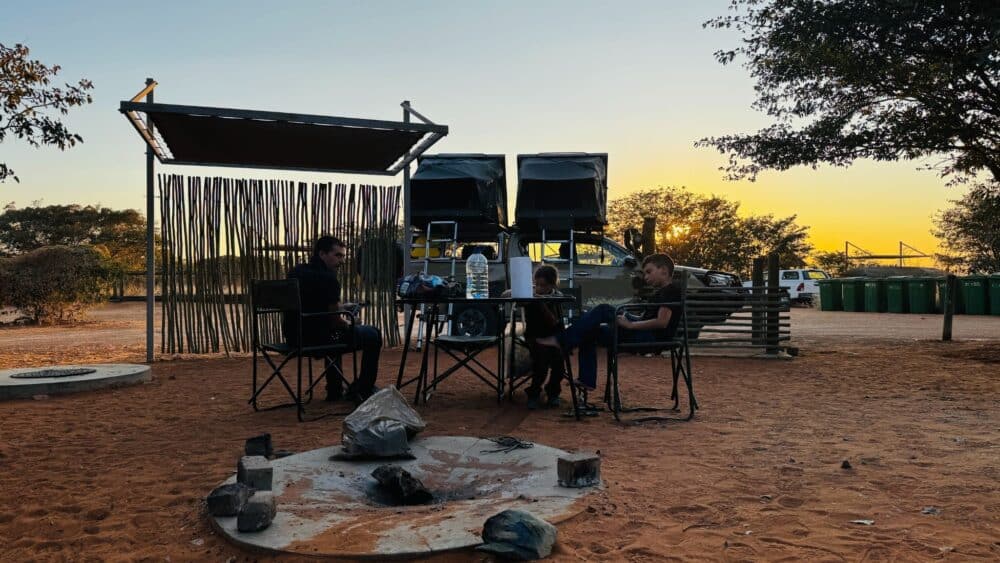
That night we slept at Namutoni Camp. After settling in, we went to see the camp's famous illuminated waterhole.
We arrived a little late and saw hardly any activity, but we learned a lesson that would stay with us for the rest of the trip: the best moments in Etosha usually occur during the first hour of the morning and especially during the last hour before sunset.
We slept camped in Numatomi, where the hot shower was a delight and the nighttime barbecue, braai, was the great culmination of the day, although at the Numatoni pond we arrived at night and there were no animals left to see, we arrived late.
Day 2: Halali and the incredible abundance of life in Etosha
If we had to choose one day to sum up what Etosha Namibia is, it would probably be this one.
We left the camp very early after consulting the famous sighting book where other travelers record the observations made during the previous days.
Our mission was clear. We wanted to find lions.
The latest notes indicated activity near several important ponds, and we spent a good part of the day following their trail.
We didn't find a single lion.
And strangely enough, we ended the day delighted.
Because Etosha taught us something we hadn't experienced on other safaris: the beauty of the park doesn't depend solely on finding predators.
For hours we explored trails surrounded by wildlife.
We saw veritable highways of zebras that seemed to have no end, large groups of giraffes walking among the vegetation, huge herds of blue wildebeest, oryx, kudus and dozens of species of antelope.
At times it seemed impossible to advance more than a few kilometers without stopping to observe some animal.
That day we also began to understand the importance of puddles. Instead of constantly driving, we learned to stop and wait. Many times the reward came on its own.
First came the zebras.
Then the antelopes.
Later, the giraffes.
And just when you least expected it, the elephants would arrive.
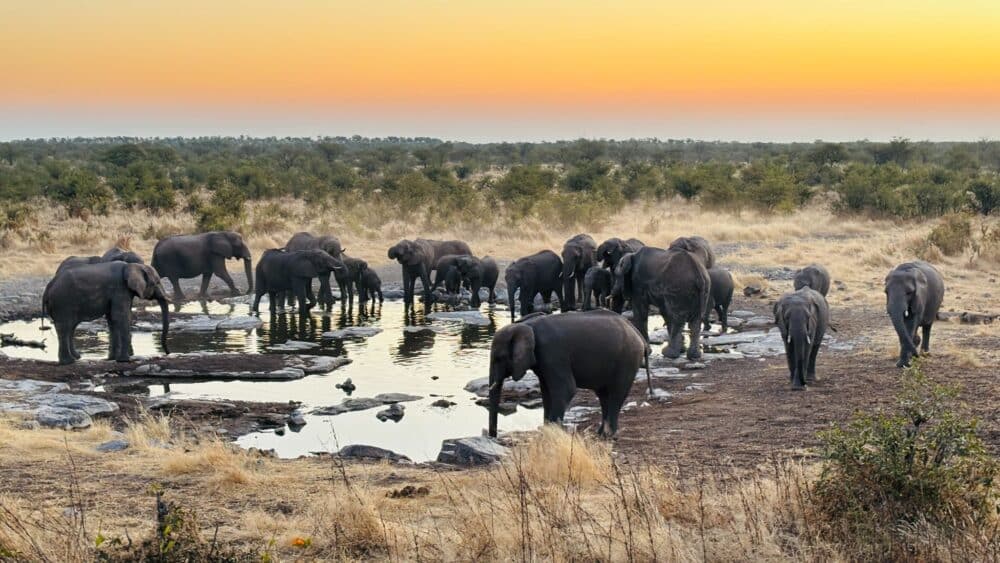
The day ended at Halali Camp and there we experienced one of the most spectacular moments of our entire visit to Etosha.
At dusk we headed to the camp's famous waterhole and for more than an hour watched as different species came to drink.
First came the zebras.
Then several rhinoceroses.
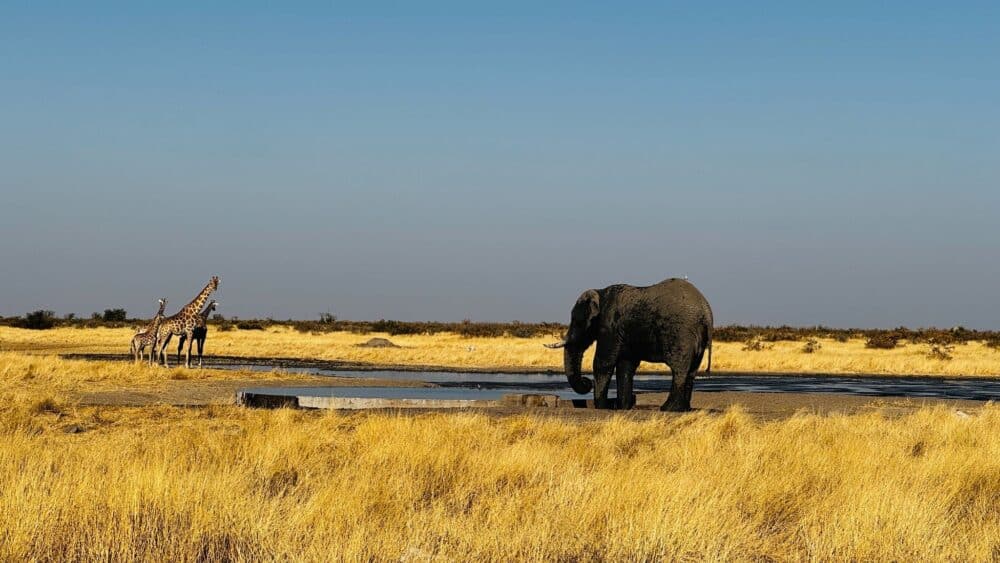
And finally, a large herd of elephants turned that sunset into one of the most special memories of our trip through Namibia.
Day 3: Olifantsrus, Okondeka and the eternal quest of the lions
Our last day began exactly the same way the previous one had ended.
Looking for lions.
The latest sightings placed activity near Okondeka , one of the most famous waterholes in the western part of the park and one of the best places to try to observe large predators.
We explored much of this western sector, visiting different waterholes and enjoying some of the most breathtaking scenery in Etosha.
Here the enormous salt flat takes on a spectacular dimension and the feeling of immensity is difficult to describe.
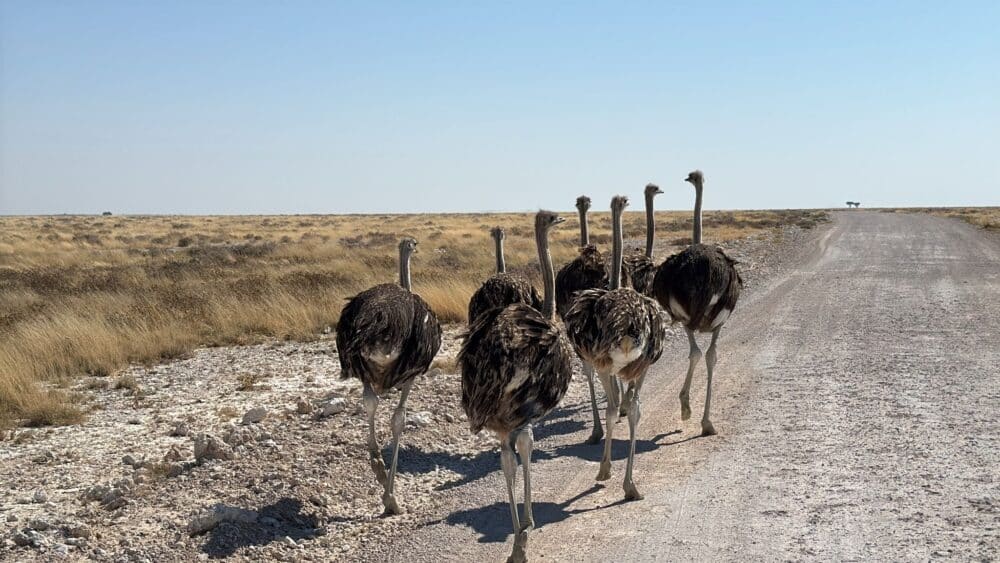
During the day we saw numerous elephants, giraffes, zebras, gazelles, ostriches and a multitude of herbivores.
Lions?
No sign.
But at that moment we had already understood something important.
Etosha is not a competition to complete a list of animals.
It is a place where simply observing nature becomes a fascinating experience.
Sometimes the reward isn't finding the rarest animal.
Sometimes it simply involves watching a giraffe walking slowly towards a watering hole as the African sun begins to set over the horizon.
Our tour ended at Olifantsrus, probably the most remote and peaceful camp in the entire park.
Its spectacular observation platform next to the waterhole and the tranquility of the area seemed like the perfect way to say goodbye to one of the most impressive places of our entire trip through Namibia, although we didn't see many animals here, to be honest.
Day 4: Our farewell to Etosha on our way to Damaraland
The following morning dawned cold and calm in Olifantsrus.
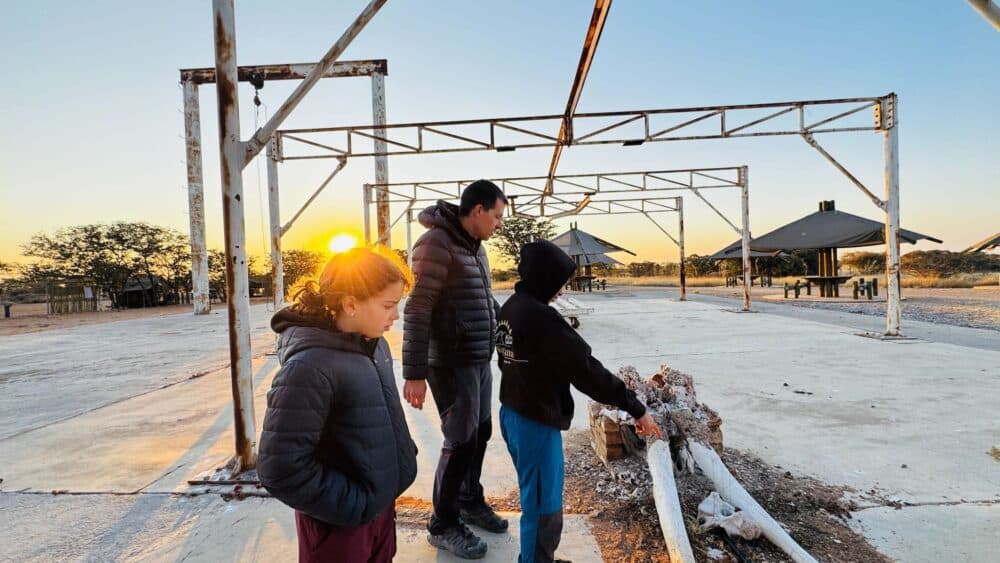
Before leaving Etosha for good, we made one last stop at one of the park's most curious and unknown places: the small interpretation center located next to the old elephant slaughterhouse, within the Olifantsrus campsite itself.
The visit is impactful. It explains how, in 1983, the authorities culled more than 500 elephants due to overpopulation , which, according to studies at the time, was jeopardizing the park's ecological balance. Some of the infrastructure used then is still preserved, and the visit leaves a strange and unforgettable feeling.
Beyond this historical episode, it also helped us understand something important about Namibia: the protection of wildlife and natural spaces is a very serious matter. Throughout the trip, we witnessed controls, strict regulations, and very rigorous management of the national parks.
After the visit we began our journey towards the western exit of the park, traveling one last time along the Etosha ski slopes.
As had happened on previous days, we again encountered numerous zebras, giraffes, springboks, and gazelles around the waterholes. The lions, however, continued to resist.
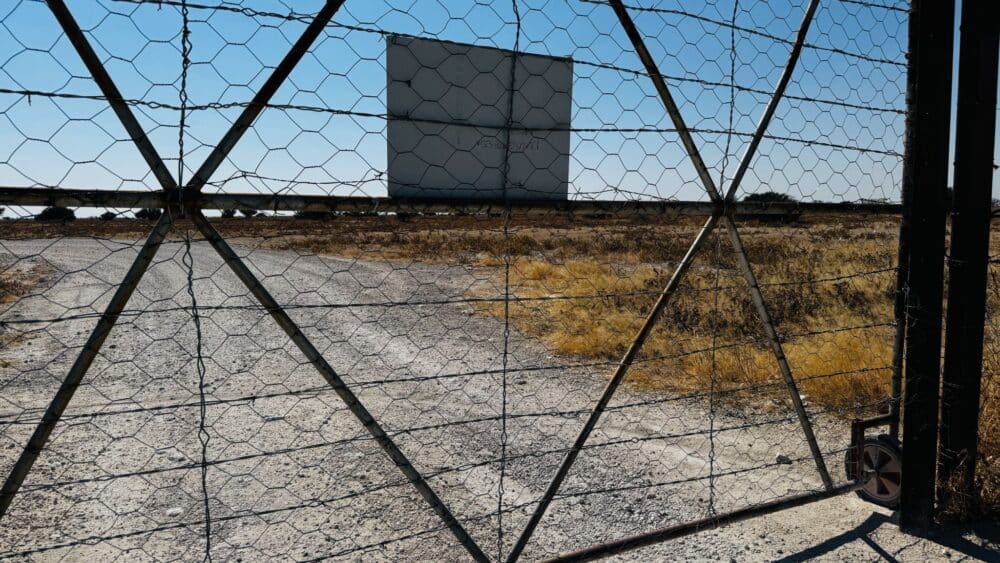
Finally, we left the park through Galton Gate. There, we went through another checkpoint where the military checked the vehicle's documentation and again verified that we weren't transporting fresh meat from the park—otherwise, it would be confiscated here— nor were we carrying prohibited plastic bags.
With Etosha now behind us, we headed towards Damaraland and Twyfelfontein , one of the most remote and spectacular regions of Namibia, where new landscapes, desert elephants and some of the most amazing accommodations of the entire trip awaited us.
The best waterholes in Etosha
If there is one thing that makes Etosha special compared to other African parks, it is its famous waterholes.
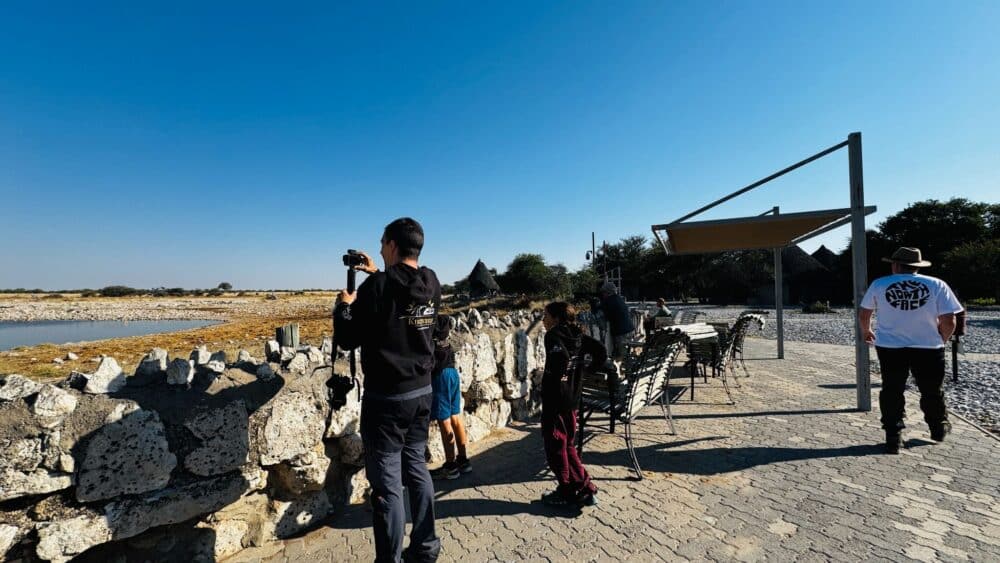
During the dry season, thousands of animals depend on these water sources for survival, congregating around them throughout the day. This transforms the ponds into veritable natural habitats where it's possible to observe a vast array of wildlife without having to travel great distances.
In fact, a large part of the success of a self-drive safari in Etosha lies in knowing which waterholes to visit and, above all, having patience.
We quickly learned that many times the best plan is simply to stop the vehicle, turn off the engine, and wait.
On the park maps sold at gas stations throughout the country and inside the park (although they were sold out inside the park when we visited), you'll see all the waterholes with their names. Otherwise, don't worry, you can also see them on Google Maps offline ; just download the offline map of Namibia.
Okaukuejo Waterhole
Probably the most famous pool in Etosha. Located within the campsite of the same name.
Its main attraction is that it remains illuminated at night, allowing you to observe animals even after the park gates have closed.
It's one of the best places to see black rhinos in Namibia. The downside: you have to book a spot at the campsite, and they fill up very, very quickly.
Halali Waterhole
For us, it was one of the best experiences in the entire park. Inside the Halali campsite.
The waterhole is a few minutes' walk from the camp and at sunset we saw elephants, zebras and rhinos parading by in a spectacular setting.
If we could only recommend one nighttime waterhole, it would probably be this one.
Okondeka
Located in the western part of the park.
It is one of the best ponds to try to observe lions and large predators.
During our visit we were not lucky with the felines, but we did see large concentrations of herbivores.
Goas
One of the best-known waterholes in the central area.
It often offers excellent opportunities to observe elephants and giraffes.
Klein Namutoni
Highly recommended if you are staying in the eastern part of the park and at the Namutoni campsite.
It allowed us to enjoy several interesting sightings during our first few days in Etosha.
Our advice is simple: don't try to travel too many kilometers. Often, the best sightings happen precisely when you decide to stay a while observing a particular pond.
Etosha's picnic areas: the only place you can get out of your car
One of the first things you learn when visiting Etosha is that you will spend many hours inside the vehicle.
Unlike other national parks, here it is strictly forbidden to get out of your car outside of designated areas. It's important to remember that we are in an environment where lions, hyenas, elephants, rhinos, and other wild animals roam freely.
That's why the fenced picnic areas scattered throughout the park have a very important function.
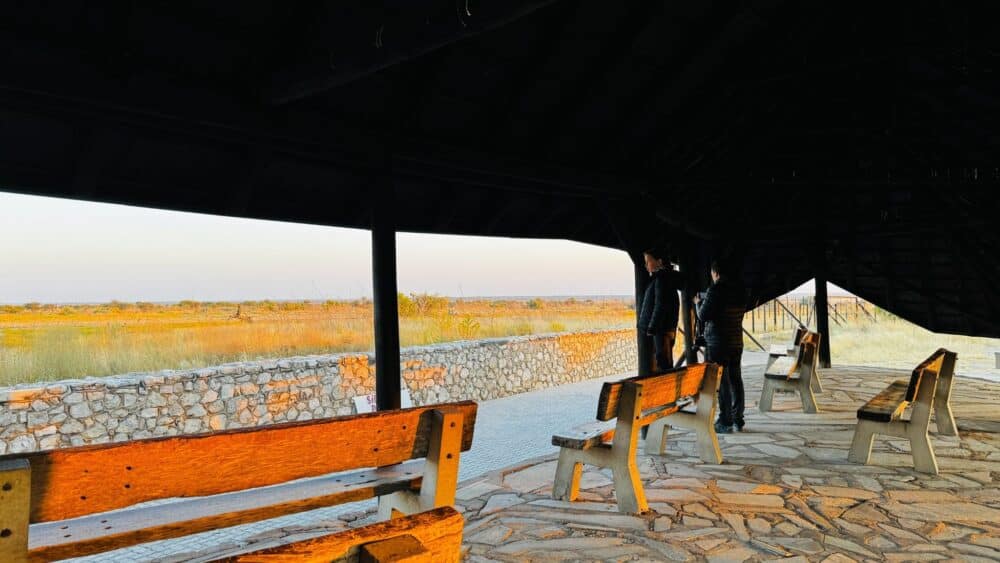
These are specially equipped areas where visitors can safely stop, stretch their legs, use the restrooms and enjoy a break during their safari day.
The most curious thing is that these areas are completely fenced off to prevent animals from entering. After spending hours observing wildlife from the vehicle, it feels strange to walk surrounded by a fence knowing that elephants or lions might be roaming on the other side.
During our visit we used several of these areas to take a break, have something to eat and allow the children to rest a little from the car.
I love it. Here, we humans are the ones locked up.
What will you find in the picnic areas of Etosha?
Although facilities may vary slightly depending on the location, they typically include:
- Picnic tables.
- Shaded areas.
- Benches for resting.
- Dry sinks.
- Litter bins.
- Safe spaces to stretch your legs.
They are not restaurants or full service areas, but they are very useful during a day of self-drive safari.
A very welcome stop during the safari
After several hours of traveling along tracks, observing animals and driving between puddles, these areas become true oases for travelers.
We took the opportunity to eat something quick, consult the map, review the latest entries in the sighting logbook, and plan the next part of the route.
Furthermore, if you're traveling with children, these stops are practically essential. Being able to run around for a few minutes, use the restroom, or simply change position greatly helps to keep the experience fun for the whole family.
Our advice is simple: use these areas to rest, but don't linger too long. In Etosha, you never know when the next elephant, rhino, or giraffe might appear around the next bend.

What animals did we see in Etosha Namibia?
If you're planning a trip, you're probably wondering what wildlife you can actually see in Etosha.
The short answer is: a lot.
During our three days in the park we saw more animals than we had imagined before arriving.
And that's without even being lucky enough to find leopards or lions, which many people also see.
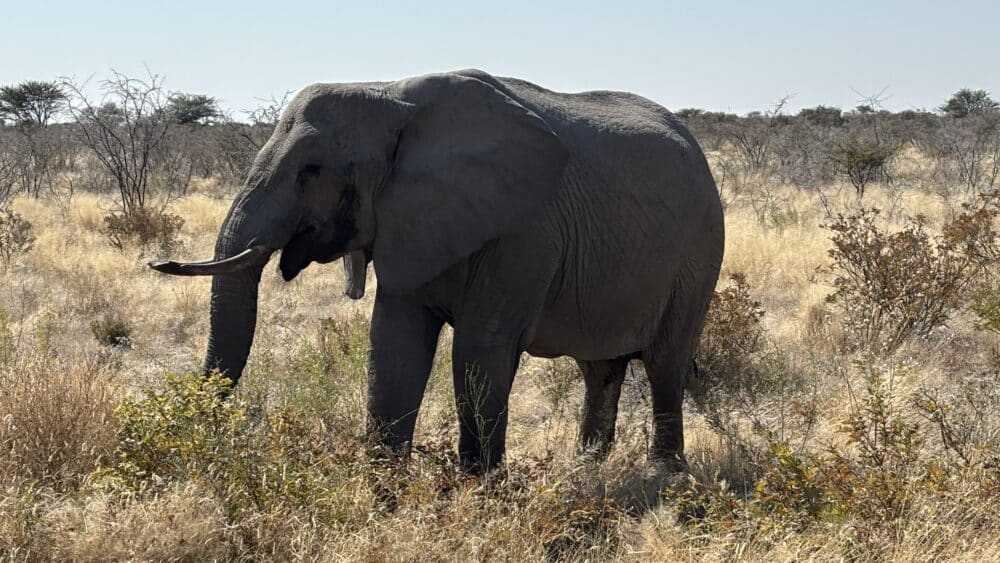
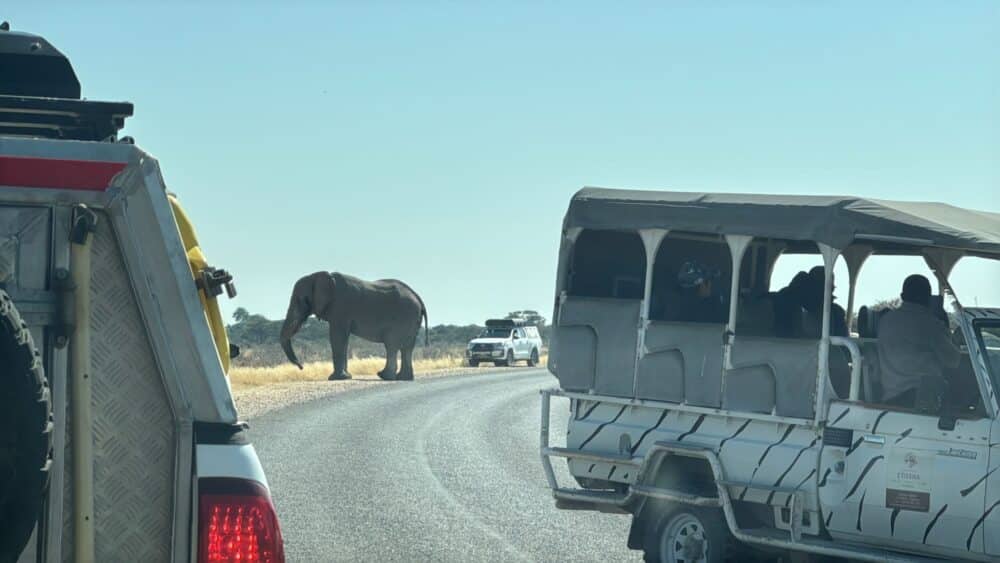
Elephants
Without a doubt, they were one of the main highlights of our visit.
We observed numerous herds approaching the pools during the hottest hours and also some impressive solitary males.
Seeing these giants slowly moving across the Etosha savanna is an unforgettable experience.
Giraffes
We saw them practically every day.
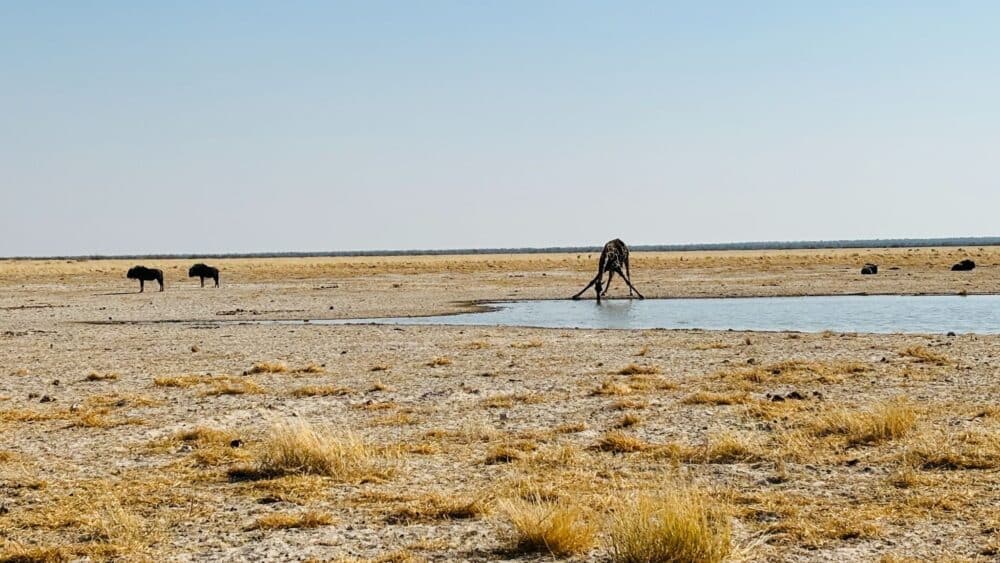
Sometimes they're alone, and other times they form small groups around the waterholes. The best thing is seeing them sprawled out drinking water—quite a sight.
Zebras
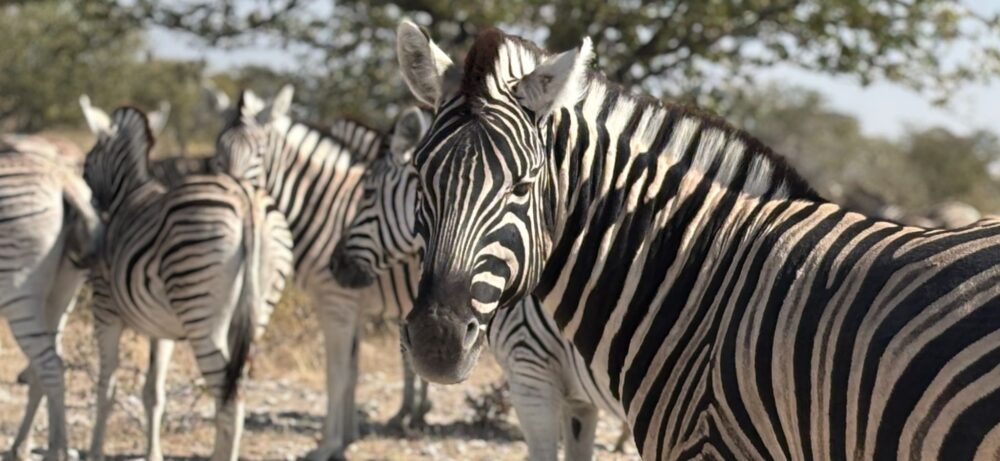
Possibly the most abundant animal on our safari.
We even saw veritable highways of zebras crossing the park's tracks.
Oryx
One of the symbols of Namibia.
Their long, elegant antlers are a constant presence throughout Etosha.
Blue wildebeest
Very common around ponds.
Especially during the early morning hours.
Rhinos
One of the most special moments of our trip.
Being able to observe rhinos in the wild at sunset was an absolutely unforgettable experience. In Waterberg we saw white rhinos, and here we were lucky enough to see black ones.
Leones
We were less lucky here.
We spent a good part of the trip looking for them, following the directions in the sighting book and visiting several of the park's most famous ponds.
Although we didn't manage to see any, this is precisely one of the things that makes a self-drive safari exciting: you never know what's going to happen.
If your main goal is to see large predators, we also recommend reading about our experience in Caprivi and Bwabwata National Park , where we had some of the most exciting encounters of the entire trip with these large predators.
Where to see more animals in Etosha: our experience
After exploring a good part of the park, there was one conclusion that was very clear to us.
The animals are not evenly distributed.
There are certain areas where the probability of observation increases significantly.
In our experience, the best sightings always occurred in three situations:
At dawn
The first few hours of the day were, by far, the most productive.
Many animals take advantage of the milder temperatures to move around and approach the ponds.
That's why we recommend leaving as soon as the camp gates open.
At sunset
Another magical moment.
Especially in the waterholes near Halali and Okaukuejo.
It was precisely during these last hours of the day that we saw some of our best sightings.
Remaining still
It may seem contradictory, but one of the biggest mistakes beginners make is constantly driving.
We found that many times the best encounters occur when you spend several minutes observing the same pond.
The animals appear little by little.
First come the zebras.
Then the antelopes.
Later came the elephants.
And, with luck, maybe a predator.
Etosha taught us that a self-drive safari is not about traveling many kilometers, but about learning to observe.
And that's precisely why it remains one of the essential places that we would include in any itinerary of what to see in Namibia.
Where to sleep in Etosha Namibia: our experience in the park camps
One of the most important decisions when organizing a visit to Etosha is choosing where to sleep.
After exploring the park for several days, our recommendation is clear: if you can, sleep inside Etosha.
Yes, accommodations are usually a bit more expensive than outside the park, but the experience is completely different.
Sleeping inside allows you to go out early in the morning, take advantage of the best hours for wildlife observation and enjoy the famous illuminated waterholes at dusk.
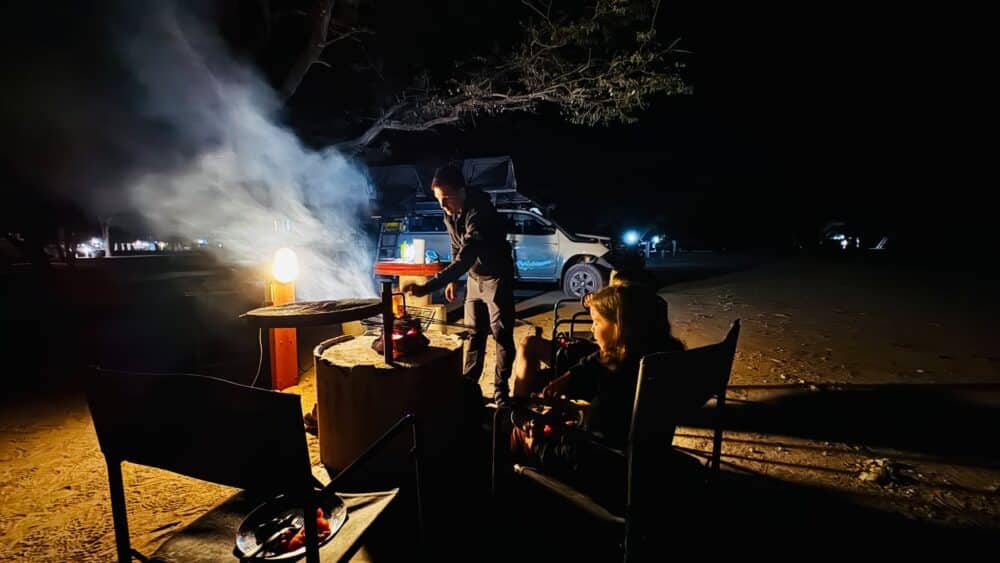
We spent our nights in three different camps and each one allowed us to discover a different side of Etosha.
Namutoni Camp
It was our first stop inside the park.
It is located in the eastern area and is ideal for those arriving from Caprivi and Bwabwata National Park.
The camp revolves around a perfectly restored old German fort, giving it a very different personality from the rest of the accommodations in the park.
It features a restaurant, swimming pool, shop and a pleasant family atmosphere.
We thought it was an excellent base from which to start our visit to Etosha.
Halali Camp
If we had to choose just one campsite, it would probably be this one.
Its central location allows for easy exploration of much of the park and also features one of the best nighttime waterholes in Etosha.
It is precisely here that we experience some of our best moments, watching rhinos, elephants, and zebras coming to drink at dusk.
For us, it was the perfect combination of location and experience.
Olifantsrus Camp
Completely different.
Smaller.
More remote.
More relaxed.
And that's precisely why we loved it.
Its spectacular elevated platform next to the waterhole allows you to observe animals from a privileged position without having to get in the car.
It is probably the most special accommodation for those seeking a different experience within Etosha.
NWR: the public company that manages the Etosha camps and other Namibian national parks
One of the things we discovered while preparing for the trip is that most of the accommodations located within Namibia's national parks belong to the same entity: Namibia Wildlife Resorts (NWR).
It is a public company dependent on the Government of Namibia, responsible for managing a large part of the tourist infrastructure located within the main protected natural areas of the country.
For this reason, when you travel through Namibia you will see that many of the best-known camps share a very similar operation.
In Etosha, for example, the main park accommodations are managed by NWR:
- Namutoni Camp
- Halali Camp
- Okaukuejo Camp
- Olifantsrus Camp
- Dolomite Camp
But its presence extends far beyond Etosha.
During a trip through Namibia you will also find NWR accommodations in iconic locations such as:
- Sossusvlei and Namib-Naukluft National Park.
- Waterberg Plateau National Park.
- Fish River Canyon.
- Skeleton Coast.
- Cape Cross.
- Hardap.
- Other national parks and reserves.
What are the accommodations like at NWR?
Our experience was quite positive, although it is true that many travelers complain about the old and neglected infrastructure.
Don't expect extreme luxury accommodations like some private lodges in Namibia, but you will find functional, well-located facilities with a huge advantage: being inside the national parks themselves.
Most usually have:
- Camping.
- Bungalows.
- Family chalets.
- Restaurant.
- Shop or small supermarket.
- Pool.
- Reception and information point.
It is precisely that privileged location that makes them so special.
Everything else is perhaps more of a drawback: more expensive, older facilities, and fewer services than most private campsites outside the parks.
But sleeping inside the park allows you to start safaris at dawn, take advantage of the best wildlife viewing hours and enjoy the famous nighttime waterholes without having to leave the premises.
Book well in advance
If you know you're going to visit Etosha during peak season, our advice is to book NWR accommodations many months in advance.
The most popular camps, especially Okaukuejo, Halali, and Namutoni, tend to fill up quite quickly.
We planned a good part of our route around the availability of these accommodations, since sleeping inside the park completely changes the experience. We missed out on Okakuejo because it was full, even though we booked six months in advance! Oh, and about the prices—to think it cost us over €100 a night at these campsites!
Experience tip
TIP: If you can't find a spot at Okakuejo or Namutoni, don't worry. You might not be able to see those waterholes at dusk with herds of elephants, but very close by are the park entrances where, just across the border, there are several campsites, cheaper and with very good facilities. Then you can leave the park and start your trek early the next day, staying at campsites like Okakuejo and seeing its waterholes for free.
Etosha with children: one of Namibia's best family experiences
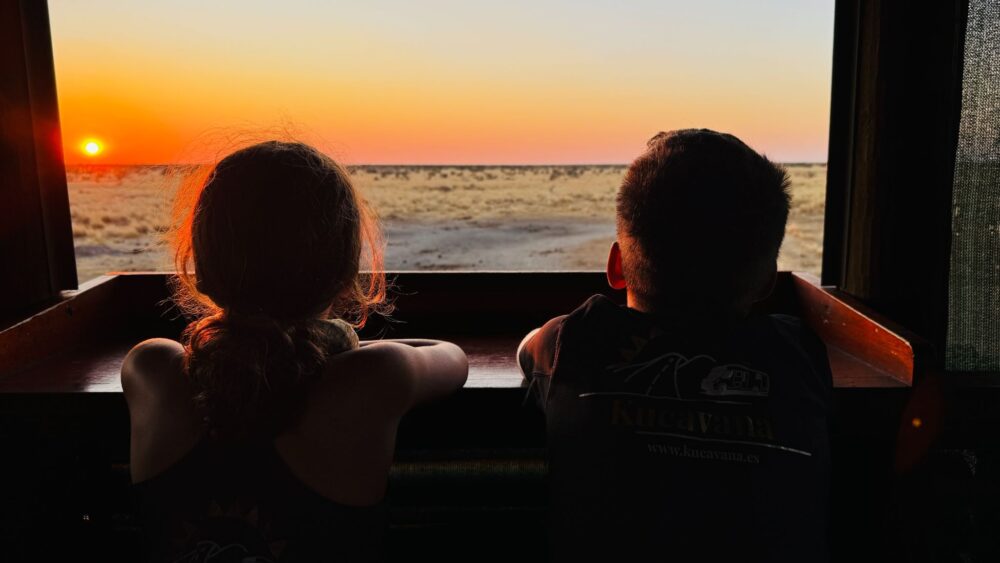
If you're traveling as a family and wondering if it's worth visiting Etosha with children , our answer is a resounding yes.
In fact, it was one of our children's favorite parts of the entire trip.
While some cultural visits can be more challenging for young children, safaris have something special about them. Each day becomes a kind of treasure hunt where you never know what animal will appear around the next bend.
During our visit we spent hours observing zebras, giraffes, elephants, gazelles and rhinoceroses.
What was surprising was that the children never got tired.
Each new sighting aroused the same excitement as the first.
In addition, the Etosha camps are very well set up for families.
Most of them include:
- Pool.
- Restaurant.
- Shop.
- Open spaces.
- Safe areas to rest.
This allows you to alternate safaris with moments of relaxation during the middle of the day.
If you're planning a family trip, we also recommend reading our complete guide to Namibia with children , where we explain all the practical details we learned while traveling the country with our kids.
How much does it cost to visit Etosha Namibia
One of the most common questions when preparing a self-drive safari in Namibia is how much it actually costs to visit Etosha.
The good news is that, compared to other African destinations where you have to book guided safaris, it's quite affordable, although not cheap either.
Entrance fees
All visitors must pay a daily park access fee.
These rates may vary slightly from year to year, so we recommend always checking the official information before traveling.
We paid the fees directly at the park entrance during the registration process. It cost us about 30 euros per day for the four of us.
Accommodations
Accommodation usually accounts for the largest part of the budget. It's not cheap at all; a simple camping pitch for our rented 4x4 cost us over 100 euros per night for the four of us.
The official Etosha campsites offer different categories:
- Camping.
- Bungalows.
- Family chalets.
- Premium rooms.
Booking several months in advance is essential, especially if you're traveling during the dry season.
Fuel Efficiency:
Although distances within the park are significant, fuel costs are usually reasonable.
However, it's advisable to always enter with a full tank, as there are currently no gas stations operating inside the Park.
Our approximate budget
In our case, Etosha represented one of the most important departures of the trip, but also one of the experiences we remember most.
If you want to know the real and detailed cost of our entire adventure, you can consult our article on How much does a trip to Namibia cost independently , where we break down flights, 4x4 rental, gasoline, accommodations, activities and final budget for the entire trip.
Best time to visit Etosha Namibia
One of the questions we were asked most before traveling was when is the best time to visit Etosha.
The short answer is simple: Etosha can be visited year-round , but the experience changes considerably depending on the season.
Dry season (May to October)
It is considered the best time for safaris.
During these months it hardly rains and much of the vegetation disappears, forcing animals to concentrate around water pools.
This makes sightings much easier.
If your goal is to see as much wildlife as possible, especially elephants, giraffes, zebras, rhinos, and lions, this is probably the best time to visit Etosha.
We traveled during the dry season and the results were spectacular.
Rainy season (November to April)
The situation changes considerably.
The vegetation becomes much greener and the landscape gains visual appeal.
In addition, it's a fantastic time for migratory bird watching.
However, the animals no longer depend so much on permanent pools, so sightings usually require a bit more patience.
So, when do we recommend traveling?
If it's your first trip to Namibia, we would definitely choose the dry season.
The concentration of wildlife around the waterholes makes Etosha one of the best places in Africa for a self-drive safari.
If you're organizing the whole trip, we also recommend checking out our guide on the Best Time to Travel to Namibia , where we analyze the country's conditions month by month.
Tips for visiting Etosha independently
After exploring the park for several days, we have some recommendations that we believe can help you enjoy the experience much more.
Get up as early as possible
The best sightings of our entire trip occurred during the early morning hours.
Many animals take advantage of the cooler temperatures to move around and approach the ponds.
Don't drive too fast
Etosha is not a race.
Often the best encounters happen when you're driving slowly and observing your surroundings.
In addition, many tracks have small irregularities that should be taken with caution.
Consult the sightings book
It's one of the best tricks in the park.
The visitors themselves note where they have seen lions, leopards, rhinoceroses or hyenas during the last few days.
It helped us a lot to plan each day.
Take binoculars
It may seem obvious, but they make a huge difference.
Many animals are found some distance from the trails, and a good pair of binoculars enhances the experience.
Always respect the rules
Do not get out of the vehicle outside of authorized areas.
Don't get too close to the animals.
And remember that closing times are strictly enforced.
Book well in advance
Especially if you want to stay inside the park.
The best campsites usually fill up several months in advance, especially during the dry season.
It has an offline connection.
Although there is usually some coverage in the main camps, you will not have a stable connection for much of the journey.
📱 Internet in Namibia: our recommendation
One of the questions we had before traveling was how to get internet access as soon as we landed in Namibia.
Based on our experience, we believe the most convenient option is to have an eSIM installed before leaving home , especially if you want to have a connection from the very beginning to check maps, reservations, routes or communicate with family.
We recommend Holafly Africa , which allows you to activate data before your trip and forget about looking for local shops or SIM cards when you arrive.
👉 Plus, you can get a 5% discount using our link.
However, it's important to be very clear about one thing: no eSIM, local SIM card, or phone company will solve the lack of coverage in some of Namibia's most remote areas.
During our trip, we found no problems with coverage in places like Windhoek, Swakopmund, Walvis Bay, and on the main paved roads. However, in regions like Bwabwata, parts of Caprivi, Damaraland, and the Skeleton Coast, we spent hours and even days without a signal.
That's why our advice is to combine the eSIM with Google Maps downloaded offline , an external battery, and good route planning.
The eSIM will make your trip much easier, but in Namibia the real key is still to travel prepared to disconnect during some parts of the adventure.
Don't bring drones to Etosha
If you're traveling with a drone, our advice is very clear: leave it out of the park.
Drones are completely prohibited in Etosha National Park, and access controls are quite strict. Military personnel inspect vehicles and luggage, and if they find a drone, they can temporarily confiscate it.
The problem isn't just that they take it away.
The most inconvenient part is that you'll usually have to retrieve it from the same spot where it was impounded. This might force you to exit through the same gate you entered, which probably won't fit with your planned route through the park.
In a place as large as Etosha, where many travelers cross the park from east to west or vice versa, this can pose a significant headache.
Don't bring plastic bags
Another rule that surprised us was the prohibition of bringing plastic bags into the park.
During access controls they may check the vehicle and remove some of the bags you are carrying.
The measure aims to reduce waste and protect the park's wildlife.
Our advice is to use reusable bags, storage boxes, or rigid containers to organize food and luggage.
Buy fresh meat inside Etosha, but eat it before leaving
If you're traveling in a 4x4 with a refrigerator or camping on a road trip, you'll probably buy fresh meat to cook during the journey.
The good news is that the main Etosha camps usually have small shops where you'll typically find meat, drinks, ice, and some basic supplies.
The bad news is that when leaving the park heading south you may encounter veterinary checkpoints where transporting certain meat products is prohibited.
We went through one of these checkpoints as we left through Galton Gate and the officers specifically checked that we were not transporting fresh meat.
Therefore, our advice is simple: buy the meat you need for one or two days and try to consume it before leaving Etosha.
If you can't find accommodation in Okaukuejo, look for a private lodge near the entrance
Many travelers become obsessed with getting a spot at Okaukuejo Camp because it is the most famous camp in the park.
However, if you travel at short notice, it's quite common to find it fully booked.
In that case, before booking a night at Olifantsrus just because that's all that's available, consider staying at one of the many private lodges located near the entrance to Okaukuejo.
We really enjoyed Olifantsrus, especially for its tranquility and its magnificent waterhole, but we also have to be realistic: it is quite far from some of the areas with the highest concentration of wildlife.
If you only have two or three days to visit Etosha, you'll probably make the most of your time by staying near Okaukuejo, just outside the park entrance, where there are many great campsites and private lodges , giving you quick access to some of the park's most productive pools and cutting down many hours of driving.
In our opinion, Olifantsrus is worthwhile if you have enough time to explore the western part of the park. If you're short on time, the Okaukuejo area is usually a better option for maximizing wildlife sightings.
Is Etosha worth visiting? Our honest opinion
After spending three days exploring the park, our answer is clear:
Yes, absolutely yes.
Of all the places we visited during our trip through Namibia, Etosha was one of those that best met our expectations.
Not only because of the number of animals we saw.
Nor solely because of the stunning landscapes of the Etosha salt pan.
What really won us over was the feeling of freedom.
Being able to travel hundreds of kilometers on our own, stopping whenever we wanted, waiting by a pond observing wildlife and experiencing each sighting as a small discovery was something hard to forget.
Furthermore, we believe it is one of the best African parks to get started with independent safaris.
The infrastructure is excellent.
The trails are well signposted.
The camps are comfortable.
And the concentration of wildlife is extraordinary.
If you're planning a route through the country, for us Etosha is not just another stop.
It is one of the great reasons to travel to Namibia.
And it continues to hold a special place among our best memories of the entire adventure.
Is it worth sleeping inside or outside of Etosha?
If I could only give you one piece of advice for organizing your visit to Etosha, it would be this:
Try to sleep inside the park.
Yes, it's usually a bit more expensive.
Yes, it requires booking well in advance.
But the difference in experience is enormous.
Sleeping inside Etosha allows you to take advantage of the two most important times of day for observing animals:
- The early hours of the morning.
- The last hours of the afternoon.
Visitors staying outside the park have to wait for the gates to open to enter and must also leave Etosha before closing time.
In contrast, those who sleep inside can be practically ready to leave as soon as dawn breaks and enjoy the famous nighttime waterholes when most visitors have already left the park.
We were lucky enough to sleep in Namutoni, Halali and Olifantsrus and we would do it again without hesitation.
Especially for experiences like watching rhinos at dusk or hearing animals approaching the waterholes while we were having dinner at the camp.
If your budget allows, we believe that sleeping inside Etosha is one of the best investments of the entire trip.
If you prefer something cheaper with better services or you haven't found a place in Okakuejo or Halali, the best option is to sleep in one of the private campsites and lodges next to the Okakuejo gate.
Mistakes we made in Etosha that you can avoid
As with any great trip, we also made some mistakes during our visit.
Luckily none of them were serious, but we did learn several lessons that would have helped us a lot if someone had told us about them before.
Arriving late to the waterholes
On the first day we arrived at several ponds too late.
Over time we discovered that the most interesting moments usually occur during the early morning hours and especially during the last hour before sunset, but before it gets dark.
Trying to travel too many kilometers
At first we thought that the more we drove, the more animals we would see.
The reality was just the opposite.
Many of our best sightings occurred while standing still by a pond for quite some time.
Etosha taught us that patience is often more important than distance.
Do not consult the sightings book beforehand
It took us a day to discover this little gem.
When we started using it, safari planning improved tremendously.
It is probably the best free resource that exists within the park.
Do not book some campsites in advance
Especially Okaukuejo.
When we organized the route, we already found little availability.
If you know you're going to visit Etosha during the dry season, try to book many months in advance.
Do not refuel just before entering Etosha
There are currently no gas stations operating inside Etosha, so don't do what we did and refuel before entering, so you don't have to leave the Park just to get gas.
Etosha access controls: drones, plastic bags, and rules you should know
Before entering Etosha, there is something important you should know.
The park entrances don't work like a simple ticket booth where you pay the entrance fee and continue on your way.
In our case, the process was much more serious than we expected.
Upon arrival at the entrance, in addition to registering and paying the fees, vehicles are inspected by military personnel. The military presence in Etosha is completely normal and is part of the park's control and protection system.
Our advice is simple: always be respectful, follow the instructions, and don't argue with the rules. The checks are quick, professional, and aimed at protecting one of Namibia's most important natural areas.
Drones are completely banned.
If you're traveling with a drone, pay close attention.
Drones are completely prohibited inside Etosha National Park and inspections at the entrances are very strict.
The military checks luggage and the vehicle for drones.
If they find one, they can temporarily confiscate it and keep it safe until you leave the park.
In addition, there is an important detail that many travelers are unaware of: you will usually have to pick it up at the same point where it was detained.
This means that, depending on your itinerary, you might be forced to leave through the same door you entered to retrieve it.
Honestly, we don't think it's worth complicating your vacation. Our advice is to leave the drone outside the park and enjoy the experience.
Plastic bags are also banned.
Another thing that surprised us was the control over plastic bags.
As is the case in many African national parks, Etosha tries to minimize waste and environmental impact.
During the vehicle inspection, they checked some of the luggage and removed some plastic bags that we were carrying without being aware that they were prohibited.
It wasn't a problem, but it was a situation that caught our attention and that is worth knowing about before arriving.
If you are carrying food, supplies, or travel gear, try to organize it in reusable bags or permanent containers.
Respect the park rules
It may seem like an obvious recommendation, but in Etosha the rules are there to protect both visitors and animals.
The main ones are:
- Do not get out of the vehicle outside of authorized areas.
- Do not feed the animals.
- Do not leave any waste.
- Do not drive outside the marked trails.
- Respect the speed limits.
- Strictly adhere to the opening and closing times.
During our visit, we saw elephants, rhinos, and other animals very close to the car. It's easy to forget that you're observing completely free wildlife and that any carelessness can have serious consequences.
That's why we believe that one of the keys to enjoying Etosha is precisely to assume that we are visiting its home and to always act with the utmost respect for the environment.
The curious veterinary meat inspection you'll find as you leave Etosha
There is another peculiarity of Namibia that surprised us quite a bit during the trip and that is worth knowing before traveling around the country independently.
When traveling between certain northern and southern regions, you will encounter several official veterinary checkpoints, popularly known as the Red Line.
Its function is to protect livestock in southern Namibia from possible animal diseases originating from some northern regions and neighboring countries.
In practice, this means that when passing through certain checkpoints, officers may ask you if you are transporting products of animal origin and inspect the vehicle.
Products that are usually restricted or prohibited include:
- Fresh meat.
- Raw meat.
- Some sausages.
- Certain unprocessed animal products.
We encountered one of these checkpoints after leaving Etosha heading south and had to reorganize some of the food we had in the 4x4's refrigerator.
It doesn't pose any serious problem, but it's still good to be aware of it to avoid surprises.
Our advice
If you are traveling in a campervan, motorhome or 4x4 with a refrigerator, try to plan your meat purchases taking these controls into account.
This way you'll avoid having to throw away freshly bought food or reorganize supplies during the trip.
It's one of those little quirks of Namibia that nobody usually tells you before the trip, but it's very useful to know.
Frequently Asked Questions about Etosha Namibia
Do you need a 4x4 to visit Etosha?
Not necessarily.
Most of the main trails can be easily navigated with a conventional car.
However, we traveled in a 4x4 and believe it provides more comfort, better visibility and greater freedom for a complete route through Namibia.
You can check out our experience in Namibia in 4x4.
How many days are needed to visit Etosha?
Our recommendation is to dedicate at least three days and two or three nights.
It's the ideal time to explore different areas of the park and enjoy the main campsites.
Which is the best entrance door?
It depends on your route.
If you are coming from the Caprivi region and Bwabwata National Park , the most common way to enter is through Von Lindequist Gate, next to Namutoni.
If you are coming from Damaraland or the Skeleton Coast, you will probably enter through Andersson Gate or Galton Gate.
Can you see the Big Five in Etosha?
Not quite.
Etosha is home to four of the so-called Big Five:
- León.
- Elephant.
- Rhinoceros.
- Buffalo.
The only one that does not regularly inhabit the park is the African buffalo, so technically it is not considered a full Big Five destination like some parks in South Africa.
Is it safe to visit Etosha independently?
Yes.
We found it to be one of the easiest and safest parks to go on a self-drive safari.
However, it is always advisable to respect the rules, not to get out of the vehicle outside of authorized areas and to drive prudently.
For more information, you can consult our guide on Is it safe to travel to Namibia?
Is Etosha worth it if you're traveling with children?
Absolutely.
In fact, it was one of our children's favorite stages during the entire route.
If you're traveling as a family, we also recommend our Namibia with Kids guide , where we explain all the practical details of our experience.
Can you see lions in Etosha?
Yes.
Etosha is home to a significant lion population and is one of the best places in Namibia to observe them.
Although we were not lucky during this visit, many travelers regularly observe them in areas such as Okondeka and other pools in the western sector of the park.
Our verdict: Is Etosha worth a visit?
After traveling through Namibia for more than three weeks, sleeping in remote campsites, sailing down the Okavango River, exploring the Caprivi Strip, traversing some of Africa's most spectacular landscapes, and driving over 5.000 kilometers in a 4x4, one thing remains very clear to us:
Etosha is one of Namibia's must-see attractions.
It's not the most remote place.
He is not the most unknown.
And it's probably not the wildest either.
But it is one of the best places on the continent to enjoy a self-drive safari.
The ease of observing wildlife, the excellent infrastructure, the campsites, the waterholes, and the freedom to explore the park at your own pace make the experience hard to beat.
If this is your first trip to Namibia, we sincerely believe that Etosha should be a mandatory part of your itinerary.
And if you've already been on other safaris in Africa, we're sure it will continue to amaze you.
For us it was one of the highlights of the trip and one of those places that we would recommend visiting even to those who only have a few days in the country.
Continue organizing your trip to Namibia
If you're planning a self-guided trip through Namibia, these are the guides that will best help you plan your journey:
🧭 Complete guide to traveling to Namibia
All the information about budget, 4x4 rental, safety, accommodations, best time to go and our complete route through the country.
📅 24-day Namibia itinerary
Our complete day-by-day itinerary.
🗺️ What to see in Namibia
The must-see places that we would include in any trip around the country.
💰 How much does a trip to Namibia cost?
Detailed actual budget for the trip.
🛡️ Is it safe to travel to Namibia?
Our real-life experience with safety, driving, and unexpected events during the trip.
Latest posts from our blog
-
Definitive manual for traveling by motorhome【2024】
Super complete manual for traveling by motorhome with all the answers to your questions.
-
Namibia Trip: Complete Guide for Independent Travel (24-day Itinerary, What to See and Tips Based on Our Experience)
Are you thinking of planning a trip to Namibia on your own and don't know where to start? After traveling the country for 24 days as a family in a 4x4 with rooftop tents, we've put together this comprehensive guide with everything we wish we had known before our trip. Here you'll find information…
-
London with children: what to see and do as a family (royal guide with map) of the top 22 plans
If you're planning a trip to London with kids and don't know where to start, here you'll find the 22 best family-friendly activities, an optimized 3-day itinerary, money-saving tips, the best free museums, and an interactive map with all the must-see places. Basic summary: London with kids. Quick information. Recommended days: 3-5…
-
Guide to traveling to Canada: everything you need to know for a trip to Canada on your own
Welcome to a super guide for traveling to Canada from Spain or anywhere in Europe. One of our newest destinations in this wonderful world, where every trip continues to surprise us with its hidden gems. How lucky we are to have been born on Earth! How fortunate to be able to travel to Canada! Visiting Canada…


Ethical code:
On our blog you will find affiliate links. These are always placed with our highest ethics. We never publish any service or product that we have not used before and that we are sincerely happy with. That is why our recommendations are always ethical. In addition, there is no additional cost for you to book through our links and, on the other hand, it means a small commission for us that helps us maintain this blog so that you can continue enjoying it for free.