Table of Contents
If you ask us what the first big positive surprise of our trip to Namibia was , we would probably answer without hesitation: Waterberg Plateau National Park.
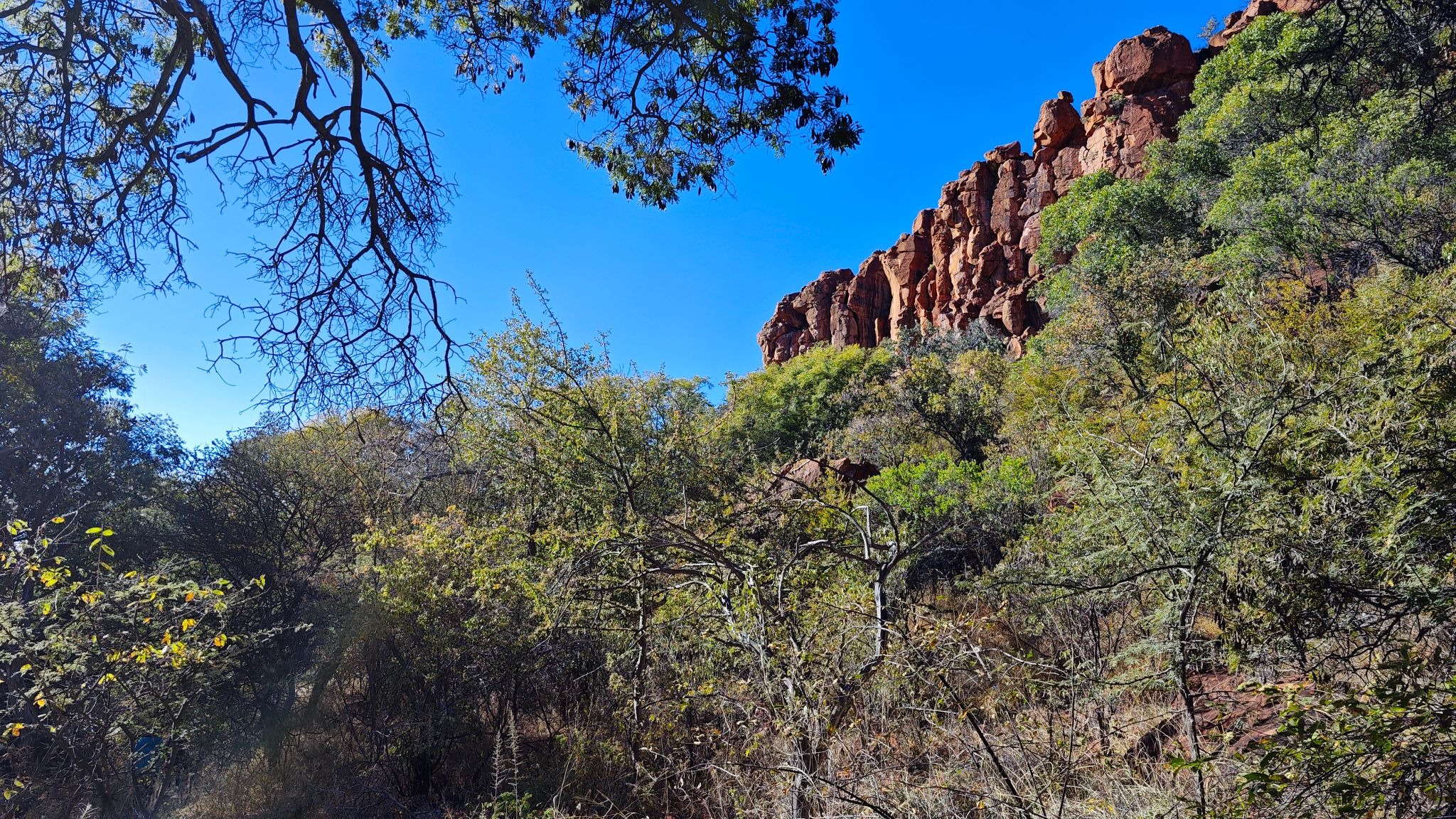
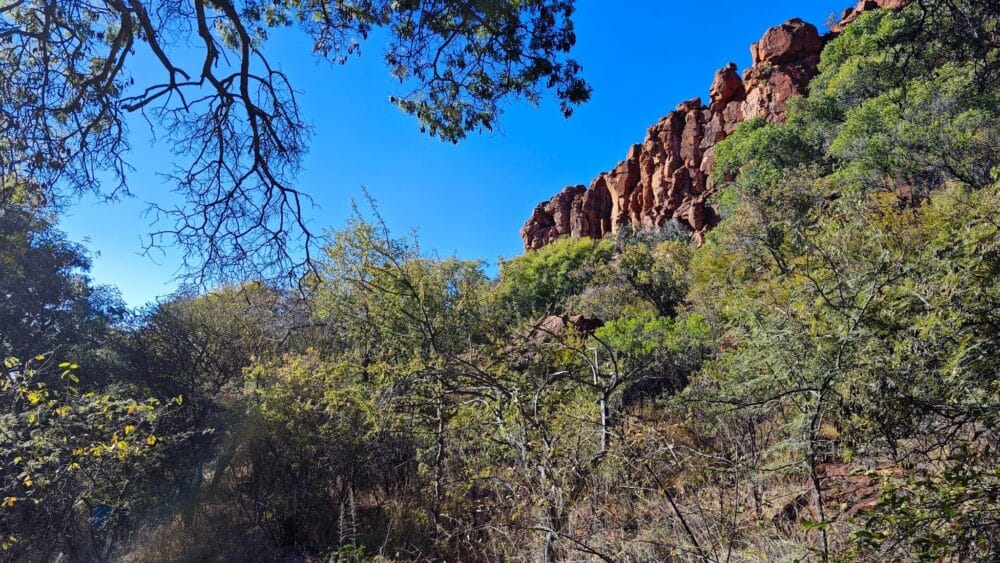
Located about three hours from Windhoek, this national park is completely different from the image many of us have of Namibia. Here you won't find the vast open plains of Etosha or the endless dunes of Sossusvlei. What unfolds before you is a huge red sandstone plateau surrounded by vegetation, forests, and surprising biodiversity that has earned it the nickname "Namibia's green oasis."
Besides its spectacular scenery, Waterberg is a major refuge for endangered species such as the white rhinoceros, black rhinoceros, sable antelope, and Cape buffalo. It is also one of the country's most important conservation projects.
For us, it was much more than just a stop along the way. It was where we saw our first giraffes in the wild, where we began to understand the social reality of Namibia, and where we discovered that this trip was going to be much more special than we had imagined.
If you're planning your trip, we recommend starting with our complete guide to traveling to Namibia , where you'll find all the trip planning, budgeting, safety, 4x4 rental, accommodations, and our complete 24-day itinerary for the country.
And if you're still planning your trip, you can also check out our guide to what to see in Namibia , where we've compiled all the must-see destinations we visited during our trip.
Waterberg Plateau National Park at a glance
| Appearance | Our experience |
| recommended time | 1-2 days |
| We were | 2 nights |
| Best activity | Rhino Drive and hikes on marked trails |
| Best accommodation | Waterberg Wilderness Lodge |
| Hiking difficulty | Easy – Medium |
| Great for kids | Yes |
| Best time | June to September |
| Featured fauna | Rhinoceroses, giraffes, baboons and antelopes |
| Worth? | Very much |
| What surprised us the most | The nighttime cold and the first wild giraffes |
IMPORTANT TIP : Don't travel to Namibia without good travel insurance . Seriously. The distances there are enormous, private healthcare is expensive, and if something happens in the middle of a national park or in a remote area, helicopter evacuation can cost a fortune. After thoroughly comparing different options, we chose IATI Estrella , which is the only one with over one million euros of medical coverage—crucial in destinations where any unforeseen event can multiply the costs. IATI also offers 24/7 Spanish-language support and an app for online medical consultations, which was incredibly useful during our trip. Here's our link with a 5% discount on any IATI travel insurance policy. If you're going to Namibia, it's truly worth traveling with peace of mind.
Our experience in Waterberg Plateau National Park: two days that made us fall in love with Namibia
Day 1: From Windhoek to Waterberg, discovering the real Namibia
We landed in Windhoek at 7:30 a.m. after a long night of flying. The first thing we did was pick up our Toyota Hilux 4x4 with two rooftop tents and receive a full explanation of how the vehicle worked.
You can consult our guide to Namibia in 4x4 here where I explain everything you need to know to choose your 4x4, what it's like to drive, regulations and much more.
With the car loaded and excitement through the roof, we made our first stop to buy supplies at a SPAR supermarket in Katutura , the most well-known township in Windhoek.
Without seeking it, we had just landed squarely in one of Namibia's least visible realities.
Katutura was created during the apartheid era to displace the Black population from areas reserved for whites. Its name literally means "the place where we don't want to live ." Here we first witnessed the enormous inequalities that still exist in the country: shacks made of corrugated iron, children begging for food in the streets, and a heavy presence of private security in the shops. However, we also found kind, polite people who were always willing to help.
With our shopping done, we headed north along the wonderful paved B1 road; there was even a section of motorway with several lanes.
During the journey, we experienced one of those situations you remember long after. At a rest stop, we met a man walking completely alone towards Windhoek, looking for work. He explained that he had come from a village almost 100 kilometers away. We offered him water and some food for the journey, and we were surprised by the enormous politeness and gratitude with which he thanked us.
Later, we picked up another man who was hitchhiking home from work. Although many rental companies advise against it, for us it was a way to experience the more authentic Namibia and show our children a reality very different from Europe. In this country, if you can help, do it; it's the least we visitors can do.
For more information on safety in Namibia, you can consult our guide on Is it safe to travel to Namibia?
The first giraffes and the excitement of finally being in Africa
The real adventure began when we left the asphalt and ventured onto the dirt tracks that lead to Waterberg.
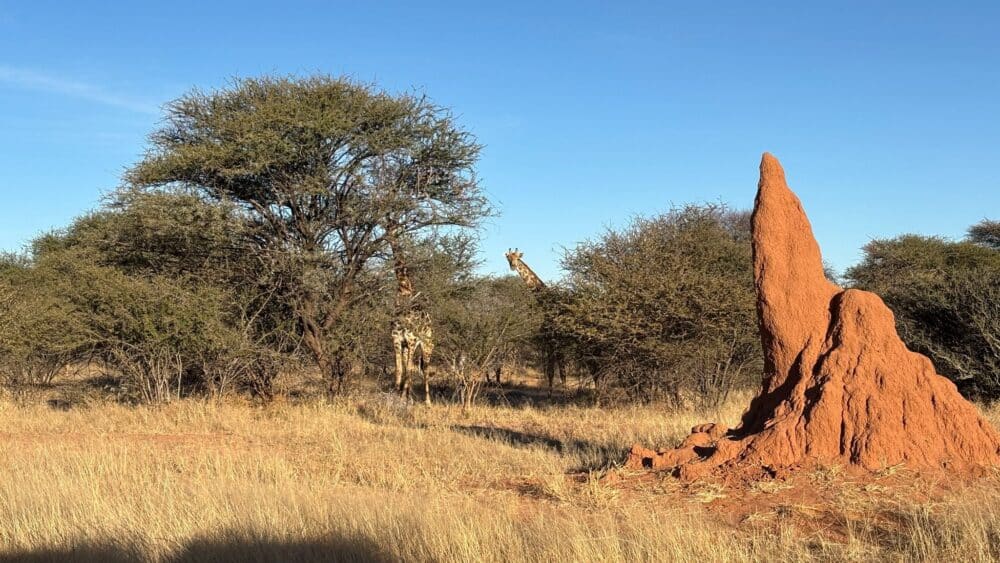
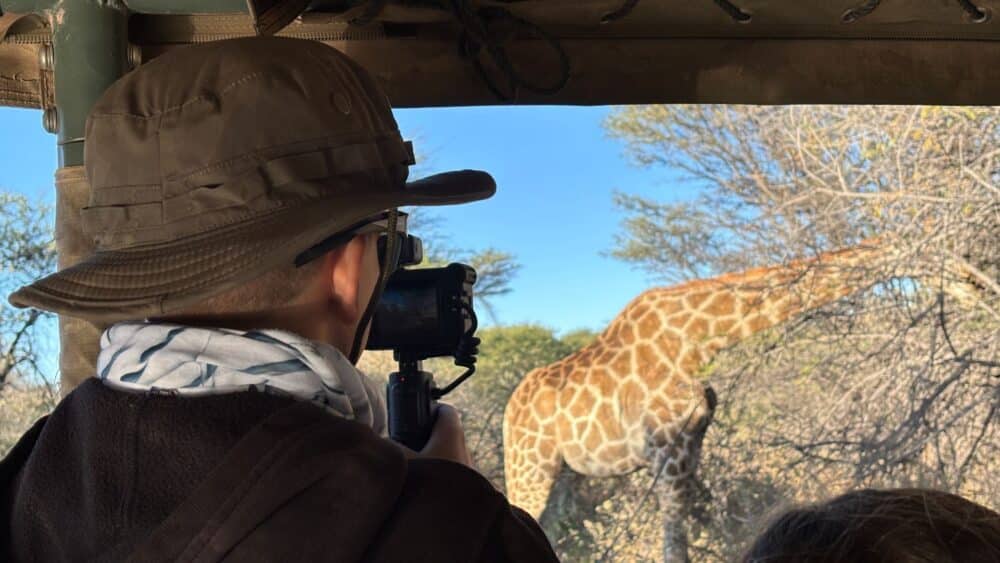
The first baboons, warthogs, guinea fowl, and other animals that we had only seen in documentaries appeared. But the moment we'll never forget came when we saw a family of giraffes walking calmly alongside the runway.
After so many months preparing for the trip, that's when we really felt like we were in Africa.
Our stay at Waterberg Wilderness Lodge
For our first two nights in Namibia we chose Waterberg Wilderness Lodge , a decision we would make again without hesitation.
After so many hours of flying, we needed to rest before facing the long days of driving that awaited us during the following weeks, and the place couldn't have been more perfect.
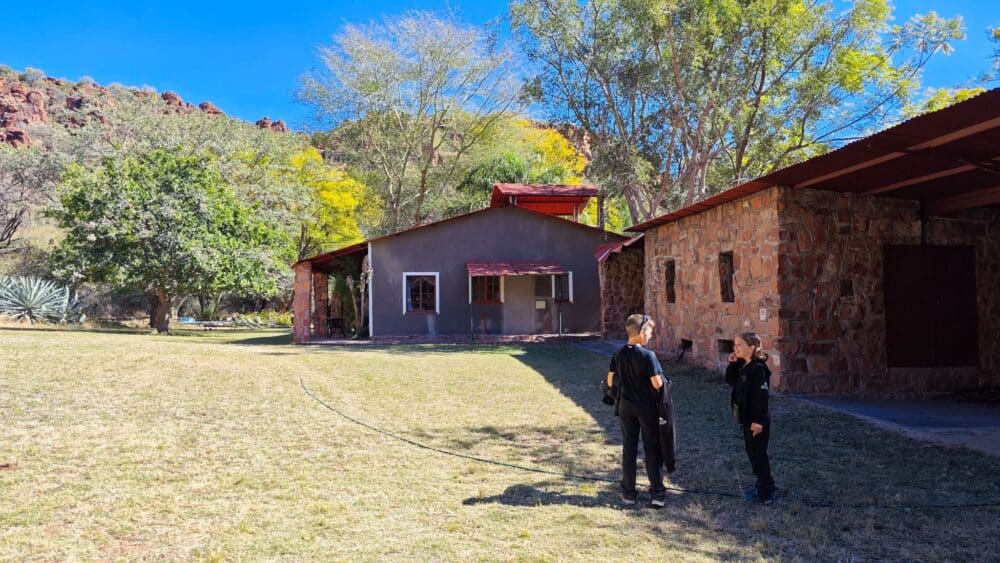
We stayed in a lovely family cottage at the lodge, although there are also camping pitches here, surrounded by nature, with small duikers scampering around the garden and spectacular views of the Waterberg plateau.
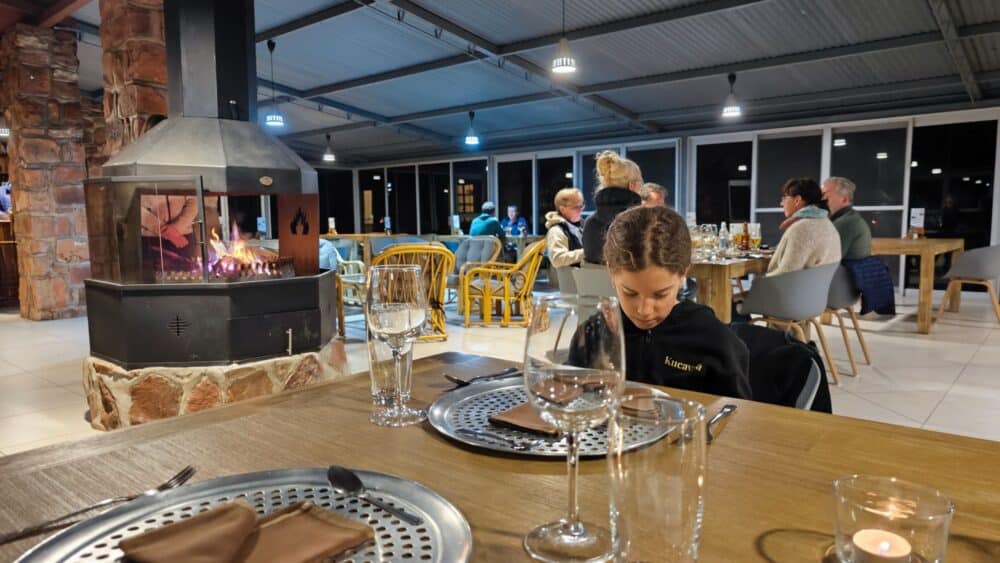
The stay included breakfast and dinner, which we greatly appreciated during the first few days of our trip. The dining room, with its large central fireplace, quickly became our favorite retreat when night fell.
We also used the afternoon to organize all the luggage, unfold the clothes we had vacuum-packed to save space in the suitcases, and familiarize ourselves with the operation of the 4x4 and all the camping equipment.
If you're planning a self-guided trip through Namibia, we sincerely believe that Waterberg Wilderness Lodge is one of the best places to start or end your journey, depending on your route . The tranquility of the surroundings, the comfortable facilities, and the activities it offers make it a highly recommended stop.
A much colder night than expected
If there was one thing we didn't expect to find in Namibia, it was cold.
That first night the thermometer dropped to -2°C. There was no heating in the room and a good part of the energy came from solar panels.
We finished by having a delicious hot soup followed by a barbecue while we warmed our hands by the central fire in the dining room.
Our advice after this experience is very clear: if you're traveling between June and August, pack thermal underwear, a fleece, a down jacket, a hat, and gloves. We forgot our gloves and we really missed them.
Day 2: Hiking and rhinos in Waterberg
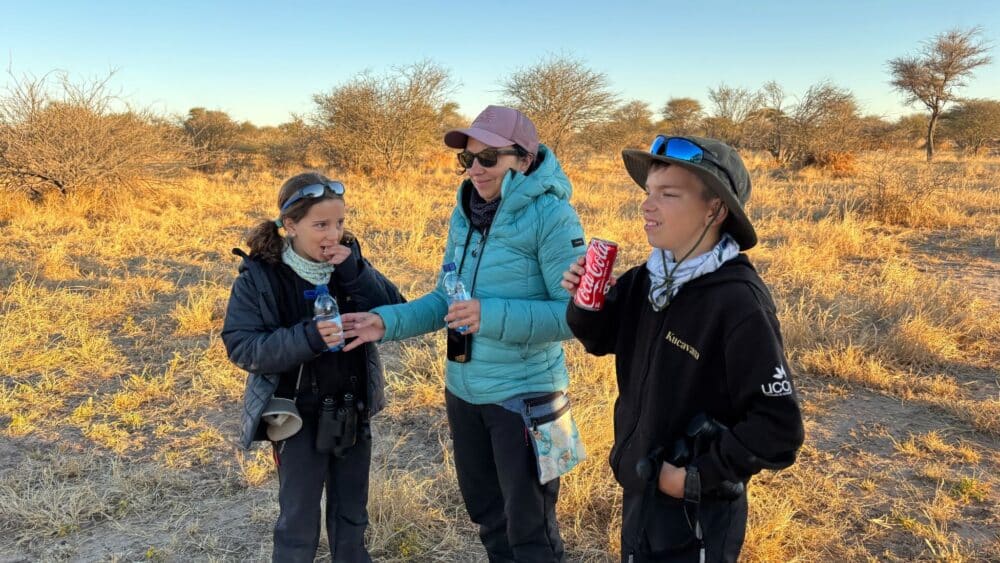
After a magnificent buffet breakfast, we decided to spend the morning exploring the lodge's marked trails.
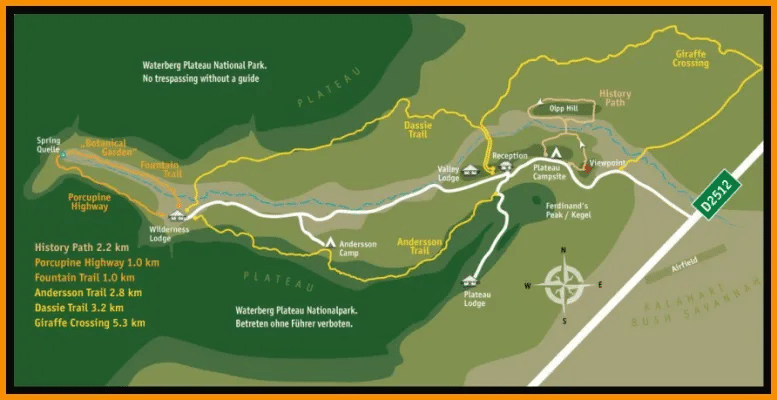
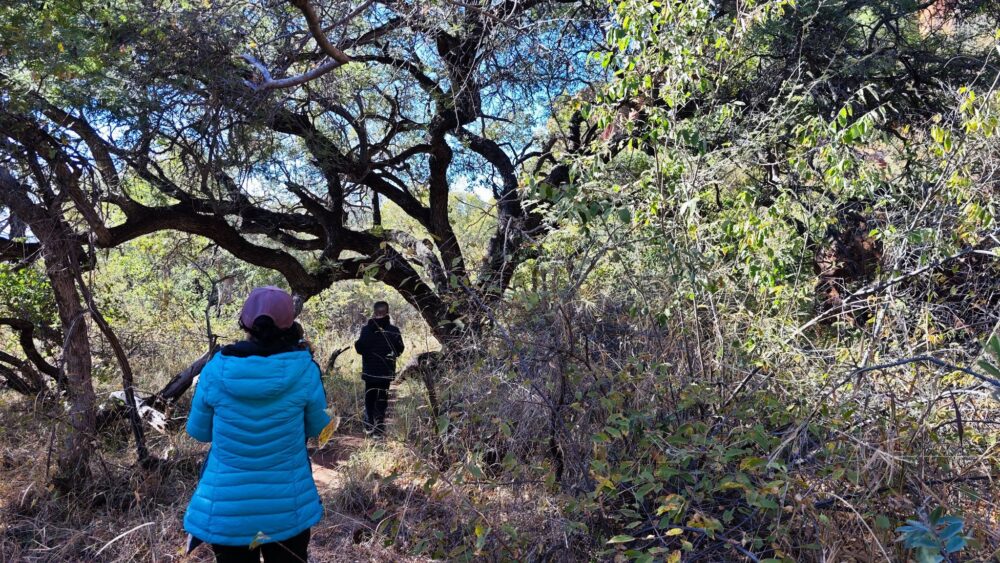
We combined the Andersson Trail and the Dassie Trail, completing a circular route of about 7 kilometers.
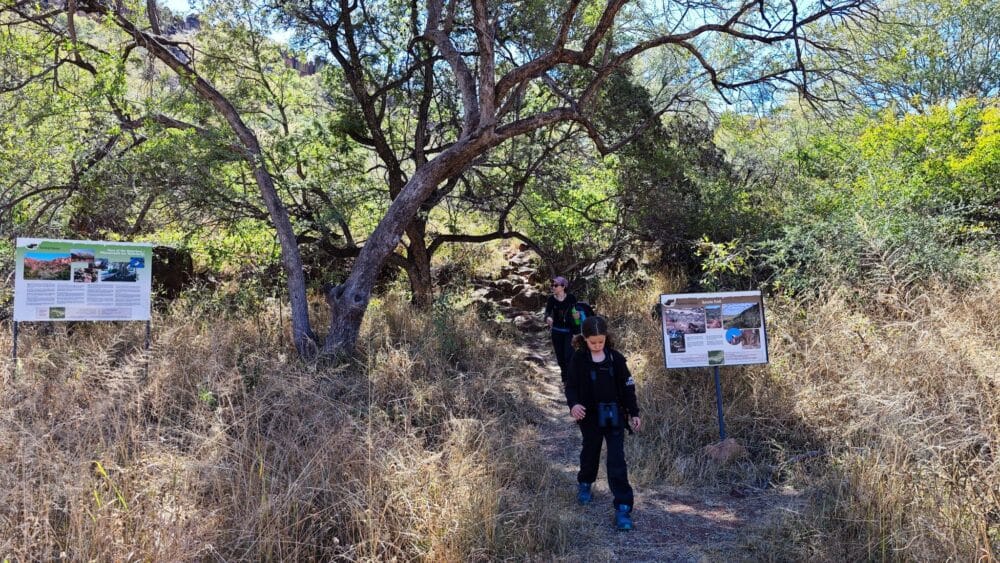
During the tour we learned to identify the enormous termite mounds that appear throughout Namibia, discovered how forest management is carried out in the area, and read several interpretive panels about rhino conservation programs.
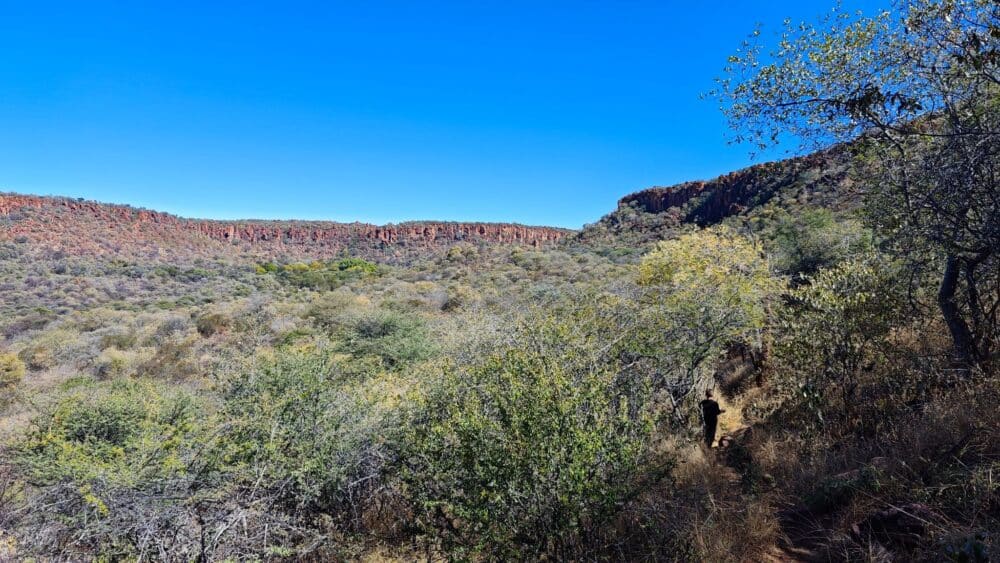
The views of the reddish Waterberg plateau from some viewpoints are truly spectacular.
The Rhino Drive: the activity we most recommend
In the afternoon came one of the most anticipated moments of our stay: the famous Rhino Drive.
It was one of the best activities of our first few days in Namibia.
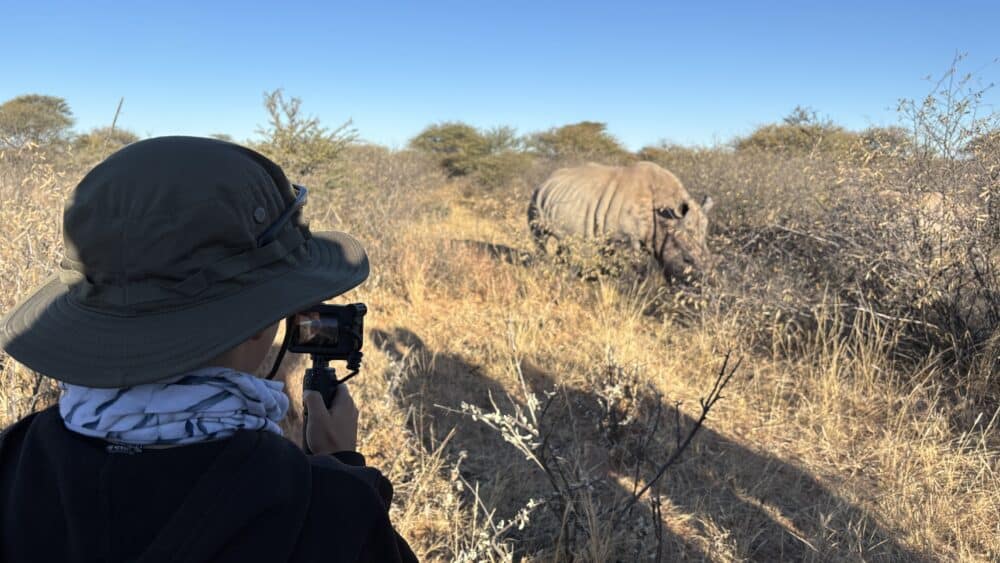
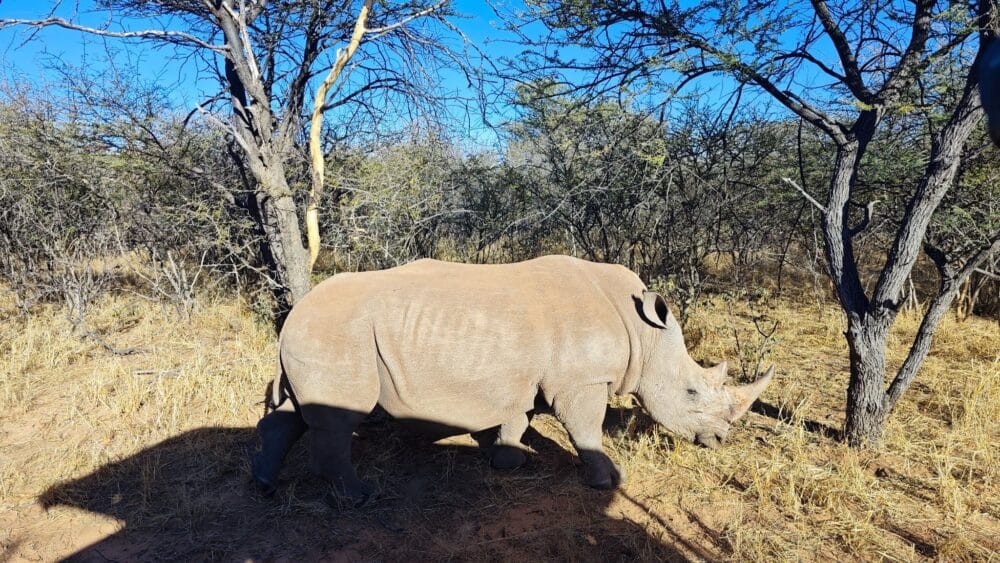
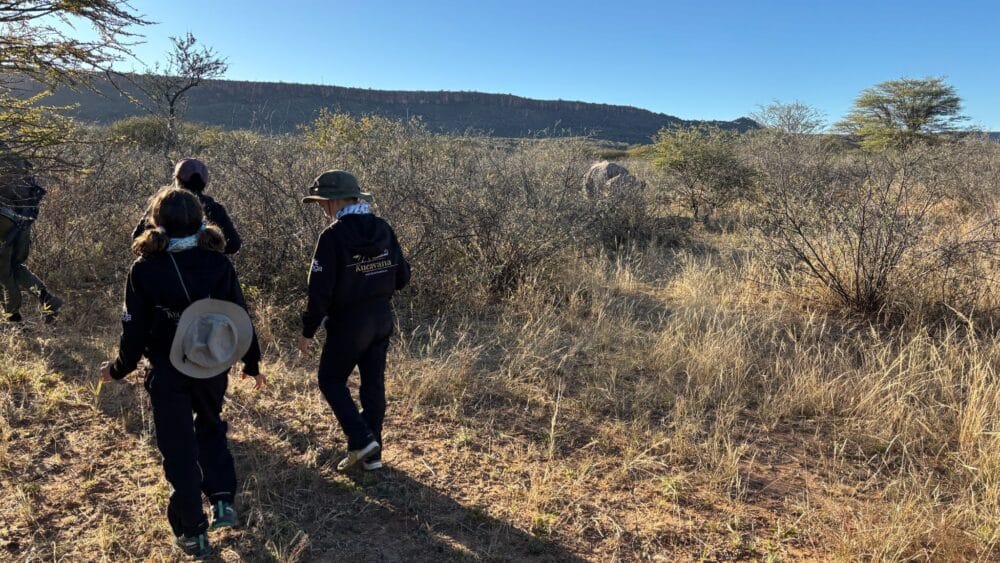
Accompanied by expert guides, we were able to observe several white rhinos at very close range and even get out of the vehicle at times to approach them under supervision.
We learned that white rhinos are not distinguished from black rhinos by color, but primarily by the shape of their mouths . We were also told about the enormous conservation work being done at Waterberg and how the white rhino population has grown from fewer than 100 individuals at the beginning of the 20th century to more than 20.000 today.
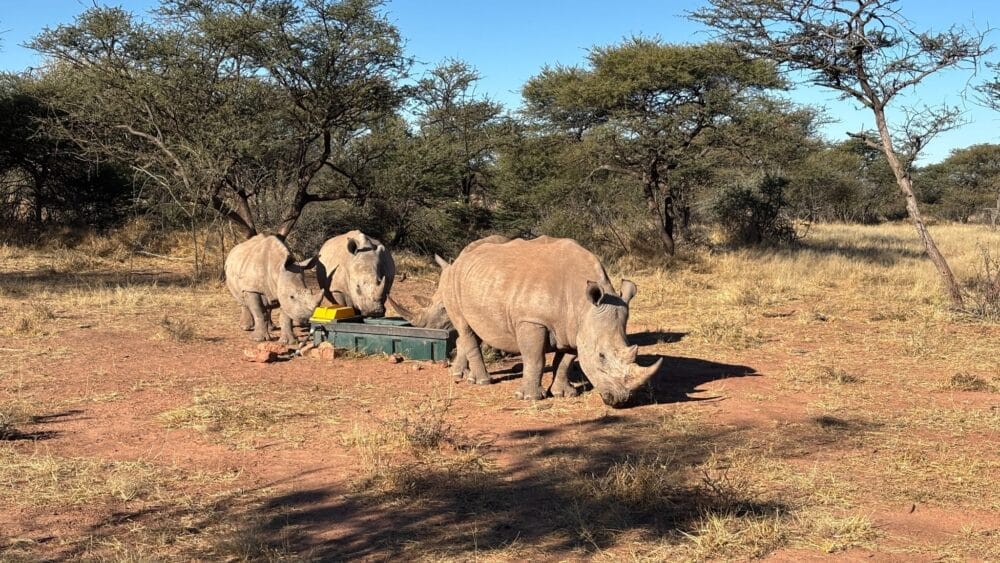
In addition to rhinoceroses we saw giraffes, antelopes and numerous species of birds.
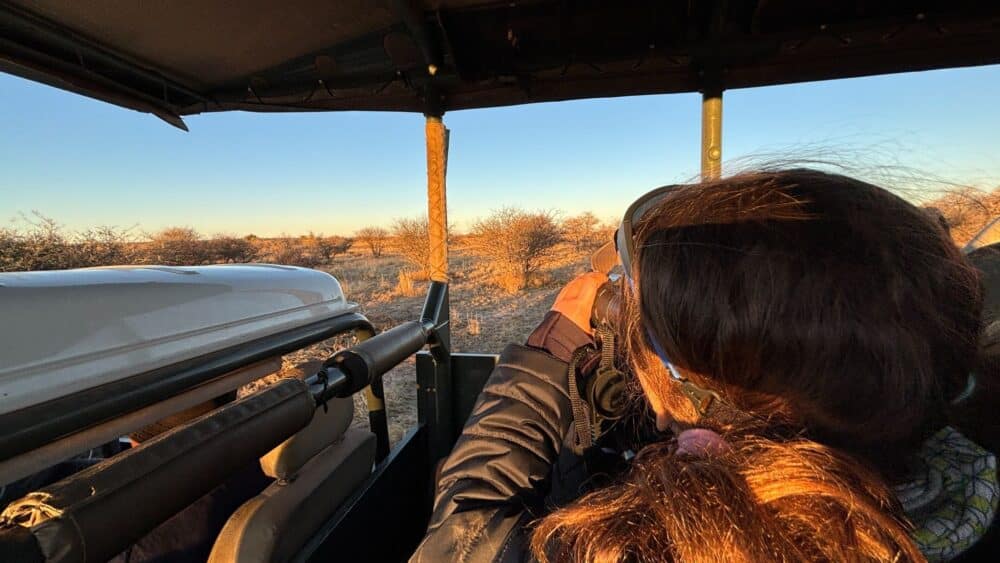
However, the cold during the afternoon safari was absolutely brutal. If you do this activity during the Southern Hemisphere winter, dress much more warmly than you think you'll need for the evening, when the temperature drops sharply from intense heat to harsh winter.
We ended the day having dinner again by the lodge's fireplace, convinced that Waterberg had been the best possible gateway to Namibia.
Where is Waterberg Plateau National Park and how to get there
Waterberg Plateau National Park is located in the Otjozondjupa region, approximately 280 kilometers north of Windhoek.
The most common way to get there is by rental car or 4x4 following the paved road B1 northwards until later turning off onto the C22 and the D2512 dirt track.
It took us a little over three hours from Windhoek, making several stops along the way.
Due to its strategic location, Waterberg is often an excellent first stop for those traveling independently through Namibia before continuing on to Etosha National Park or the Caprivi Strip.
Best time to visit Waterberg Plateau National Park
Waterberg can be visited year-round, although the experience changes considerably depending on the season.
During the dry season, between May and October, the vegetation is less dense, making it easier to spot animals. Furthermore, the daytime temperatures are very pleasant for walking and safaris.
We visited Waterberg at the end of June and enjoyed sunny days perfect for hiking. However, the nights were much colder than we expected, even dropping below freezing.
During the rainy season, between November and April, the landscape becomes even greener and more spectacular, although wildlife can be somewhat more difficult to spot due to the abundance of vegetation.
If you're looking to combine hiking, wildlife viewing, and pleasant daytime temperatures, we think the months between June and September are probably the best time to visit Waterberg Plateau National Park.
If you're organizing the whole trip, we also recommend checking out our guide on the Best Time to Travel to Namibia , where we analyze the country's conditions month by month.
History and features of Waterberg Plateau National Park
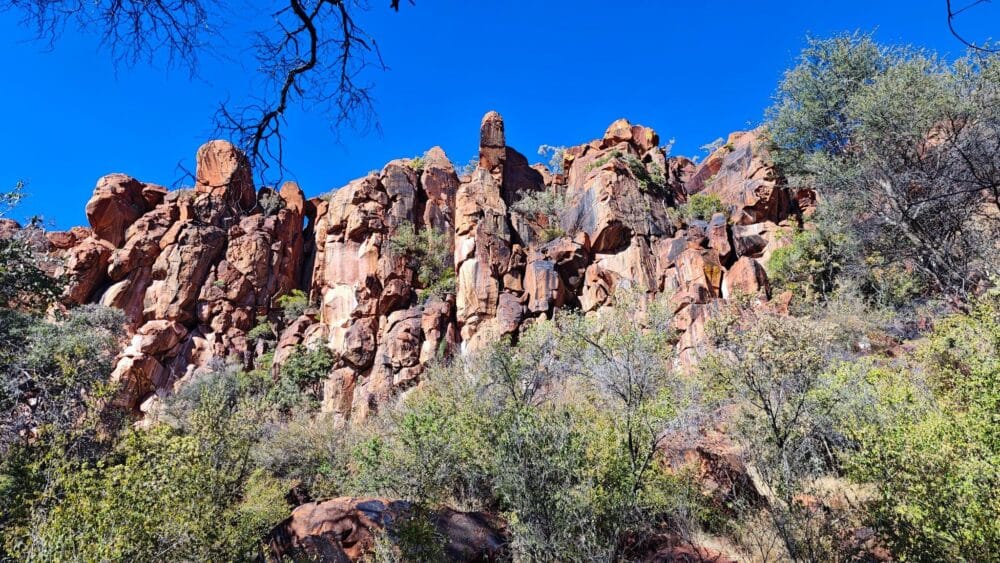
Waterberg Plateau National Park is one of Namibia's most unique geological formations. Its enormous red sandstone plateau was formed over 200 million years ago and rises some 200 meters above the surrounding plains, creating a landscape completely different from that found in other parts of the country.
It is precisely this elevation that has allowed for the preservation of a unique ecosystem. Thanks to higher humidity and its own microclimate, Waterberg boasts much greener and more abundant vegetation than that found in much of Namibia.
But Waterberg's importance goes far beyond its landscapes. It is currently one of Namibia's main conservation refuges and plays a vital role in protecting endangered species such as the white rhinoceros, the black rhinoceros, Cape buffalo, and sable and roan antelope.
During our visit we learned that many of the rhinos living in Waterberg today are part of recovery programs that have managed to save the species from a critical situation just a few decades ago.
Furthermore, the region holds great historical significance for Namibia. The Battle of Waterberg, a pivotal event during the German occupation and one of the most important in the country's modern history, took place here in 1904.
For all these reasons, Waterberg is not just a national park. It is also one of Namibia's most important places from a natural, historical, and conservation perspective.
What to see in Waterberg Namibia
Although many travelers use Waterberg only as a stop on the way to Etosha, we believe it deserves at least one or two full days of visiting.
Do the Rhino Drive
If we only had to recommend one activity in Waterberg, it would be this one.
The Rhino Drive allowed us to observe several white rhinos at very close range and learn a great deal about the conservation programs that are being developed in the area.
It was one of the most special activities of our first days in Namibia and a very different experience from the traditional safaris in Etosha, where we didn't see white rhinos, much less as close as here.
Explore the Waterberg trails
One of the things we liked most about Waterberg was being able to walk.
We combined the Andersson Trail and the Dassie Trail into a circular route of about 7 kilometers that allowed us to discover the park's vegetation, observe giant termite mounds and enjoy magnificent views over the reddish plateau.
In addition, the trails are very well signposted and have interpretive panels that explain the fauna, flora and conservation projects of the area.
If you are staying in public NRW there are other marked trails you can do.
Observe wildlife in the wild
Although Waterberg does not offer the same concentration of animals as Etosha, during our stay we saw giraffes, baboons, warthogs, duikers, guinea fowl and numerous antelopes.
In fact, the first wild giraffes we saw in Namibia appeared right here, a moment we will hardly forget.
Enjoy the scenery of the plateau
The main attraction of the park is the Waterberg plateau itself.
Its reddish walls contrast with the green vegetation, creating some of Namibia's most striking landscapes. This is especially true at sunrise and sunset, when the light bathes the rocks in intense shades of red.
Animals you can see in Waterberg Namibia
Many travelers arrive in Waterberg expecting a park similar to Etosha and are surprised to discover that the experience is completely different. Wildlife is present here, but it tends to be more dispersed among the vegetation and mountainous landscapes of the plateau.
That lower level of overcrowding is precisely part of its charm.
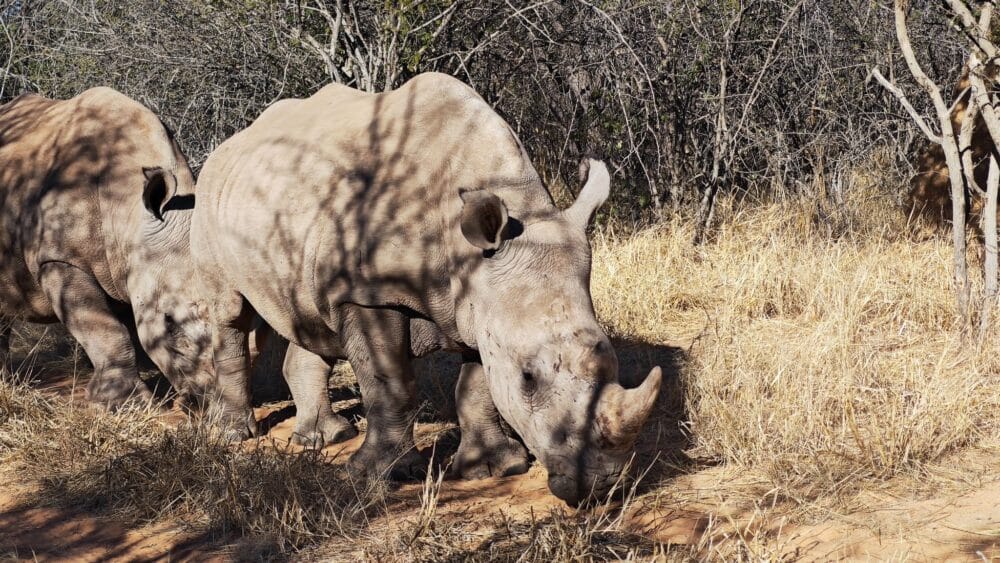
During our stay we saw giraffes, baboons, warthogs, duikers and numerous birds, although the real stars of Waterberg are the rhinoceroses, currently in danger of extinction.
Thanks to conservation programs developed over decades, Waterberg has become one of Namibia's main refuges for white and black rhinos. The famous Rhino Drive is the best activity for observing them and understanding the importance of these recovery projects.
Besides rhinos, Waterberg is also home to:
- Giraffes
- Baboons
- Warthogs
- Divers
- Sable antelopes
- Roan antelopes
- Cape Buffalo
- More than 200 species of birds
Although it's not the ideal place for a classic safari like Etosha National Park , Waterberg offers something different: the chance to observe wildlife in a much quieter environment, with spectacular landscapes and hardly any crowds.
For us, the first wild giraffes we saw in Namibia appeared right here, a moment that made Waterberg one of the most special memories of the entire trip.
Where to stay in Waterberg Plateau National Park
Although there are several accommodation options in Waterberg, after our experience we're pretty sure where we'd sleep again if we went back tomorrow. There's also an NWR campsite, but some friends who stayed there strongly advised against it. The rhinos aren't there, the facilities are much worse, and the trails for trekking aren't as safe as in the Wilderness where we stayed. We're telling you this from people we spoke to on our trip who were at the NWR.
Waterberg Wilderness Lodge: our recommendation
We stayed two nights in Waterberg Wilderness and it was one of the best decisions of the whole trip.
After an intercontinental flight, picking up the 4x4, doing some initial shopping, and driving several hours from Windhoek, arriving at a quiet place surrounded by nature and with all the comforts was exactly what we needed.
The rooms are spacious and comfortable, although there are also camping pitches if you prefer. The surroundings are spectacular, and we found both breakfast and dinner to be excellent. Furthermore, your stay includes access to several marked hiking trails and allows you to book activities like the Rhino Drive directly from the accommodation. There's a swimming pool, beautiful gardens—it's all very nice.
Another thing we really liked was the tranquility. During our stay, we saw small antelopes around the room, heard birds constantly, and enjoyed breathtaking night skies.
For a first contact with Namibia, it seemed like an ideal option.
👉 If you are going to travel around Namibia independently in a 4x4, we recommend booking in advance, especially between June and September, which is the most popular season.
Other accommodation options in Waterberg
Besides Waterberg Wilderness Lodge, there are other interesting alternatives:
- Waterberg Resort (managed by NWR).
- Waterberg Wilderness Campsite.
- Private accommodations on farms in the surrounding area.
- Lodges located in private reserves near the park.
If you're traveling on a budget, campsites can be an excellent option, whether it's the NWR or the Wilderness. However, for the first few nights of your trip, we think it's worth treating yourself to a nice lodge and resting before starting the longer stages of the route. We did it to acclimatize, and it was a great decision.
How many nights do we recommend?
Although many travelers only spend one night in Waterberg, we recommend spending at least two.
This way you can recover from your international trip, do some hiking, participate in the Rhino Drive and start your Namibia adventure much more calmly.
Our advice for booking accommodation in Namibia
⚠️ Don't make our mistake: Before discovering online booking through this platform , we wasted hours sending emails, waiting for replies, and making international transfers for some accommodations in Namibia. Today, we would book almost everything online again for convenience, flexibility, and peace of mind.
👉 Check out the accommodations we used during our Namibia trip and booked online without any problems.
Does the accommodation you choose influence your experience of visiting Waterberg?
Yes, and probably much more than you imagine.
In fact, after our visit we believe that a large part of the Waterberg experience depends on the accommodation you choose, as not all of them offer access to the same activities or the same wildlife viewing areas.
On one hand, there's the NWR (Namibia Wildlife Resorts) Waterberg Resort , the public accommodation located within the national park. Its main advantage is its location and the possibility of accessing some marked trails and viewpoints on the plateau. It's an interesting option for those on a budget or simply looking for a quick stop on their way to Etosha.
However, according to several travelers we met along our route, the wildlife experience is much more limited; they didn't see anything. They don't offer the white rhino safaris found in other private reserves in the area, and the facilities are simpler.
We chose Waterberg Wilderness Lodge , a private reserve located next to the national park, and we honestly believe it was one of the best decisions of the whole trip. Here we saw a lot of animals, including rhinos, and were able to walk along great, safe trails.
In our case, this allowed us to enjoy the best of both worlds:
- Go hiking in the morning.
- Observe wildlife but “safe” during walking routes.
- Participate in the Rhino Drive.
- See white rhinos.
- Enjoy a much quieter and more exclusive accommodation with good facilities and a swimming pool.
Therefore, if your goal is simply to visit Waterberg and do some hiking, the NWR's public accommodation might be sufficient. But if you want a more comprehensive experience, combining hiking, wildlife viewing, and seeing white rhinos, we think options like Waterberg Wilderness Lodge are well worth considering.
In fact, looking back, many of our memories of Waterberg—the giraffes, the rhinos, the trails, and the tranquility of the surroundings—are directly related to having chosen this accommodation for our first two nights in Namibia.
Practical tips for visiting Waterberg Plateau National Park
After spending two full days in Waterberg, these are the tips we think will help you the most in preparing for your visit.
Pack warm clothes even if you're traveling to Africa
That was probably what surprised us the most.
During our visit at the end of June we enjoyed very pleasant temperatures during the day, but at night we recorded temperatures of around -2°C.
If you are traveling during the Southern Hemisphere winter, don't forget to pack thermal clothing, a fleece, a warm jacket, a hat, and gloves.
Book the Rhino Drive in advance
It is one of the most popular activities in the area and, for us, one of the best experiences in Waterberg.
In addition to observing rhinos, you will learn a lot about the conservation projects taking place in Namibia.
Dedicate at least two nights
Many travelers use Waterberg only as a technical stop on the way to Etosha.
We believe it is a mistake.
Waterberg deserves time to walk, relax, and enjoy the surroundings. Two nights seemed perfect to us to start the trip at a leisurely pace.
Take the opportunity to adapt to the African rhythm
Waterberg was our first contact with Namibia and proved ideal for gradually adapting to long distances, dirt tracks and the operation of the 4x4.
Looking back, we believe it was a much better decision than heading straight for Etosha on the day of arrival.
Take binoculars
Although Waterberg is not a safari park in the style of Etosha, we saw giraffes, baboons, warthogs, duikers and numerous birds.
A good pair of binoculars always helps to enjoy the experience much more.
Do not hurry
If there's one thing we learned during our trip to Namibia, it's that the best moments usually happen when you slow down.
An unexpected conversation with a local, a family of giraffes crossing the track, or a sunset over the reddish Waterberg plateau are memories that are hard to forget.
And Waterberg is precisely one of those places where it's worth stopping, breathing, and starting to enjoy the trip from day one.
Is Waterberg worth visiting with children?
Yes , in fact we thought it was one of the best places to start a route through Namibia with children.
After a long flight and before tackling the country's major driving stages, Waterberg offers a calm, safe and very comfortable environment for the whole family to gradually adapt to the African rhythm.
Unlike other national parks in Namibia, here you can walk along marked trails, take short hiking routes and enjoy very comfortable accommodations surrounded by nature.
Our children especially enjoyed identifying animals during the trail runs, observing the first wild giraffes of the trip, and participating in wildlife observation activities.
Furthermore, the fact that Waterberg is not as crowded as other tourist destinations makes the experience much more relaxing for families.
In our experience, Waterberg was the perfect place for our children to begin falling in love with Namibia.
If you're planning a family trip, we also recommend reading our complete guide to Namibia with children , where we explain all the practical details we learned while traveling the country with our kids.
Is Waterberg in Namibia worth visiting?
Yes. Without a doubt.
In fact, if we were to return to Namibia tomorrow, Waterberg would once again be part of our route.
Many travelers pass through Etosha thinking it's just a stopover, but for us it was so much more. Waterberg allowed us to rest after our flight, adjust to the African pace of life, learn to drive the 4x4, and begin discovering Namibia's wildlife and landscapes at a leisurely pace.
Furthermore, it offers something different from the rest of the country.
While Etosha is known for its safaris, Sossusvlei for its giant dunes and the Skeleton Coast for its wild landscapes, Waterberg combines hiking, wildlife conservation, spectacular scenery and charming accommodations.
The Rhino Drive alone would justify the visit, but if you also enjoy walking and exploring less crowded places, we believe Waterberg is one of the most pleasant surprises on any independent trip through Namibia.
How much time should be dedicated to Waterberg?
Our recommendation is to dedicate two nights.
You can visit the park in just one night, but you'll have to do it in a hurry.
In contrast, with two nights you can rest after your international flight, do some hiking, participate in the Rhino Drive and enjoy the spectacular sunrises and sunsets of the plateau.
Would we include it in our route again?
Absolutely yes.
Of all the places we visited during our trip through Namibia, Waterberg was probably the best possible way to start the adventure.
Waterberg or Etosha: which park is more worthwhile?
This is one of the most common questions when organizing a route through Namibia, especially if time is limited and stops need to be prioritized.
The reality is that Waterberg and Etosha do not compete with each other , but rather offer completely different and complementary experiences.
If you're looking for a classic African safari with large concentrations of animals, then Etosha National Park is in a league of its own. There you'll find enormous herds of zebras, giraffes, elephants, wildebeest, gazelles, and, with a bit of luck, lions, leopards, or rhinos. It's one of the best places in Africa for a self-drive safari and wildlife viewing around the famous waterholes.
However, Waterberg stands out for other reasons.
Here, the star attraction is the stunning reddish plateau that dominates the landscape, along with hiking trails, tranquility, and conservation programs for endangered species. Waterberg allows you to enjoy Namibia at a much more leisurely pace, with fewer vehicles, fewer tourists, and a closer connection with nature.
Furthermore, while in Etosha the main activity consists of traversing kilometers of tracks in search of animals, in Waterberg you can also go hiking, learn about the history of the country, learn about rhino conservation projects and enjoy some of the most charming accommodations in Namibia.
For us the difference was very clear:
- Etosha impressed us with the number of animals.
- Waterberg captivated us with its overall experience and the opportunity to walk while observing animals safely up close. The paths are fenced off to protect large mammals like rhinos.
In fact, if we had to recommend an ideal order for a first trip through Namibia, we would do exactly the same as we did: start with Waterberg to recover from the flight, adapt to the country and enjoy the first encounters with African wildlife, and then continue towards Etosha National Park , where the intensity of the safaris reaches another level.
Our conclusion
If you only have a couple of days and your absolute priority is seeing animals, we would choose Etosha.
But if you're planning a trip to Namibia for two weeks or more, we sincerely believe that Waterberg deserves to be part of your itinerary , as it offers something you won't find anywhere else in the country: a unique combination of hiking, conservation, spectacular scenery, and tranquility.
And that's precisely why, looking back, we wouldn't change either of them. Waterberg was the best possible way to start our African adventure, and Etosha was one of the most exciting moments of the entire trip.
Frequently Asked Questions about Waterberg Plateau National Park
How many days are needed to visit Waterberg Plateau National Park?
Ideally, you should dedicate between one and two full days. We stayed two nights and we think that's the perfect amount of time to enjoy the surroundings at a leisurely pace.
Is the Rhino Drive worth it?
Yes. It was one of the best activities of our stay and one of the most interesting experiences of our first few days in Namibia.
Can you see rhinos in Waterberg?
Yes. Waterberg is one of Namibia's main rhino conservation centers and one of the best places in the country to see them.
Is Waterberg or Etosha better?
They are completely different experiences.
Etosha offers a higher concentration of wildlife and is one of Africa's best safari parks. Waterberg, on the other hand, is known for its hiking, scenery, rhino conservation, and tranquility.
We recommend visiting both.
Is it suitable for traveling with children?
Totally.
In fact, we found it to be one of the most comfortable and safest places to start a trip through Namibia with children. The trails are easy, the accommodations are very well-equipped, and wildlife viewing is very exciting for little ones.
Is it cold in Waterberg?
Yes, much more than most travelers imagine.
During our visit in late June, we recorded temperatures close to -2°C at night. If you travel during the Southern Hemisphere winter, pack warm clothing.
Is a 4x4 necessary to visit Waterberg?
It is not essential.
You can get there in a regular car using the main roads. However, if you're planning a complete tour of Namibia, a 4x4 is much more comfortable and highly recommended.
What is the best accommodation in Waterberg?
Our experience was at Waterberg Wilderness Lodge and we would recommend it without hesitation to those looking for tranquility, nature and an excellent base from which to explore the area.
Is it possible to visit Waterberg in one day?
Yes, it's possible to visit Waterberg as a day trip from Windhoek, as it's about a three-hour drive from the capital. However, we believe that doing so would mean missing out on much of the experience.
Waterberg isn't just a place for a quick stop; it's an ideal destination for relaxing, hiking, wildlife viewing, and enjoying spectacular sunsets. In our experience, it's best to spend at least one night, though we recommend two to fully enjoy Rhino Drive and explore the trails at a leisurely pace.
Are there lions in Waterberg?
No. Unlike Etosha National Park, Waterberg is not a destination geared towards observing large predators.
The most prominent wildlife in Waterberg consists of white and black rhinoceroses, giraffes, baboons, warthogs, duikers, sable antelopes, roan antelopes and numerous species of birds.
It is precisely the absence of large predators in some areas that allows hiking trails and wildlife observation activities on foot that would be unthinkable in other national parks in Namibia.
How much does Rhino Drive cost in Waterberg?
The price of the Rhino Drive may vary slightly depending on the season and the accommodation from which it is booked.
When we visited Waterberg, this activity was booked directly through Waterberg Wilderness Lodge and had an additional cost on top of the accommodation.
Beyond the price itself, we sincerely believe it's one of the best value activities in all of Waterberg. Being able to observe white rhinos at very close range while learning about Namibia's conservation programs was one of the most special experiences of our trip.
Our advice is to check the updated price directly with the accommodation when making the reservation.
If you want to know the real and detailed cost of our entire adventure, you can consult our article on How much does a trip to Namibia cost independently , where we break it down
Is it possible to explore Waterberg independently?
Yes, although it depends on the area you visit and the accommodation chosen.
In Waterberg, there are several marked trails that can be explored independently, allowing you to discover the vegetation, geology, and some of the most spectacular viewpoints on the plateau. We hiked the Andersson Trail and the Dassie Trail without a guide.
However, some wildlife viewing activities, such as the Rhino Drive, can only be done with licensed guides. Additionally, access to certain areas and experiences depends on your accommodation.
Therefore, if your goal is to combine hiking, wildlife viewing, and rhinoceros watching, we believe it's worth choosing accommodation that offers access to all these activities, as we did during our stay in Waterberg.
Conclusion: Our opinion on Waterberg Plateau National Park
Waterberg was our gateway to Namibia and, looking back, we can't think of a better way to start this trip.
Here we saw our first wild giraffes, learned our first lessons about the history and social reality of the country, went on our first rhino safari and gradually adapted to the African rhythm before venturing into much more remote regions.
But beyond the animals and the landscapes, Waterberg gave us something that few places achieve: the feeling that the adventure had just begun.
If you're planning a self-guided tour of Namibia, we believe that spending two nights in Waterberg Plateau National Park is a decision you'll hardly regret making.
And if you're also looking for comfortable, peaceful accommodation perfectly integrated into nature, our experience at Waterberg Wilderness Lodge was excellent and we would book it again without hesitation.
For us, Waterberg wasn't just a stop on the way to Etosha. It was one of those places that ends up becoming part of the most special memories of the trip.
Continue organizing your trip to Namibia
If you're planning a self-guided trip through Namibia, these are the guides that will best help you plan your journey:
🧭 Complete guide to traveling to Namibia
All the information about budget, 4x4 rental, safety, accommodations, best time to go and our complete route through the country.
📅 24-day Namibia itinerary
Our complete day-by-day itinerary.
🗺️ What to see in Namibia
The must-see places that we would include in any trip around the country.
Latest posts from our blog
-
Definitive manual for traveling by motorhome【2024】
Super complete manual for traveling by motorhome with all the answers to your questions.
-
Namibia Trip: Complete Guide for Independent Travel (24-day Itinerary, What to See and Tips Based on Our Experience)
Are you thinking of planning a trip to Namibia on your own and don't know where to start? After traveling the country for 24 days as a family in a 4x4 with rooftop tents, we've put together this comprehensive guide with everything we wish we had known before our trip. Here you'll find information…
-
London with children: what to see and do as a family (royal guide with map) of the top 22 plans
If you're planning a trip to London with kids and don't know where to start, here you'll find the 22 best family-friendly activities, an optimized 3-day itinerary, money-saving tips, the best free museums, and an interactive map with all the must-see places. Basic summary: London with kids. Quick information. Recommended days: 3-5…
-
Guide to traveling to Canada: everything you need to know for a trip to Canada on your own
Welcome to a super guide for traveling to Canada from Spain or anywhere in Europe. One of our newest destinations in this wonderful world, where every trip continues to surprise us with its hidden gems. How lucky we are to have been born on Earth! How fortunate to be able to travel to Canada! Visiting Canada…
Ethical code:
On our blog you will find affiliate links. These are always placed with our highest ethics. We never publish any service or product that we have not used before and that we are sincerely happy with. That is why our recommendations are always ethical. In addition, there is no additional cost for you to book through our links and, on the other hand, it means a small commission for us that helps us maintain this blog so that you can continue enjoying it for free.