
Table of Contents
"There are places you visit because they appear in all the guidebooks. And then there are those hidden gems that, unexpectedly, end up becoming one of the best memories of the trip. For us, Spitzkoppe was exactly that."
When we were planning our independent trip to Namibia , we knew that Spitzkoppe was famous for its spectacular granite mountains and the iconic rock arch we had seen so many times in photographs. However, we never imagined it would end up being one of the most moving places of the entire trip.
You don't just come here to admire a landscape.
Come to walk among mountains that seem sculpted by giants , discover cave paintings thousands of years old, observe zebras in the wild, contemplate one of the best sunsets in Namibia and sleep under one of the most starry skies on the planet.
In this guide you will find what to see in Spitzkoppe , how to get there, where to sleep, what activities are worth doing, our real experience exploring it for two days and all the tips we wish we had known before arriving.
If you're planning your trip, we recommend starting with our complete guide to traveling to Namibia , where you'll find all the trip planning, budgeting, safety, 4x4 rental, accommodations, and our complete 24-day itinerary for the country.
And if you're still planning your trip, you can also check out our guide to what to see in Namibia , where we've compiled all the must-see destinations we visited during our trip.
Spitzkoppe at a glance
| Information | Facts & figures |
| 📍 Location | Erongo Region, Namibia |
| 🪨 What to see | Granite mountains, cave paintings, Rock Arch and sunsets |
| ️ recommended time | 1 full day (ideally with one night) |
| 🏕️ Where to sleep | Camping or tented camps within Spitzkoppe |
| 🚙 Ideal for | 4x4 trips, photography, families, hiking and nature |
| ⭐ Essential | Sunset Tour, Bushman's Paradise and Rock Arch |
What is Spitzkoppe?
Spitzkoppe is one of Namibia 's most spectacular landscapes and, for many travelers, one of the most photogenic places on the entire African continent.
Known as "the Matterhorn of Namibia" , this enormous granite formation rises almost 700 meters above the desert plain , creating a landscape unlike any other in the country.
But Spitzkoppe is not just a mountain.
It is a huge collection of granite domes, natural arches, narrow canyons, viewpoints, cave paintings and camps scattered among some of the oldest geological formations on the planet.
And that is precisely what makes it such a special place.
You can spend an hour taking the typical photograph of the famous Rock Arch.
Or you can spend two days exploring every corner and discover that Spitzkoppe is so much more than that image we've all seen at some point.
We chose the second option.
And it was one of the best decisions of the whole trip.
🌍 Did you know that…?
The Spitzkoppe Mountains began forming approximately 120 million years ago , when enormous masses of granite were exposed after millions of years of erosion. The result is some of Africa's most spectacular geological landscapes.
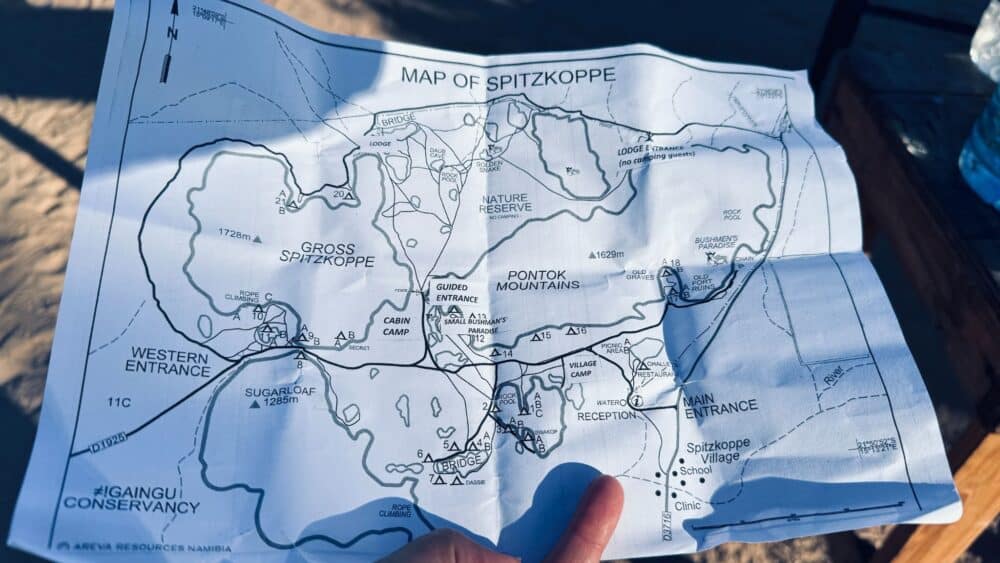
Where is Spitzkoppe?
Spitzkoppe is located in the Erongo region of western Namibia, approximately at:
- 150 km from Swakopmund.
- 230 km from Cape Cross.
- 270 km from Twyfelfontein.
Its location makes it an almost perfect stop between the Atlantic coast and the interior of the country.
We had arrived from Cape Cross , where we had spent the morning visiting the impressive colony of sea lions.
If you haven't yet visited this place, we recommend you first read our guide to Cape Cross , where we tell you how to visit Africa's largest seal colony and why we found it to be one of the wildest experiences of the trip.
After leaving Cape Cross we still made several stops before arriving in Spitzkoppe.
And they were all worth it.
How to get to Spitzkoppe
Getting to Spitzkoppe is quite simple.
From Cape Cross we continue south through Dorob National Park , traveling along one of the most beautiful roads on the entire Atlantic coast.
During the journey we made several highly recommended stops.
The first was at some curious stalls where the locals sell blocks of crystallized salt.
The surprising thing is that there's no one answering.
Each stone has its price marked on it, and you simply leave the money in a small container.
It reminded us a lot of the trust system we had seen in some villages in Switzerland.
We bought a stone simply because we thought it was beautiful and because we liked being able to contribute directly to the local economy.
A few kilometers later we made another highly recommended stop to visit the Zeila shipwreck , a ship that has been stranded since 2008 and can be seen perfectly from the coast.
It requires hardly any time and we believe it is well worth including it in the route.
Finally we arrived in Swakopmund , where we took the opportunity to refuel and stock up at the supermarket.
Although we wouldn't be visiting the city yet —we would do that two days later—, it was the perfect place to buy food before heading to Spitzkoppe.
🚗 Kucavana Council
Take advantage of your time in Swakopmund to do your shopping for several days. It's one of the cities with the best supermarkets in Namibia, and afterwards you'll venture back into much more isolated areas.
Our arrival in Spitzkoppe
We arrived in the mid-afternoon with that mixture of tiredness and excitement that you only feel after many kilometers on the road.
The first impression was spectacular.
The enormous granite mountains suddenly appeared in the middle of the plain as if someone had left them there in a completely impossible way.
Up to that point we had seen many photographs.
But none of them do justice to the feeling of having them in front of you.
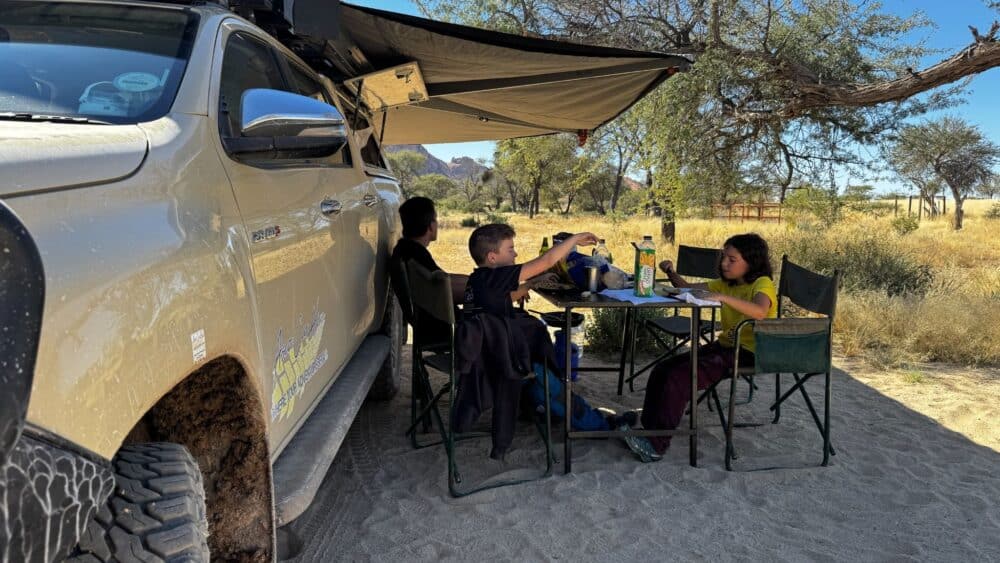
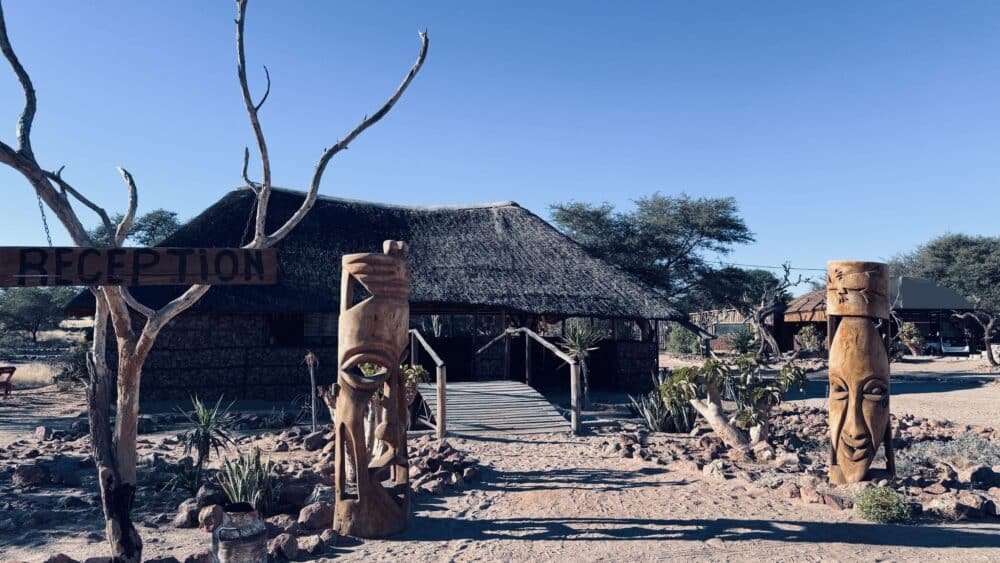
We stayed at Spitzkoppe Tented Camp & Campsite , a much cheaper campsite than the main one in the park, and it turned out to be quite a discovery.
It had plenty of shade, a swimming pool, and a very peaceful atmosphere.
We quickly set up camp.
Because that afternoon one of the best activities of our entire trip through Namibia was still waiting for us.
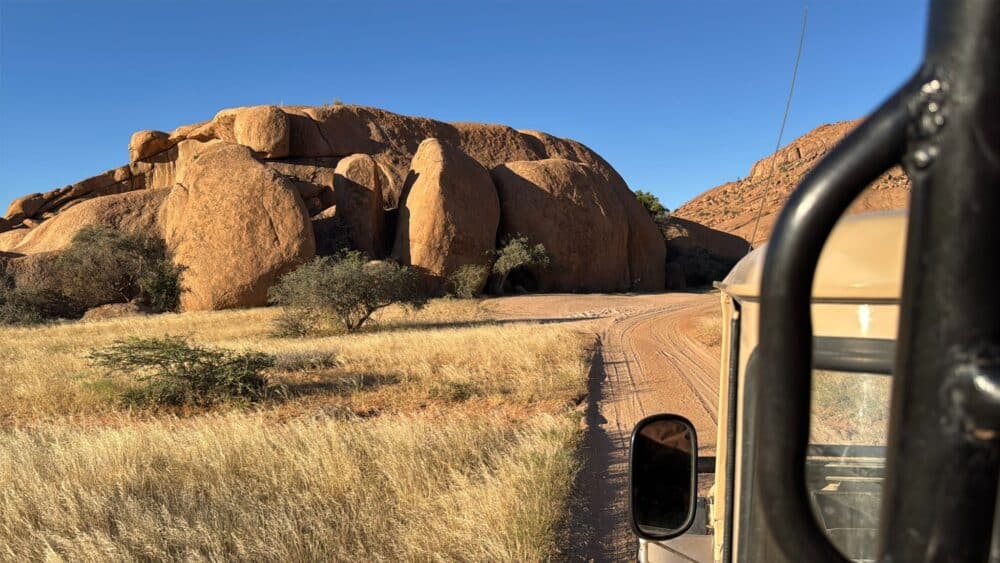
A guided 4x4 tour of Spitzkoppe at sunset.
And if there's one activity we would wholeheartedly recommend to any traveler visiting this area…
That's precisely it.
⭐ Our recommendation
If you're spending a night in Spitzkoppe, book a guided sunset tour with your campsite or lodge . We were debating whether to do it or explore the area on our own, but after experiencing it, we can say it was one of the best decisions of the entire trip. The guide took us to places with restricted access, explained the history of the rock paintings, and we ended up watching an absolutely unforgettable sunset next to the famous Rock Arch , which would have been difficult to find on the first try without a guide.
Our tour of Spitzkoppe: the best decision of the trip
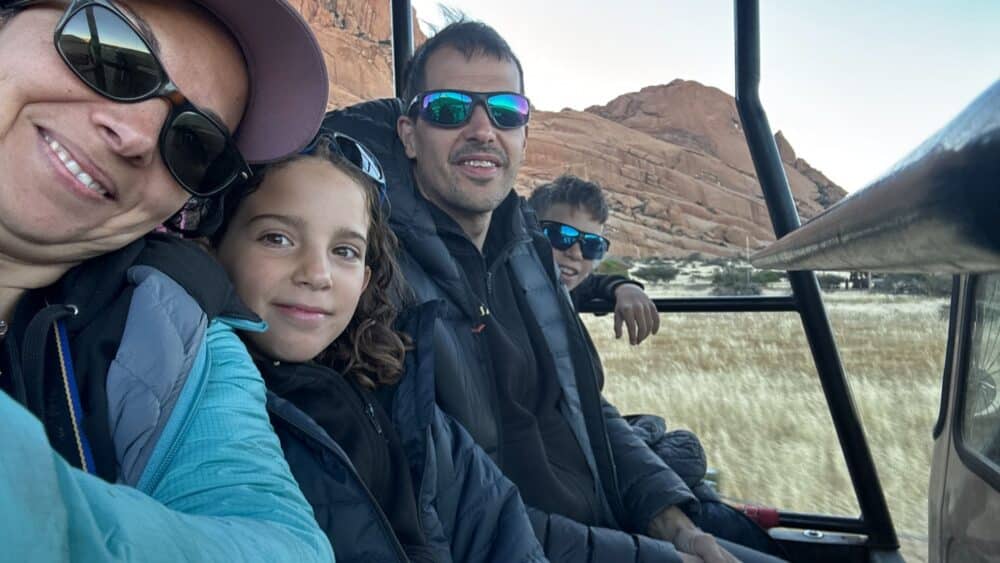
If we could only give you one piece of advice for visiting Spitzkoppe , it would be this: Book a guided sunset tour.
We had a lot of doubts before hiring him.
We planned to explore the area on our own and only visit the famous rock arch.
Thank goodness we changed our minds.
It was, without exaggeration, one of the best activities of our entire trip through Namibia.
As soon as we got into the 4x4, the guide explained that we were going to visit some places that many travelers don't even reach because they are poorly signposted or because they can only be visited with people who know the area perfectly.
And then began an afternoon that we still remember today.
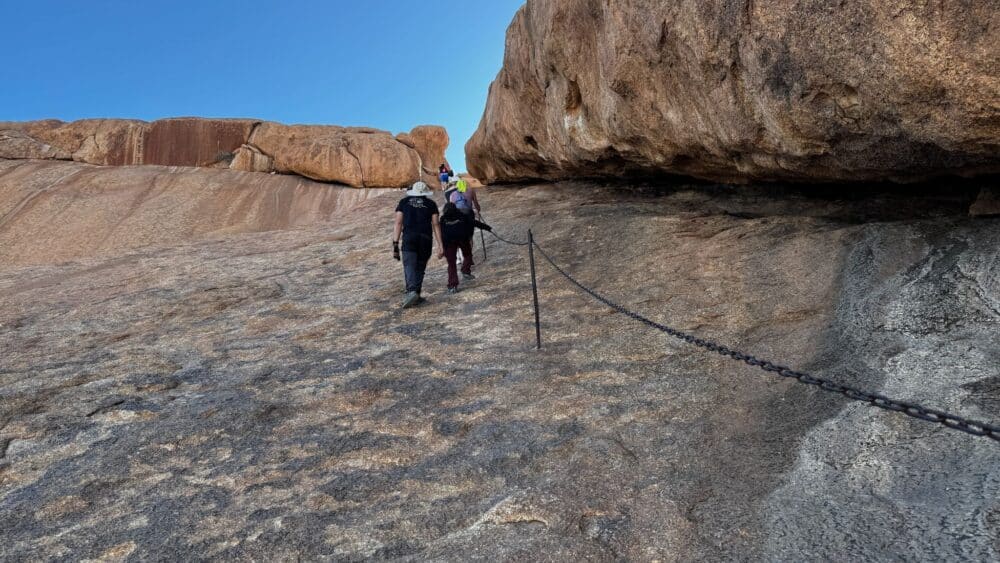
Bushman's Paradise: Traveling back 4.000 years
The first stop was probably the one that surprised us the most.
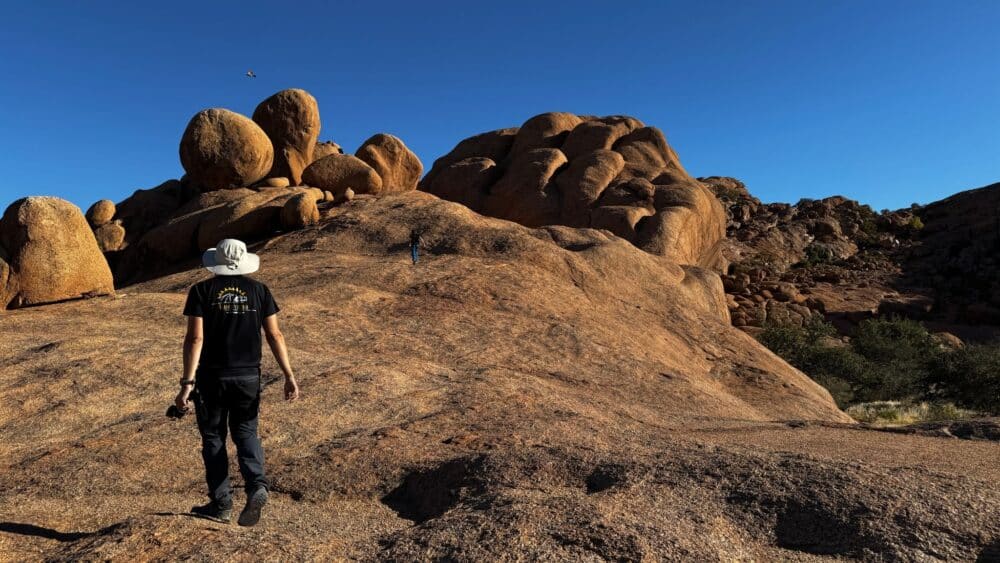
After traveling along several paths between the enormous granite mountains, we left the vehicle and began a short climb.
It wasn't particularly long.
But it did have an element of adventure.
In one section we had to use some chains fixed to the rock to overcome a slightly more vertical passage.
Nothing complicated.
In fact, our children did it without any difficulty.
But it adds that little touch of exploration that makes the experience even more fun.
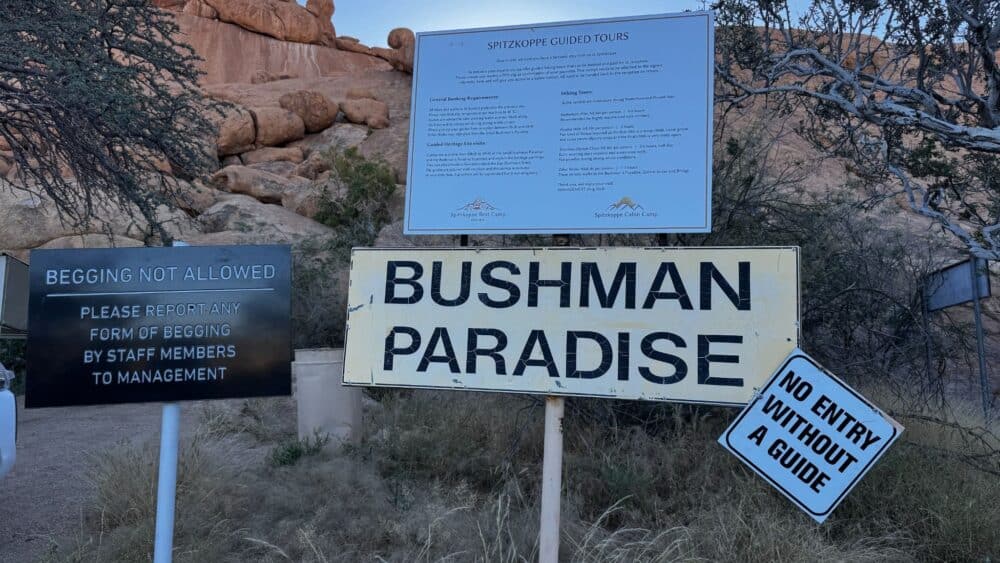
When we got to the top, we immediately understood why that place is called Bushman's Paradise.
Before us appeared a huge rock shelter where cave paintings made by the San or Bushman people between 2.000 and 4.000 years ago are still preserved.
Our guide explained the meaning of many of them.
Hunting scenes.
Animals.
Symbols.
Small fragments of the history of those who inhabited these mountains thousands of years before there were roads, campsites or travelers like us.
Being there, surrounded by that granite landscape and contemplating paintings that had survived for millennia, was truly exciting.
💡 Kucavana Tip
If you've already visited Twyfelfontein , don't think Spitzkoppe will be "more of the same".
The exact opposite happens.
In Twyfelfontein, rock engravings predominate , while in Spitzkoppe you will find mainly cave paintings.
They are two completely different places and we believe both are worth a visit.
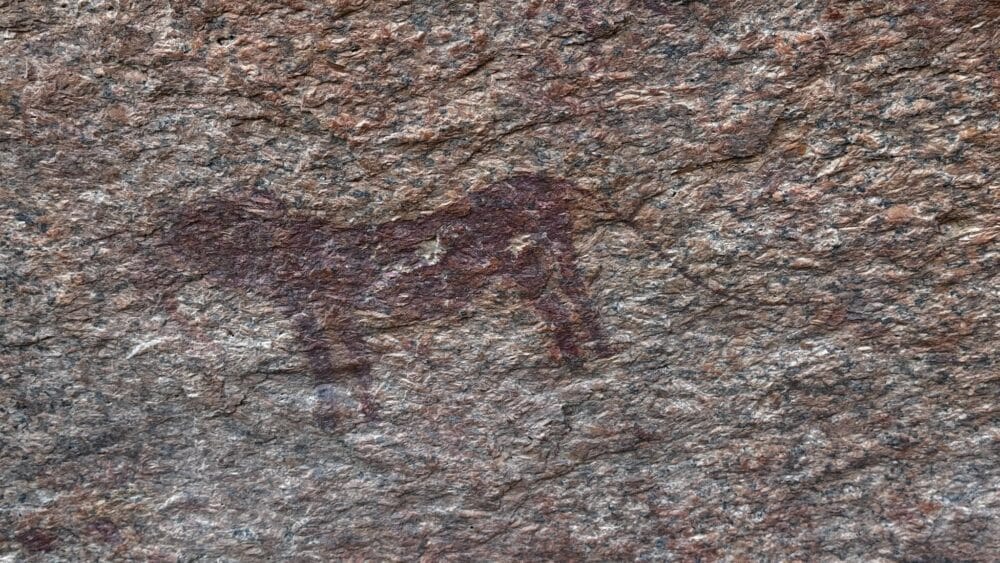
Little Bushman's Paradise
The next stop was an area known as Small Bushman's Paradise.
Many travelers simply pass by.
And it's a shame.
Here we found new cave paintings perfectly integrated among the rocks.
We especially liked it because there was hardly anyone there.
As the guide continued to explain the history of the place, all we could think about was the number of generations that had passed through those mountains long before us.
It is one of those places that transmits a peace that is difficult to explain.
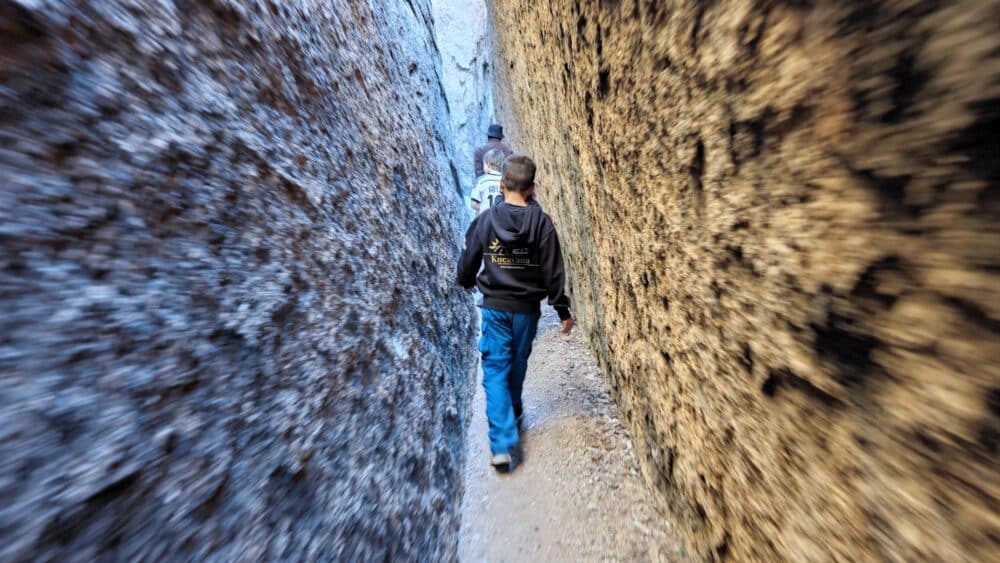
A granite labyrinth hidden among the mountains
The third stop was completely different.
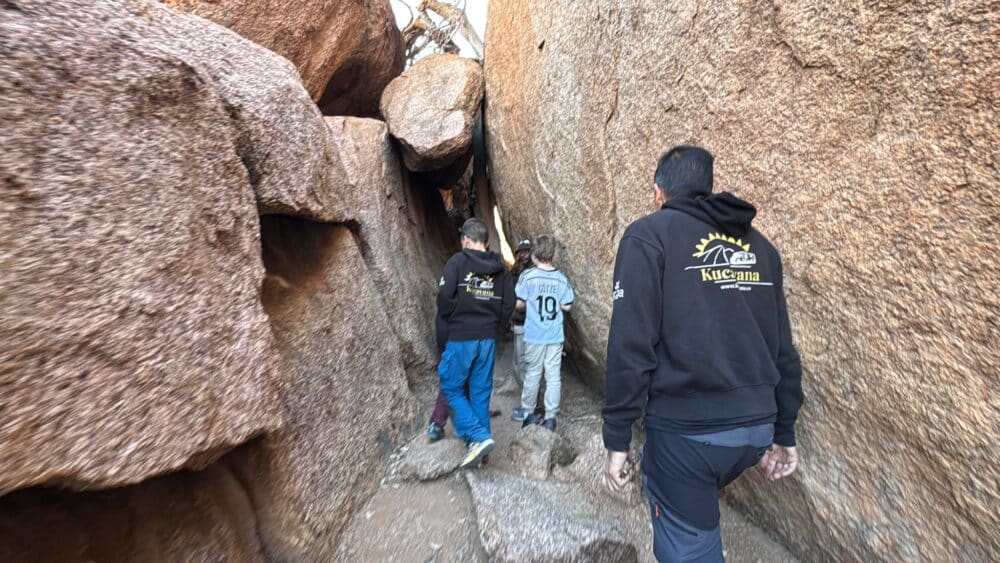
The guide took us to a restricted access area where huge granite blocks form a kind of natural labyrinth.
Cracks.
Narrow corridors.
Small caves.
Giant rocks leaning on top of each other in a seemingly impossible way.
It was probably the most surprising place from a geological point of view.
As we walked between those enormous granite walls, the guide stopped several times to show us new cave paintings that would have gone completely unnoticed if we had explored Spitzkoppe on our own.
And then came another surprise.
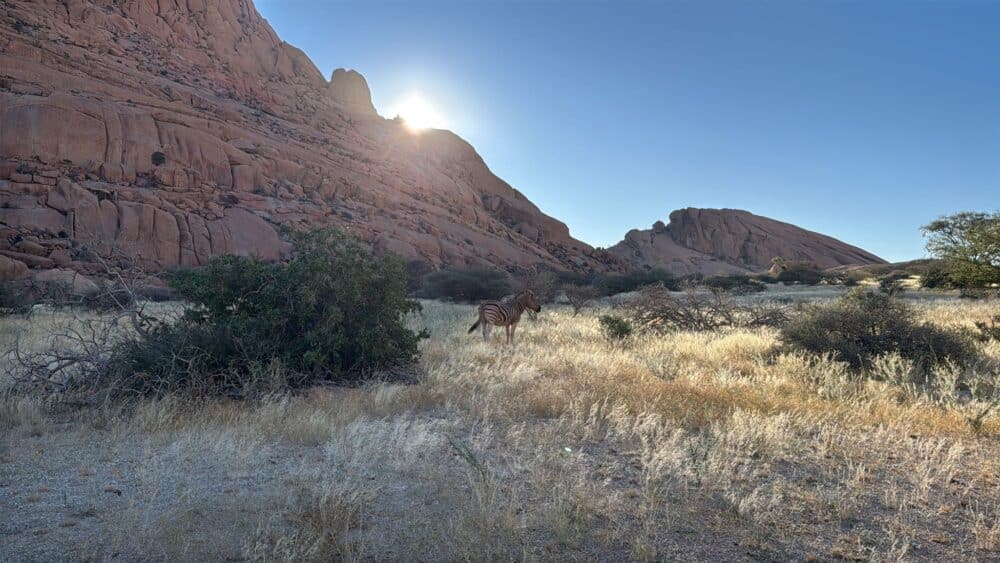
Several zebras appeared among the rocks, roaming freely.
We watched them for a few minutes as they continued walking calmly among the granite, completely unaware of our presence.
It was one of those little gifts that Namibia often offers when you least expect them.
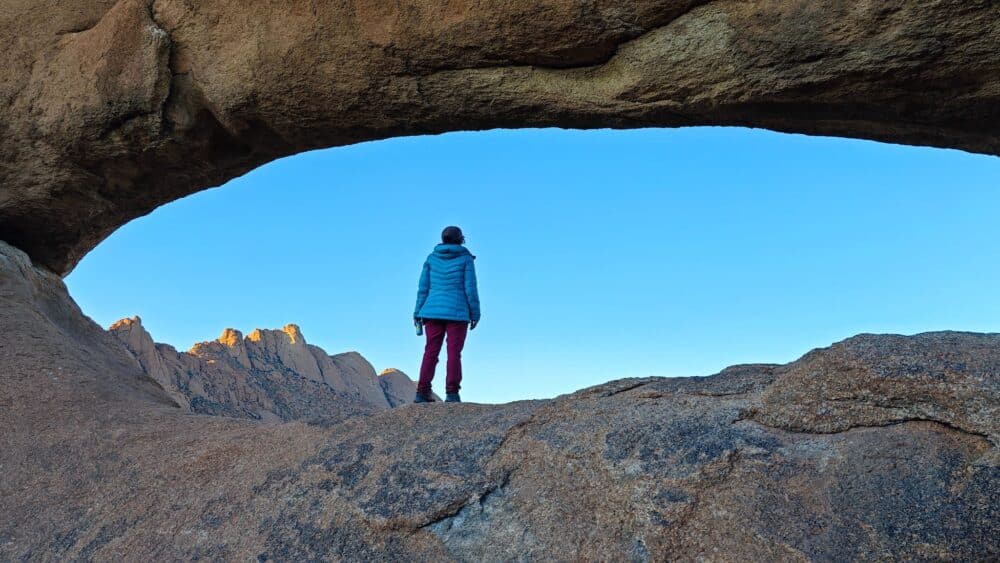
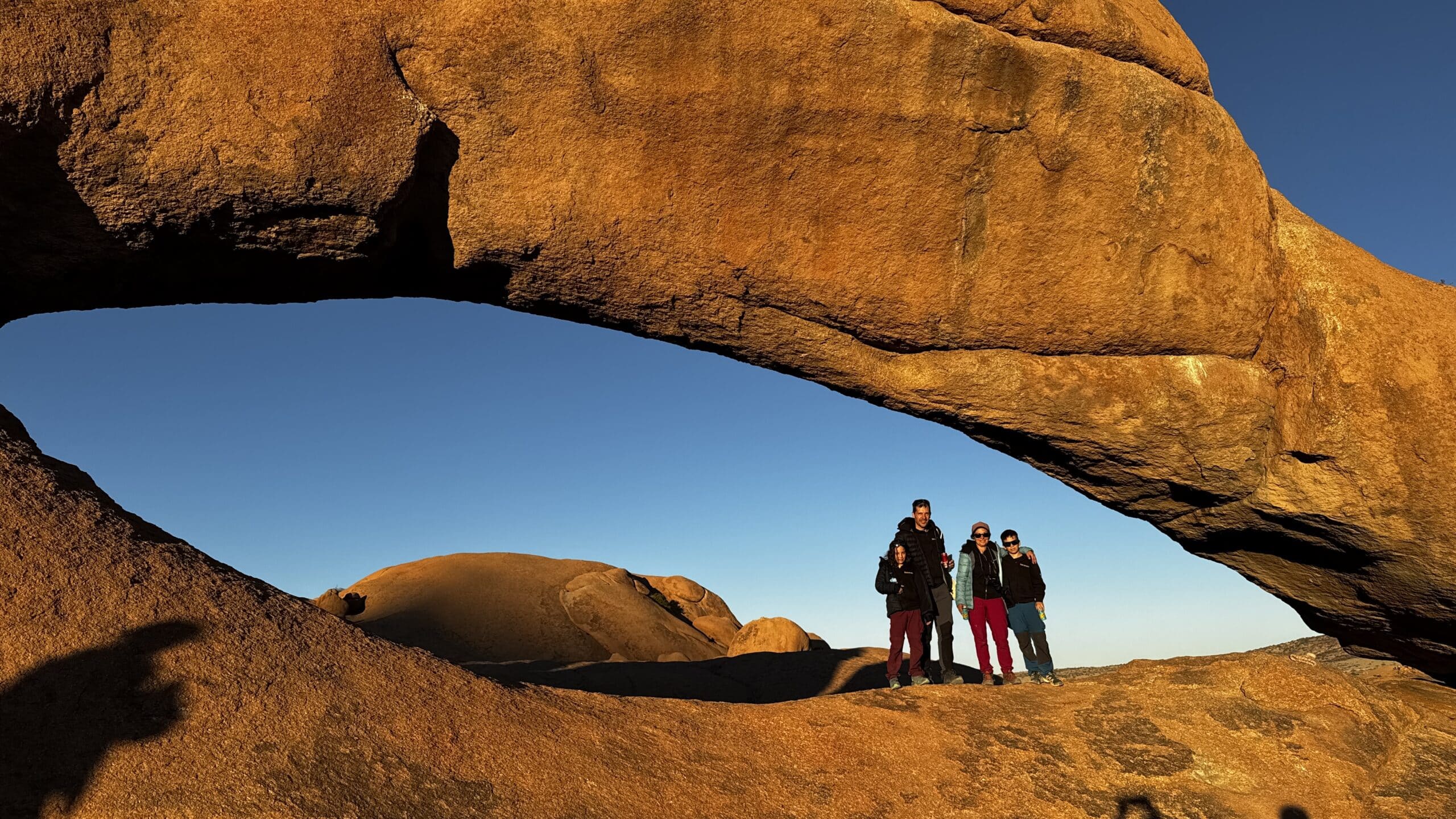
The famous Rock Arch at sunset
If there is one image that represents Spitzkoppe , it is undoubtedly its famous Rock Arch.
And if there's a moment to visit him…
It's sunset.
Our guide perfectly calculated the timings to arrive just as the sun began to descend over the horizon.
The light began to change.
The gray tones of the granite gradually transformed into orange, reddish, and golden colors.
Every minute was different.
Each photograph seemed better than the last.
But honestly…
There was a moment when we stopped taking photos.
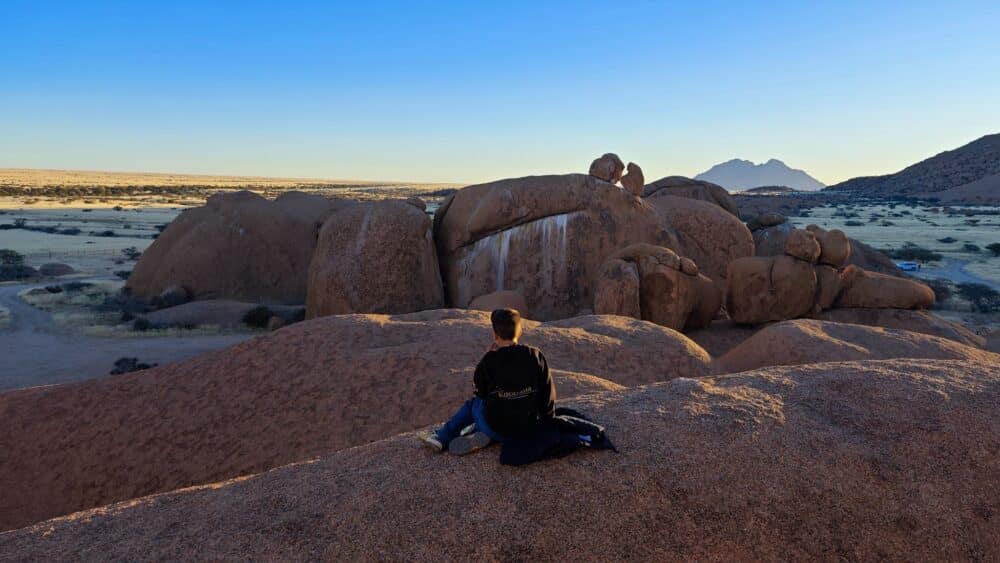
We sat down.
They offered us a small snack.
And we simply contemplated the landscape.
It's funny how some places manage to make you put your camera away for a few minutes so you can just enjoy yourself.
That's exactly what happened to us in Spitzkoppe.
And we believe that's the best definition of a truly special place.
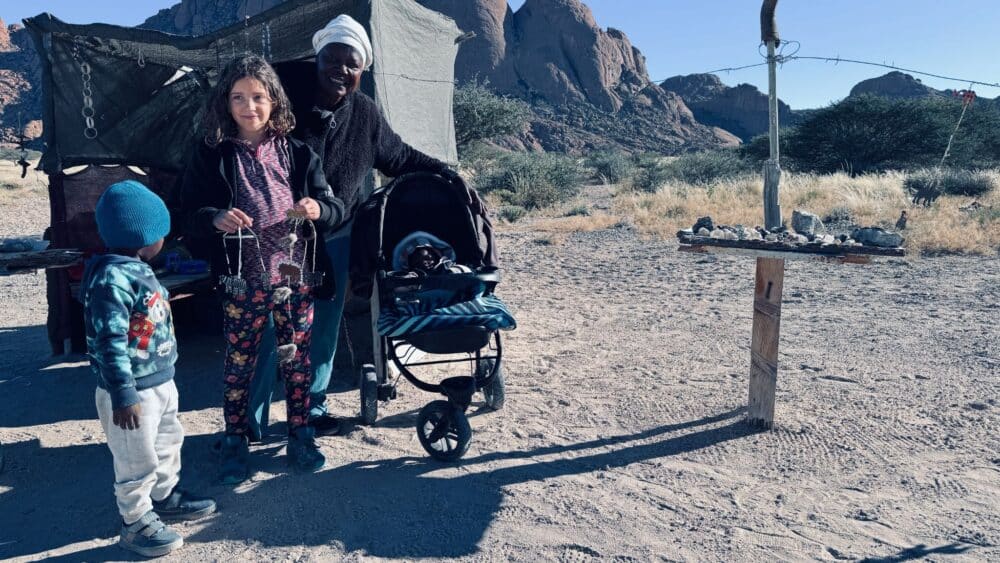
Supporting local communities before leaving Spitzkoppe
The next morning we woke up to that characteristic Namibian winter chill. After breakfast and a leisurely packing up camp, we made one last stop before saying goodbye to Spitzkoppe.
We approached the small village located next to the mountain, where several families sell handmade crafts.
As we had done in other places on our trip, we took the opportunity to buy some wooden pieces and small souvenirs. Beyond the souvenir itself, we believe it's a simple and direct way to contribute to the local economy and support the communities living in this part of Namibia.
But the most special moment came when we took out of the car again the pencils, notebooks and school supplies that we had bought during the trip to distribute among the children of the small villages we were finding.
Seeing the excitement with which they were received was one of those memories that don't appear in any travel guide, but end up being among the most beautiful.
💚 Our Kucavana tip
If you're traveling through Namibia and have a little space in your luggage, bringing pencils, crayons, notebooks, or other school supplies, along with some candy, can be a simple gesture that will bring great joy to children in some rural communities. Always give them respectfully and, if possible, through the families or community leaders.
With that image still in our heads and a photo that the artisan asked us to take, we set off for our next stop: Swakopmund , where, after many days of camping and rooftop tents, we would once again enjoy a bed, a hot shower and a small reunion with civilization.
The best places to photograph Spitzkoppe
If you like photography, these are our favorite spots:
- Rock Arch at sunset.
- Bushman's Paradise and its cave paintings.
- The large granite walls illuminated by the Golden Hour.
- Zebras walking among the rocks.
- The panoramic views from the higher areas of the route.
Our favorite: Rock Arch at sunset. It's probably one of the most photogenic landscapes in all of Namibia.
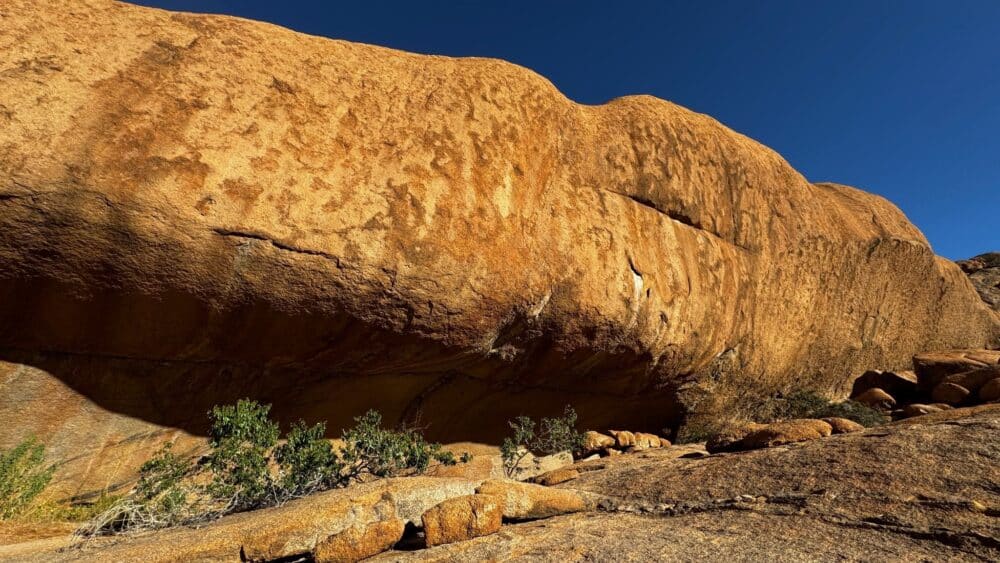
⭐ Our tour rating
⭐⭐⭐⭐⭐ 5 / 5
Best
✔ You gain access to little-known places.
✔ You learn a lot about Bushman culture.
✔ You discover cave paintings that would otherwise go unnoticed.
✔ See Spitzkoppe from unique perspectives.
✔ You end up enjoying one of the best sunsets in Namibia.
Would we hire him again?
Without thinking twice.
If we only had one afternoon in Spitzkoppe, we would repeat the exact same plan.
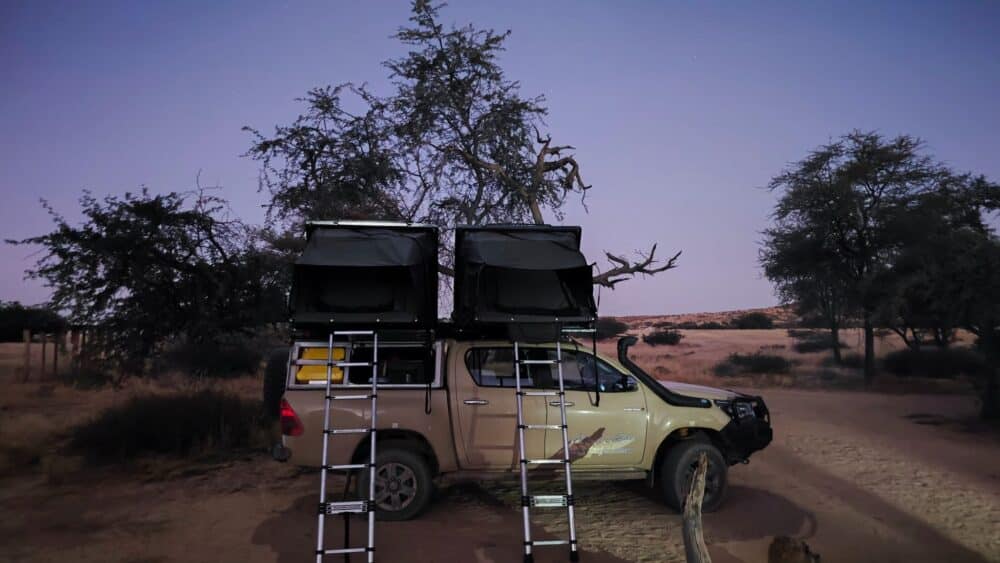
Where to sleep in Spitzkoppe
One of the best decisions we made was to spend a night inside Spitzkoppe.
Many travelers take a day trip of a few hours from Swakopmund and return the same day.
Frankly, we believe it's a mistake.
Part of Spitzkoppe 's magic appears when the hikers disappear, the sun begins to set, and the mountains completely change color.
We stayed at Spitzkoppe Tented Camp & Campsite , an option that we found to be excellent value for money.
Our experience at Spitzkoppe Tented Camp
- Much cheaper than other nearby options.
- Spacious plots with plenty of shade.
- The pool is perfect after many days on the road.
- Very peaceful atmosphere.
- Very good location for exploring Spitzkoppe.
After several days sleeping in the rooftop tent of the 4x4, we were very grateful to find such a comfortable campsite.
We set up camp, enjoyed a good barbecue, and when night fell, that dry cold so characteristic of Namibian winter returned.
We ended up doing exactly the same thing as almost every night of the trip:
A nice dinner.
A really thick jacket.
And go to bed early.
When you've spent several days getting up early to take advantage of the African sunrises, your body doesn't crave many more adventures after dinner.
💡 Which campsite to choose in Spitzkoppe?
Many travelers are undecided between the Community Rest Camp, and the Spitzkoppe Tented Camp or the Spitzkoppe Cabin Camp.
We can only speak about the second to last one because that's where we stayed, but from what I saw while passing by the others, they are all an excellent choice.
If you're looking for a peaceful experience with good facilities and a reasonable price, we found ours to be an excellent option; it was the cheapest and had good services, and we were able to spend what we saved on the sunset tour.
The incredible Welwitschia mirabilis
Although we were not lucky enough to see it during this stage, this whole area is home to one of the most extraordinary plants on the planet.
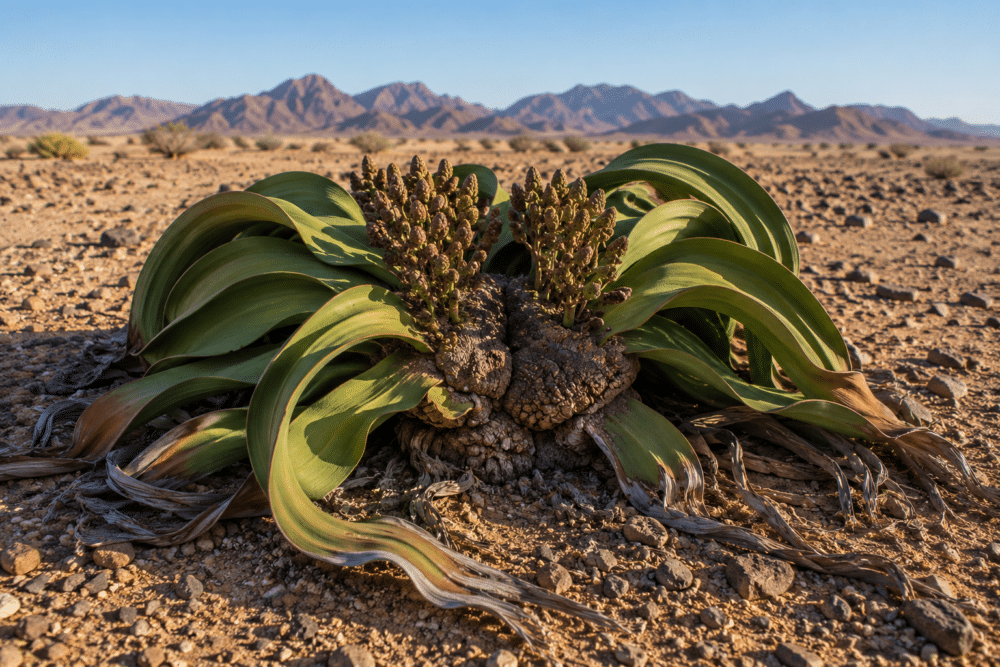
The Welwitschia mirabilis.
And we're not exaggerating when we say she looks like she's from another world.
🌿 Why is Welwitschia mirabilis so special?
🌍 He only lives in one place in the world
It is an endemic species that only grows naturally in a narrow strip of the Namib Desert, between Namibia and southern Angola.
🧓 It can live for more than 1.500 years
Some plants began to grow when medieval castles were still being built in Europe.
🍃 It only has two leaves
Although it looks like a tangle of dry leaves, the entire plant only develops two leaves during its lifetime. The wind and sand gradually tear them apart, creating its peculiar appearance.
☁️ Survive thanks to the fog
In one of the driest places on the planet, it obtains much of its water by condensing the moisture from the fog onto its leaves.
🐝 Its flowers attract unique insects
It produces male and female cones that give off a sweet aroma to attract its pollinators.
🧬 It's a true mystery to science
Its enormous genome and its adaptations to the desert continue to be studied.
🔒 It is strictly protected
The oldest plants remain fenced off and damaging them is strictly prohibited.
Although we didn't see it during our visit, we believe it's worth keeping an eye out for if you travel through this area of Namibia.
Finding a plant that has been alive for over a thousand years puts things into perspective.
Tips for visiting Spitzkoppe
Based on our experience, these would be our main tips.
- Dedicate at least one night to Spitzkoppe.
- book a guided sunset tour.
- Wear comfortable shoes for walking on granite.
- Don't rush. Spitzkoppe is meant to be savored slowly.
- Take advantage of the opportunity to take photographs during the Golden hour.
- If you come from Cape Cross, take the opportunity to stop at the Zeila shipwreck.
- Make your purchase at Swakopmund before arriving at the campsite.
Is Spitzkoppe worth visiting?
Our answer is very simple.
Yes. Very much so.
In fact, if we had to choose the five places that surprised us the most during the entire trip through Namibia , Spitzkoppe would undoubtedly be among them.
And not only because of the famous rock arch.
What makes this place special is the overall experience.
The mountains.
The silence.
Cave paintings.
Zebras.
The enormous granite blocks.
The sunset.
And that constant feeling of exploring a still very authentic corner of Africa.
Many travelers arrive thinking they are only going to take a picture of the Rock Arch.
We also.
And we ended up discovering one of the places that excited us the most during the entire trip.
⭐ Kucavana Rating
| Appearance | Nota |
| Landscape | ⭐⭐⭐⭐⭐ |
| Photograph. | ⭐⭐⭐⭐⭐ |
| Nature | ⭐⭐⭐⭐⭐ |
| Kids | ⭐⭐⭐⭐⭐ |
| Campsite | ⭐⭐⭐⭐⭐ |
| Sunset | ⭐⭐⭐⭐⭐ |
Overall rating: 5/5
Frequently Asked Questions about Spitzkoppe
How long does it take to visit Spitzkoppe?
Ideally, you should dedicate a full day and a night . This way you can enjoy the sunset, sleep inside the park, and explore the main areas at your leisure.
Is it possible to visit Spitzkoppe without a guide?
Yes.
Much of the park can be explored independently.
However, we believe the guided tour is well worth it because it allows access to little-known places and a better understanding of the history of the cave paintings.
What is the best time to visit Spitzkoppe?
It can be visited year-round.
During the austral winter (June-August) daytime temperatures are very pleasant, although it gets quite cold at night.
Is it advisable to sleep in Spitzkoppe?
Yes.
In fact, we believe it is almost essential.
The colors of sunrise and sunset are a fundamental part of the experience.
Are there animals in Spitzkoppe?
Yes.
We saw several zebras during the guided tour, but they are in a restricted access area.
It is also possible to observe hyraxes, oryx and numerous birds.
Our final reflection
There are places that impress from the very first moment.
And others who need a few hours to win you over.
Spitzkoppe clearly belongs to the second group.
We arrived thinking we were going to see some beautiful mountains and a famous rock arch.
We left with the memory of an afternoon walking through impossible landscapes, discovering cave paintings thousands of years old, seeing zebras among enormous granite blocks and contemplating one of the most beautiful sunsets we have ever experienced.
Perhaps that's why, when someone asks us what place surprised us the most during our trip through Namibia, Spitzkoppe always comes up in the conversation.
Because it's not just a mountain.
It's one of those places that makes you forget about the clock for a few hours and simply enjoy yourself.
And, in the end, that's exactly what we're looking for when we travel.
Continue organizing your trip to Namibia
If you're planning a self-guided trip through Namibia, these are the guides that will best help you plan your journey:
🧭 Complete guide to traveling to Namibia
All the information about budget, 4x4 rental, safety, accommodations, best time to go and our complete route through the country.
📅 24-day Namibia itinerary
Our complete day-by-day itinerary.
🗺️ What to see in Namibia
The must-see places that we would include in any trip around the country.
Namibia with children
Everything we learned while traveling as a family through Namibia.
💰 How much does a trip to Namibia cost?
Detailed actual budget for the trip.
🛡️ Is it safe to travel to Namibia?
Our real-life experience with safety, driving, and unexpected events during the trip.
Latest posts from our blog
-

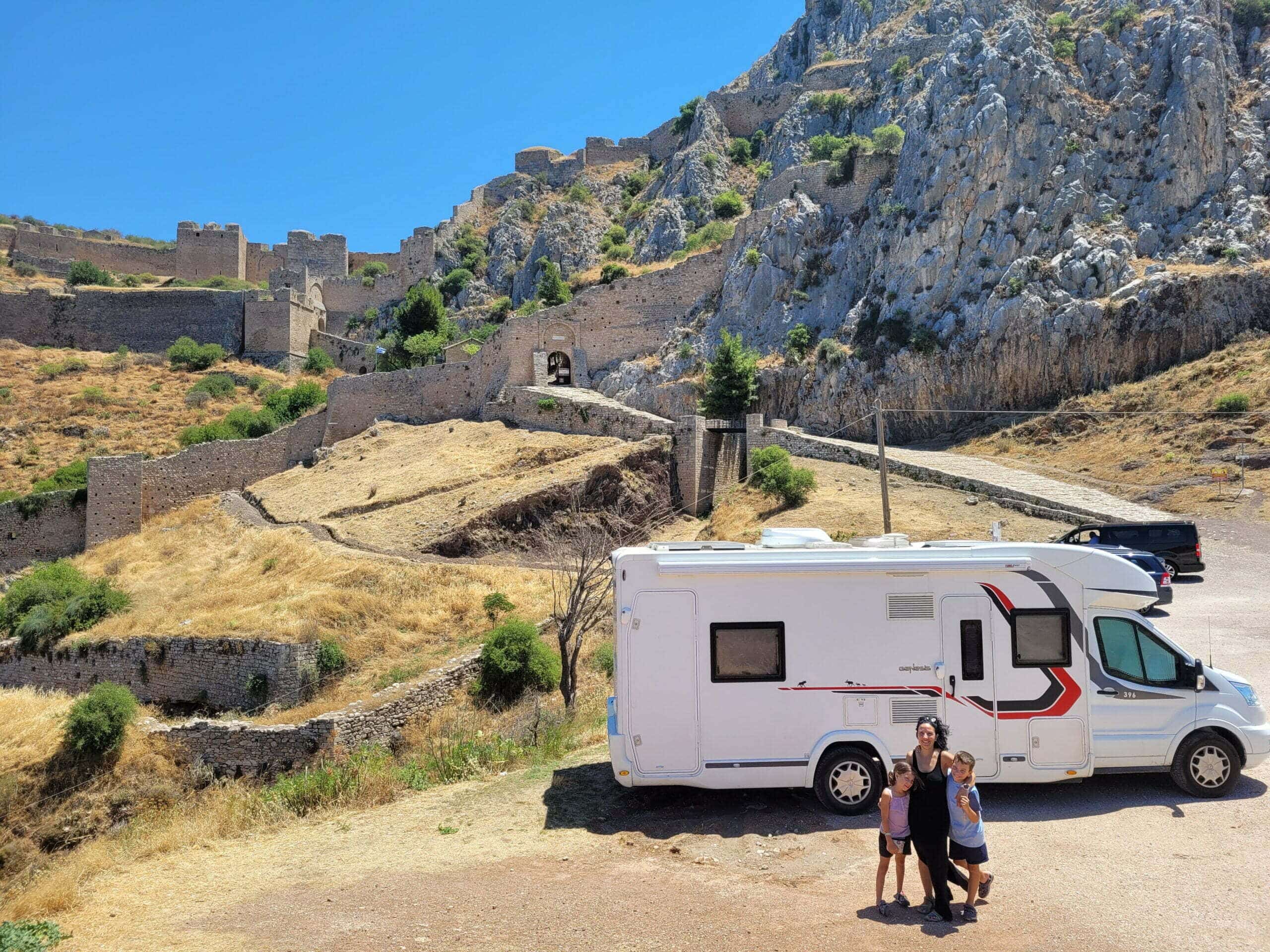
Definitive manual for traveling by motorhome【2026】
Super complete manual for traveling by motorhome with all the answers to your questions.
-

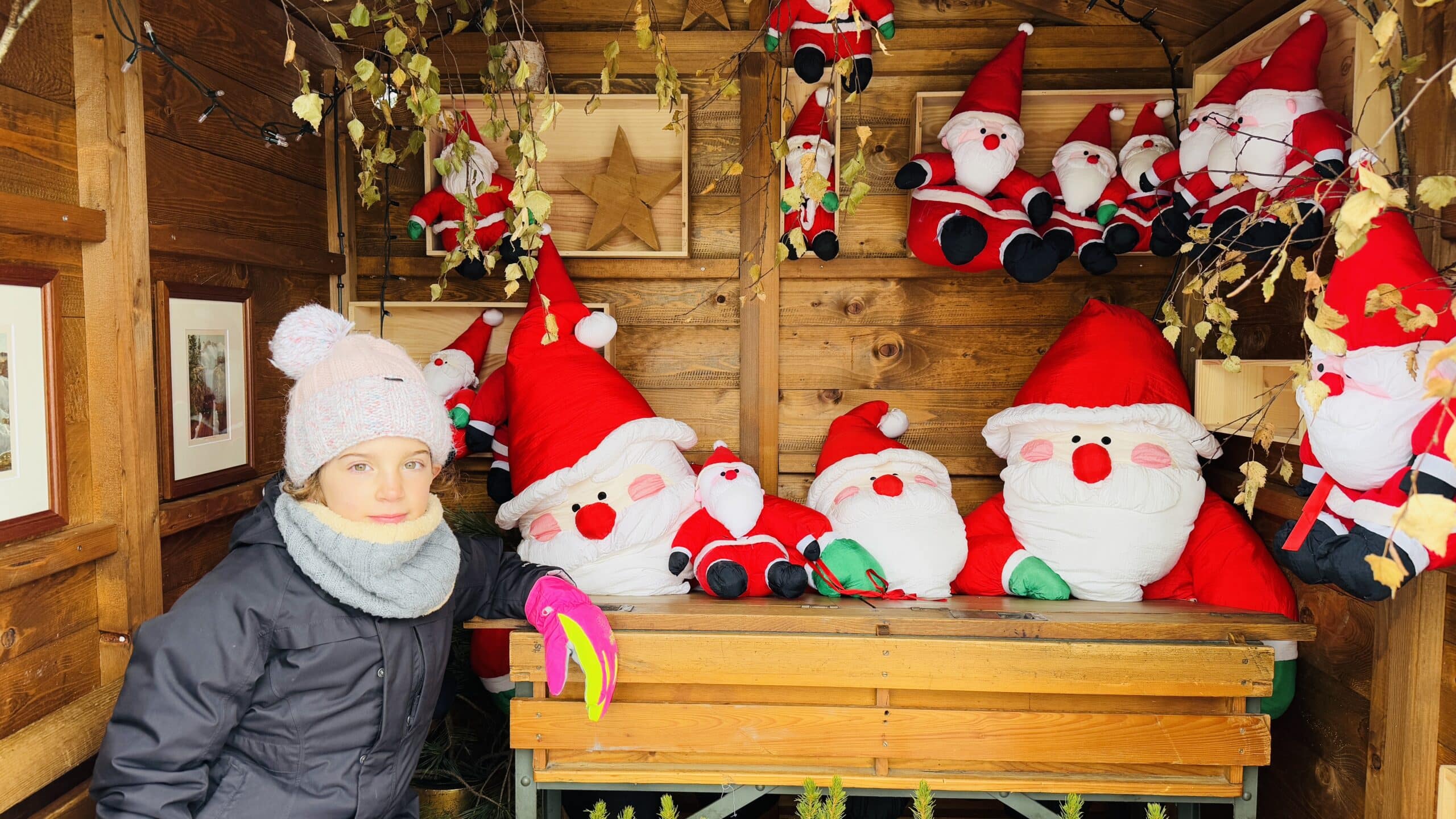
Switzerland at Christmas: our family adventure between lights, snow and hot chocolate
If you're thinking of spending a magical Christmas in a fairytale destination, Switzerland at Christmas should be on your list. This year we took the plunge (and skis) and set off to explore Switzerland at Christmas with the kids, a plan we knew couldn't fail. Spoiler alert: everything we…
-
Guide to traveling to Alsace at Christmas: costs, map, route, tips and the 20 essential plans
Enjoy our guide to travelling to Alsace at Christmas. With this post we want to share our experience and learnings at the destination and help you prepare your next trip to Alsace at Christmas on your own. We are Kucavana, a family with two children and two dogs who love to travel. And if you want…
-

Guide to traveling to Iceland by motorhome
Traveling to Iceland in a campervan is a dream. If you're looking for everything about traveling to Iceland by campervan, stay tuned to this article because we'll tell you everything! Iceland is a country that seems straight out of a fairy tale, with breathtaking landscapes, majestic waterfalls, imposing glaciers, and active volcanoes. For many travelers, exploring this unique island…
Ethical code:
On our blog you will find affiliate links. These are always placed with our highest ethics. We never publish any service or product that we have not used before and that we are sincerely happy with. That is why our recommendations are always ethical. In addition, there is no additional cost for you to book through our links and, on the other hand, it means a small commission for us that helps us maintain this blog so that you can continue enjoying it for free.