

Table of Contents
The Skeleton Coast is a Namibian national park located on the country's Atlantic coast, famous for its shipwrecks, desert lions, permanent fog, and landscapes where the ocean meets the Namib Desert.
If there is one place that can summarize the wildest essence of Namibia, it is probably the Skeleton Coast.
Here, the Atlantic Ocean , the dunes of the Namib Desert, and the fog generated by the cold Benguela Current create one of the most extreme and fascinating landscapes in Africa.
During our 4x4 route we crossed more than 200 kilometers of virtually uninhabited coastline, surrounded by dunes, ancient shipwrecks, salt tracks, huge windswept beaches and a feeling of isolation that is hard to find anywhere else in the world.
It was also one of the most amazing places on our entire trip. We crossed a huge dune that had trapped other travelers, observed a spectacular wild brown hyena , visited the remains of the South West Seal shipwreck , and discovered why this coast has been feared by sailors for centuries.
Namibia's Skeleton Coast is n't a destination for those seeking comfort or large tourist infrastructure. It's a place for those who enjoy unspoiled nature, remote landscapes, and 4x4 adventures.
If you're planning your trip, we recommend starting with our complete guide to traveling to Namibia , where you'll find all the trip planning, budgeting, safety, 4x4 rental, accommodations, and our complete 24-day itinerary for the country.
And if you're still planning your trip, you can also check out our guide to what to see in Namibia , where we've compiled all the must-see destinations we visited during our trip.

The Skeleton Coast at a glance, where the desert meets the ocean
| Information | Facts & figures |
| Official name | Skeleton Coast National Park |
| Location | Northwest coast of Namibia |
| Long Jump | More than 500 km |
| Recommended days | 1 full day |
| Best way to visit it | 4 × 4 |
| Featured fauna | Desert lions, brown hyena, jackals, and oryx |
| Mobile coverage | Virtually non-existent |
| Essentials Collections | South West Seal, coastal dunes and Atlantic landscapes |
| Great for kids | Yes, with planning. |
Our assessment: After doing a 24-day independent trip through Namibia, I can tell you that this is one of the wildest, most remote, and most spectacular places in all of Namibia.
What is the Skeleton Coast and why is it called that?
The Skeleton Coast is one of Africa's most famous, wild, and mysterious national parks. Located on Namibia's Atlantic coast, it stretches for over 500 kilometers between the Ugab River in the south and the Kunene River on the Angolan border, covering an area of over 16.000 km².
This territory is part of Skeleton Coast National Park , one of the most remote protected areas on the continent and one of the most fascinating places to visit during a trip to Namibia.
IMPORTANT TIP : Don't travel to Namibia without good travel insurance . Seriously. The distances there are enormous, private healthcare is expensive, and if something happens in the middle of a national park or in a remote area, helicopter evacuation can cost a fortune. After thoroughly comparing different options, we chose IATI Estrella , which is the only one with over one million euros of medical coverage—crucial in destinations where any unforeseen event can multiply the costs. IATI also offers 24/7 Spanish-language support and an app for online medical consultations, which was incredibly useful during our trip. Here's our link with a 5% discount on any IATI travel insurance policy. If you're going to Namibia, it's truly worth traveling with peace of mind.

Why is it called the Skeleton Coast?
The name Skeleton Coast originates from the numerous shipwrecks that were trapped for centuries on this inhospitable Atlantic coastline.
The combination of the cold Benguela current, the almost permanent fog, the strong ocean currents and an extremely dangerous ocean turned this coast into a real trap for sailors, fishermen and merchant ships.
Many ships managed to reach land after running aground.
The real problem begins later.
Before the survivors lay hundreds of kilometers of desert with virtually no water or human settlements, making any attempt to escape an almost impossible mission.
In addition to the remains of ships, the name is also related to the skeletons of whales, seals and other marine animals that used to appear scattered along the beaches of this coast.
Today most of those remains have disappeared, although some historical vestiges and emblematic shipwrecks such as the South West Seal , one of the region's best-known symbols, can still be found.
One of the most dangerous coastlines in the world
For centuries, the Skeleton Coast was considered one of the most feared places for sailors sailing along the African coast.
The fog could appear suddenly, reducing visibility to just a few meters, while the heavy swell and currents made navigation extremely difficult.
To make matters worse, once they reached the coast, the survivors found themselves trapped between the Atlantic Ocean and one of the driest deserts on the planet.
It is not surprising that some indigenous peoples came to refer to this region as:
"The land that God created in anger."
An expression that perfectly sums up the harshness and isolation of this landscape.
From hostile land to protected national park
Over time, diamond mining, fishing, and the first scientific expeditions began to make this region known to the rest of the world.
The ecological importance of its ecosystems eventually led to the creation of Skeleton Coast National Park in 1971, with the aim of protecting one of Africa's most unique natural spaces.
Today the park is a refuge for such emblematic species as desert lions , brown hyenas , desert-adapted elephants , black rhinoceroses , and numerous seabirds.
Despite its growing popularity among travelers, it remains one of the most remote, least altered, and wildest national parks on the entire African continent.

Where is the Skeleton Coast in Namibia?
The Skeleton Coast of Namibia occupies a large part of the Atlantic coastline of the northwest of the country, between the Damaraland regions and the border with Angola.
The national park is divided into two clearly differentiated sectors.
The southern area can be visited independently and is where the main points of interest accessible to travelers are located.
The northern area , much more remote and wild, remains restricted and can only be visited through special permits or organized expeditions.
We explored the southern area during our 4x4 route, entering from the Palmwag and Damaraland area and then continuing towards Dorob National Park and the coast near Henties Bay.
Within a route through Namibia, the Skeleton Coast is often combined with destinations such as Damaraland and Twyfelfontein , Cape Cross , Spitzkoppe , Swakopmund and the Namib-Naukluft National Park , forming one of the most spectacular stages of the entire trip.

Access to the Skeleton Coast
One of the most common questions when organizing a route through Namibia is understanding exactly which part of the Skeleton Coast can be visited independently.
The area is accessible to travelers.
The vast majority of travelers only visit the southern part of the park.
This is the area where they are located:
- Ugab Gate.
- Springbokwasser Gate.
- Torra Bay.
- South West Seal.
- The main points of interest accessible by private vehicle.
It was precisely the section that we crossed during our route.
The northern zone
Access is restricted beyond certain points.
It is one of the most remote regions in all of Africa and can only be visited through special permits or authorized expeditions.
It is also home to many of the famous desert lions.
Our recommendation
If you are traveling to Namibia for the first time, the southern region offers more than enough to understand the essence of the Skeleton Coast.
The landscapes, the wildlife, and the feeling of isolation are exactly the same as what have made this place famous worldwide.

Our 4x4 route along the Skeleton Coast: 200 kilometers of fog, sea and desert
The day began in Damaraland after visiting Twyfelfontein and sleeping surrounded by volcanic and desert landscapes. By seven in the morning, we were already packing up camp in temperatures barely 4 degrees Celsius. Luckily, with practice, taking down the rooftop tents only took us a few minutes. Something we could practically do with our eyes closed after our 24-day independent trip through Namibia .
That day we had a single objective: to cross the accessible part of the Skeleton Coast National Park and see if it really was as wild as all the guidebooks said.
Spoiler: it is.
By 8:40 we were already on our way. The temperature had risen to 11 degrees Celsius, but we were still driving with our jackets on. The first few kilometers were along well-maintained gravel tracks, although the constant changes in gradient made the road feel like a roller coaster.
In fact, one of the things that surprised us the most was precisely that.
The tracks are very well maintained, but it's not advisable to speed . Many of the crests are completely blind and could conceal another vehicle on the other side.
Halfway there we also had our little mechanical problem of the day.
Suddenly all the car's cigarette lighter sockets stopped working.
Without internet.
No coverage.
And without having any idea where the fuse was.
The solution would have to wait.

The entrance to the Skeleton Coast and the desert lions
After about three hours of driving we finally arrived at the park entrance at the Springbokwasser Gate access.
Here we pay the entrance fees and take the opportunity to read the information panels that explain the history of the Skeleton Coast, its fauna and the famous desert lions , probably the most emblematic animals of this region.
It was precisely there that we read a story that left us quite shocked.
A German tourist who was financially supporting lion conservation projects had died just a few weeks earlier in the northern part of the park. According to reports, he left his tent at night to relieve himself and was attacked.
It may seem like an extreme anecdote, but it helps to understand something very important about Namibia: In national parks, safety rules are not recommendations. They are life or death rules.
We carried a small container (a pot of hair mask) for the girls and a bottle for the boys in case it was essential not to leave the tent during the night.
It may sound exaggerated.
Until you understand where you are. And besides, hey, it's very comfortable too.
By the way, if you're interested in this topic, we highly recommend the National Geographic documentary about desert lions ; it's a real marvel.

The dune that almost put us to the test
Shortly after leaving the entrance and reception where we paid the park fees, our first moment of tension arrived.
Before reaching the coast we found a huge dune that had completely invaded the track.
And right in front, a group of South Africans completely stuck.
We stopped to try to help.
We were already preparing the tow strap and considering lowering the tire pressure when a professional safari guide appeared with his 4x4.

What he did next put our minds at ease.
He crossed the dune without any problem.
He kicked out the South Africans.
And he waited to see if we could get through too.
His advice was simple:
Don't stop. Don't hesitate. Maintain a constant speed, as fast as you can within the smallest space you can manage.
And it worked.
That was our first big dune in the Atlantic desert and one of those moments when you realize that all the hours spent driving through sand during the trip are starting to pay off.
When we saw the car on the other side we felt enormous relief.
200 kilometers from absolute nowhere
Once we reached the coast, the landscape changed completely.
The dunes disappeared.
The road was transformed into a track of compacted salt.
And so began one of the strangest experiences of the entire trip.
For more than 200 kilometers we traveled between the Atlantic Ocean and the desert.
Sometimes the sea was just a few meters away.
Others we could barely see because of the fog and distance.
We only made three stops on the entire trip.
Because there's really nothing here.
Nothing but sea, wind, fog and desert.
Mobile coverage disappeared completely.
We had rented a satellite phone along with the 4x4 specifically for this leg of the journey. We probably could have managed without it, as we occasionally passed other vehicles, but the peace of mind it provided in such a remote area seemed more than worth it.
It was also here that we discovered that one of the park's most curious animals is the so-called silver lizard , an endangered species capable of remaining buried under the sand for hours to protect itself from the extreme conditions of the desert.
The Skeleton Coast is exactly that: sea, fog, and wind.
And that's precisely why it's so fascinating.

Three stops we'll never forget
During the entire trip along the Skeleton Coast, we only made three important stops.
It may seem like little for a whole day, but when you find yourself surrounded by hundreds of kilometers of desert, ocean and fog, you quickly understand that here the true protagonist is the landscape itself.

First stop: the Atlantic Ocean in its wild state
Our first stop was by the sea.
Or at least as close as the fog allowed.
The Atlantic roared with awe-inspiring force. Waves crashed violently against the shore as the wind blew relentlessly. It was probably the first time during the trip that we truly understood why this place was called the Skeleton Coast.
It wasn't hard to imagine ships struggling against that combination of fog, currents, and waves, only to end up running aground on a completely inhospitable coast.
That stop also coincided with a former diamond mining area.
Few people know that Namibia produces some of the highest quality diamonds in the world thanks to their extraordinary purity and natural brilliance.
For decades, diamonds were found mixed in with the sands of this coast. Today, virtually all accessible deposits have disappeared, and extraction is carried out mainly offshore using specialized vessels and underwater diving operations, although precious stones are still found in some areas.
As we gazed at that raging ocean and the wind whipped against our faces, it was hard to believe that beneath those same waters lay one of the country's greatest natural treasures.

Second stop: an unexpected brown hyena in the middle of nowhere
The second stop was probably the most exciting of the whole day.
We stopped next to an old, completely abandoned oil extraction structure . The place already had a post-apocalyptic feel, with the ocean in the background, the wind blowing constantly, and miles of desert stretching in every direction.
When we got out of the car we saw some footprints.
Our first thought was:
—Are they lion skin?
After all, we were in the territory of the famous desert lions.
But no.
A few seconds later the person responsible appeared.

A huge brown hyena practically walked right past us.
I admit that the size was much more imposing than we imagined.
Those of us who were outside the car quickly went back inside while watching the animal move calmly through the landscape.
The scene had something surreal about it.
There we were, in the middle of one of the most remote places in Africa, observing a species that is extremely difficult to see.
The brown hyena is considered a vulnerable species and is one of the most iconic animals of the Skeleton Coast. In fact, upon leaving the park, we were told that any sightings should be reported to the rangers to help with wildlife monitoring programs.
Looking back, it was probably one of the most unexpected wildlife encounters of the entire trip.

Third stop: the South West Seal shipwreck
The last stop of the day was to visit one of the most well-known symbols of the Skeleton Coast.
The South West Seal shipwreck.
This ship ran aground approximately forty years ago and today perfectly represents the constant struggle between the ocean and everything that tries to remain on this coast.
What surprised us most was seeing how much it had changed compared to the historical photographs on the information panel.
The sea has gradually reclaimed the structure and currently only a small part remains visible.
Even so, contemplating it there, surrounded by fog and ocean, is impressive.
It is one of those places that helps to better understand the history of the Skeleton Coast and the reason why so many ships ended their days here.

From the Skeleton Coast to Dorob National Park
After our last stop, we left the national park to enter another, much less well-known protected area: Dorob National Park.
The funny thing is that many people don't even know they're going through it.
Unlike the Skeleton Coast, there is no proper entrance gate here, nor is it necessary to pay special fees or permits, even though it is also a Namibian national park.
The landscape remains virtually the same.
Kilometers and kilometers of desert plains, salt flats, ocean and compacted salt tracks.
The big difference is that we started to find a bit more human activity.
Mainly fishermen.
Many fishermen.
For several kilometers we continually crossed paths with 4x4 vehicles equipped with enormous fishing rods that traveled along the coast looking for the best spots to cast their lines into the Atlantic.

Our night at Mile 108 Campsite
Late in the afternoon we finally arrived at our accommodation.
The Mile 108 Campsite , managed by NWR (Namibia Wildlife Resorts).
And the truth is that it was a very positive surprise.
Each plot had its own sheltered space, a private bathroom, and a small building with a spacious private bathroom that served as a refuge. Everything was practically new and very well maintained.
That night we only shared the campsite with a small group of young South African fishermen next door.
Otherwise, the place seemed completely empty.
After setting up camp, we took advantage of the Wi-Fi to finally solve the mystery of the fuse that had left the car sockets without power all day.
Problem solved.
It was time to rest.
We took a short walk along the sea, played with the friendly campsite dog, enjoyed a spectacular sunset over the Atlantic and got ready to spend the night.
Although sleep might not be the most appropriate word.
The wind began to blow with impressive force.
At several points we wondered if the tent would hold until the next morning or if we would end up taking refuge in the small building on the plot.
Luckily it held up perfectly.
And today that wild windy night is part of the funniest memories of our adventure along the Skeleton Coast, before heading off to our next adventure in Cape Cross the following day.

How to visit the Skeleton Coast independently
Although many people think that Namibia's Skeleton Coast can only be visited through organized tours, the reality is that there is a perfectly accessible stretch for those traveling independently in 4x4 vehicles.
The southern part of the park can be explored without a guide, always respecting the authorized trails and conservation rules.
Important rules you should know
- Bringing drones into the country is prohibited.
- Plastic bags are not allowed.
- Driving outside the marked trails is not permitted.
- Camping is not allowed outside of authorized areas.
- Registration at the entrance gates is mandatory.
During our journey we found several checkpoints where these rules are taken very seriously, especially those related to environmental conservation.
Do you need a 4x4?
Yes.
Although most of the tracks are in very good condition, there are areas where the sand completely covers the path.
We experienced a rather illustrative situation.
Shortly after entering the park, we encountered a huge dune blocking the track. Right in front of it was a South African vehicle completely stuck.
IMPORTANT TIP: If you're traveling to Namibia, rent a 4x4 with a rooftop tent; it's undoubtedly the best option for independent travel. Asco Car, with whom we rented without any issues and highly recommend, has given us a 5% discount that you can all use by booking with them on their website and adding the discount code @KUCAVANA.
While we were preparing the tow strap and even considering lowering the tire pressure, a professional guide appeared with his 4x4, crossed the dune without difficulty and helped to get the stuck vehicle out.
Then he told us how we should deal with it.
Don't stop.
Maintain constant speed.
And trust.
It worked.
That was our first big Atlantic dune and one of those moments when you are extremely grateful to have gained experience during the trip.
What to see on the Skeleton Coast in 1 day
Most travelers arrive expecting to find a national park full of animals.
The reality is very different.
The magic of the Skeleton Coast lies in its landscapes, its history, and the constant feeling of being in one of the most isolated places on the planet.
Namibia's wildest Atlantic Ocean
Our first stop was by the sea.
Or at least relatively close.
The fog was so thick that we could barely make out the ocean clearly until we were practically on top of it.
When we finally arrived, we fully understood why so many ships ended up wrecked here.
The waves crashed against the coast as the wind blew steadily from the Atlantic.
It was one of those places where nature conveys a sense of power that is difficult to explain.
Dunes invading the roads
One of the most striking landscapes in the park is the enormous dunes that slowly advance towards the ocean.
Some even completely cover the runways.
Watching the desert gradually reclaim land from the sea is an image you'll hardly forget.
The old diamond mines
During the tour we also found old facilities related to diamond mining.
Namibia produces some of the highest quality diamonds in the world, and much of this wealth comes precisely from the Atlantic coast.
Currently, extraction continues offshore using specialized platforms and ships.
A landscape that looks like another planet
For over 200 kilometers we traveled practically without crossing paths with anyone.
Sea only.
Just fog.
Just desert.
And a constant feeling of being in one of the last truly wild places in Africa.
Our recommended 1-day Skeleton Coast route
| Place | recommended time | Essential |
| Park entrance | 20 min | ⭐⭐⭐ |
| Atlantic dunes | 15 min | ⭐⭐⭐⭐ |
| Coast and former diamond mining area | 30 min | ⭐⭐⭐⭐ |
| Oil platform and wildlife | 20 min | ⭐⭐⭐⭐⭐ |
| South West Seal shipwreck | 20 min | ⭐⭐⭐ |
| Scenic tour along the Atlantic | Variable | ⭐⭐⭐⭐⭐ |
| Exit towards Dorob National Park | ⭐⭐⭐⭐ |
Our favorite stop
Although many people visit the Skeleton Coast for its shipwrecks, our favorite stop was undoubtedly the old industrial platform where we had the unexpected encounter with a huge brown hyena , one of the most difficult animals to spot in Namibia.
The most impressive thing
However, the most intense memory we take away was not a specific place.
It was driving for hours between the Atlantic Ocean, the fog and the desert without hardly crossing paths with anyone.

Map of the Skeleton Coast
One of the most frequent questions when preparing a trip is understanding exactly where the Skeleton Coast begins and ends.
The national park covers more than 500 kilometers of Atlantic coastline between the Ugab River and the Kunene River, on the border with Angola.
The main areas of the Skeleton Coast
| Area | Access |
| Southern Sector (Ugab – Springbokwasser) | Free with admission |
| Torra Bay | Accessible |
| South West Seal | Accessible |
| Terrace Bay | Accessible with reservation |
| Northern Sector | Special permit required |
Our tour
We explored the southern part of the park, the only area accessible independently for most travelers.
The route began at the entrance to Torra Bay and continued parallel to the Atlantic Ocean until connecting with Dorob National Park , where we would spend the night at Mile 108 Campsite.
Practical tip
Always download offline maps before entering.
Mobile coverage is virtually nonexistent for much of the route, and relying exclusively on Google Maps is not a good idea.

From the Skeleton Coast to Cape Cross
One of the great successes of our route was combining the Skeleton Coast , Dorob National Park and Cape Cross on consecutive days.
Although they are part of the same Atlantic coast, they offer completely different experiences.
What each place offers
| Destination | Best |
| Skeleton Coast | Wild landscapes and adventure |
| Dorob National Park | Atlantic coast and fishing |
| Cape Cross | Africa's largest seal colony |
After sleeping at Mile 108 Campsite , the next day we headed towards Cape Cross , home to the largest colony of seals on the African coast.
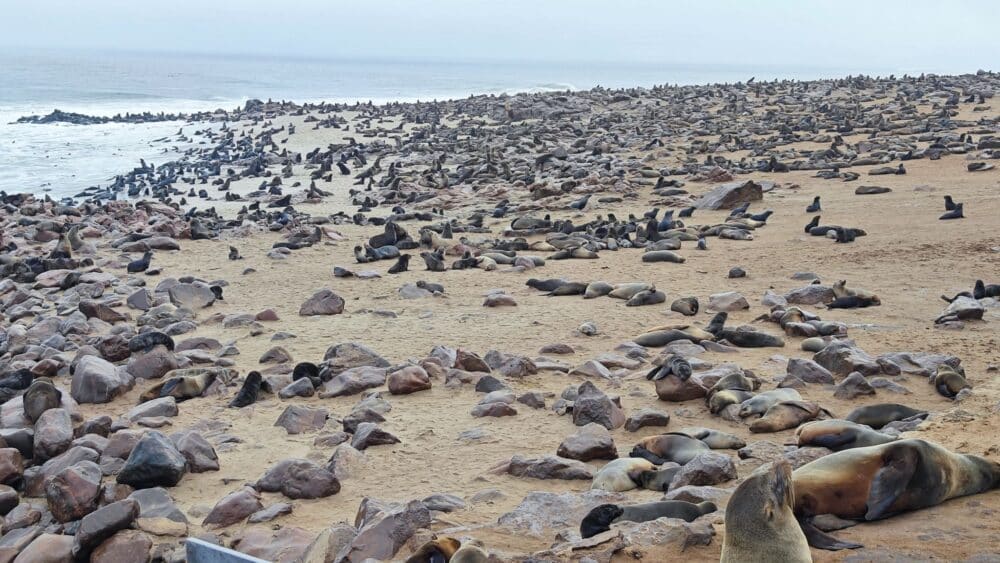
Depending on the time of year, between 100.000 and more than 200.000 seals can congregate , creating one of Namibia's most impressive natural spectacles.
Besides seals, the area also attracts:
- Black-backed jackals.
- Brown hyenas.
- Numerous seabirds.
- Large concentrations of sport fishermen.
That's why we believe the Skeleton Coast + Cape Cross combination is one of the most complete stages of any Namibian route.
To sleep we ended up in Spitzkoppe after visiting Cape Cross.

The shipwrecks of the Skeleton Coast
When someone hears about Namibia's Skeleton Coast , they usually imagine abandoned ships emerging from the fog, the ocean, and the desert dunes.
It's not by chance.
Shipwrecks are part of the history and identity of this corner of Africa, to the point of having contributed to giving it its name.
Why were there so many shipwrecks on the Skeleton Coast?
For centuries this coast was a real nightmare for sailors.
The combination of the cold Benguela current , the dense banks of fog that appear suddenly, the strong Atlantic swell and the absence of natural harbors turned this coastline into a real trap for merchant ships, whalers and fishing boats.
Many managed to survive the shipwreck.
The real problem came later.
Before them lay hundreds of kilometers of desert with virtually no water or human settlements. For many sailors, the coast was only the beginning of an even greater tragedy.
That is why the Skeleton Coast became one of the most feared places for sailors traveling along the African coast.

The South West Seal, the park's most famous shipwreck
Currently, the most famous and accessible shipwreck in the area is the South West Seal , a fishing vessel that ran aground approximately four decades ago.
We made a specific stop to visit it during our route along the Skeleton Coast.
However, we must admit that it surprised us quite a bit.
And not precisely because of its size.
Comparing the current state with the historical photographs displayed on the information panels, it is clear that the ocean has gradually reclaimed the structure. Today, only a small part of the ship remains visible.
Even so, it remains an interesting visit because it helps to better understand the maritime history of this coast and the enormous power of the Atlantic in this region of Namibia.
The current reality of shipwrecks on the Skeleton Coast
If you visit the Skeleton Coast expecting to find numerous abandoned ships scattered along the coast, it's best to adjust your expectations a bit.
Most of the historical shipwrecks have disappeared, are located in inaccessible areas, or have been practically swallowed by the sea.
In fact, throughout our entire journey we barely saw any spectacular remains of ships.
What is truly impressive here is not so much the visible shipwrecks as the landscape that caused them: the raging ocean, the constant fog, the wind, and the immensity of a coastline where nature continues to impose its rules.
The best shipwreck of this stage can be found in Dorob National Park
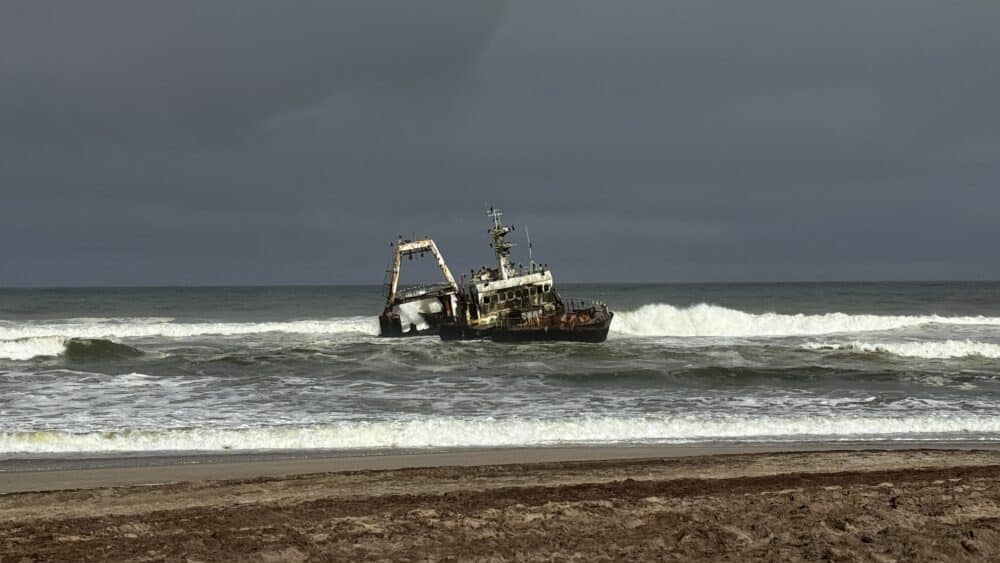
Interestingly, the shipwreck that impressed us the most during this part of the trip was not located within the Skeleton Coast itself.
It would be a few hours later, while exploring the coast of Dorob National Park , that we would discover a much more photogenic and better preserved shipwreck.
One of those abandoned ships that perfectly fits the image we all have in mind when we think of the great shipwrecks of Namibia.
So, if your main goal is to photograph shipwrecks, don't limit yourself to just the Skeleton Coast. The areas around Henties Bay , Cape Cross , and Dorob National Park also hold some very interesting surprises.
Our opinion on the shipwrecks of the Skeleton Coast
After visiting it, we believe that the fame of the Skeleton Coast is not solely due to the sunken ships.
Its true appeal lies in the whole.
The fog that suddenly appears, the endless beaches, the ocean roaring without rest, the feeling of absolute isolation and the history of all those ships that never managed to escape from this coastline make the visit a unique experience.
Because in reality, more than seeing shipwrecks, what you do here is understand why they happened.

Animals of the Skeleton Coast: what wildlife can you see
Although most travelers visit the region for its landscapes, the fauna adapted to this extreme environment is truly fascinating.
Most common animals
| Animal | Probability |
| Black-backed jackal | High |
| Oryx | Media |
| Sea birds | High |
| Brown hyena | Low |
| Desert Lion | Very low |
| Silver lizard | Very low |
| Phocas | High near Cape Cross |
Our best sighting: the brown hyena
It was undoubtedly the brown hyena.
It appeared completely unexpectedly next to an old abandoned industrial structure and ended up becoming one of the most exciting moments of our entire trip through Namibia.
Although many people associate the Skeleton Coast only with desert landscapes and shipwrecks, the reality is that it is home to a surprisingly rich fauna adapted to extreme conditions.
Our encounter with a brown hyena
Without a doubt, the most unexpected sighting of the entire day was a huge brown hyena.
We found it next to an old abandoned industrial structure while exploring one of the stops on the route.
At first we saw some footprints and thought they might belong to a lion.
The surprise came a few seconds later.
An impressive hyena appeared, walking calmly a few meters away from us.
I admit that the size was much more imposing than we imagined.
Furthermore, it is a vulnerable and relatively difficult species to observe, so that encounter ended up becoming one of the most special memories of our entire visit to the Skeleton Coast.
The mysterious silver lizard
Another of the most curious inhabitants of this region is the so-called Namib silver lizard , a species perfectly adapted to life among the coastal dunes.
It is able to bury itself under the sand to protect itself from extreme temperatures and can spend long hours hidden beneath the surface.
We didn't get to see it, but knowing that it lives under those dunes made the landscape even more fascinating.

The most difficult animal to see: The desert lions of the Skeleton Coast
If there is one animal that has helped make Namibia's Skeleton Coast famous , it is undoubtedly the desert lion.
Although many people think that lions only live in savanna areas with abundant water and vegetation, in Namibia there is a unique population capable of surviving in some of the most hostile environments on the planet.
These lions mainly inhabit the most remote regions of the northern Skeleton Coast and parts of the Kunene territories, where they travel enormous distances in search of food and water.
His adaptation is extraordinary.
They can survive long periods without drinking directly and have developed very different behaviors from other African populations.
During our visit we were not lucky enough to see any, which is completely normal considering the vastness of the territory they occupy.
However, the information panels at the park entrance perfectly explain their history and the importance of the conservation programs that try to protect them.
If you're interested in this topic, we highly recommend the National Geographic documentary about desert lions , a true marvel that helps you understand how they manage to survive in such extreme conditions.
A rule you should never ignore
Precisely because of the presence of large predators, safety regulations in Namibia are especially strict.
During our visit we learned of the case of a tourist who had died a few weeks earlier after leaving his tent at night in a remote area in the north of the park.
It may seem like an exceptional situation, but it serves as a reminder of something fundamental:
In Namibia's national parks, you should never leave your tent or vehicle in unauthorized areas, especially at night.

Tips for visiting the Skeleton Coast independently
After touring the Skeleton Coast in a 4x4, these are the tips we believe are most important for any traveler.
Don't expect to find mobile coverage
For most of the journey we had absolutely no coverage.
We had a rented satellite phone with us, and although we probably didn't end up needing it, it gave us a lot of peace of mind.
For us, the best option is Holafly, which offers unlimited data to keep your social media updated and stay in touch with family and friends. It's undoubtedly the best option for price and data allowance . However, keep in mind that this option requires a latest-generation mobile phone that supports eSIMs.
If you don't have a state-of-the-art mobile phone, you may have problems, although we have found a solution to make e-sims work without having a state-of-the-art mobile phone like us: install an e-sim.me first.
You buy it online and the physical SIM card arrives at home and with its app you can now make the e-sim work by downloading it there. It makes the virtual card work for you without a problem, we have verified it on our trip. Read the QR that Holafly sends you in the app and you already have the e-sim installed and working on your mobile that is not the latest generation. And if it is of the latest generation, less hassle and it works super easily for you.
Finally, here's a 5% discount on your Holafly card that we've been given. Click the link below and enter the code Kucavana to get the discount. Using this link not only saves you money, but it also helps us maintain our blog with a small commission. And remember, we don't recommend anything we don't use ourselves, and we always recommend the best after extensive comparison and testing—it's our ethical code and our commitment to you.
Don't bring drones
As in other Namibian national parks, drones are prohibited.
The penalties can be significant and the regulations are enforced quite rigorously.
Do not bring plastic bags
At the park entrances, the entry of plastic bags is also controlled to minimize environmental impact.
Drive carefully on changes in gradient
The tracks are in very good condition, but there are many changes in gradient that prevent you from seeing what's on the other side.
Even if it feels like you're driving completely alone, it's advisable to moderate your speed.
Bring enough fuel, water, and food.
There are practically no services inside the park.
Before entering, make sure you have plenty of fuel, plenty of water, and everything you need to deal with any unforeseen circumstances.
Don't underestimate the cold
Many travelers associate Namibia with extreme heat.
However, we crossed the Skeleton Coast with temperatures of only 4 degrees in the morning, accompanied by constant wind and fog.
A good jacket can be just as important here as sunscreen.

Skeleton Coast or Dorob National Park: what are the differences?
Many travelers visit both parks on the same day without realizing that they are crossing two different protected areas.
We did it too.
After leaving the Skeleton Coast, we continued our route through Dorob National Park , a huge coastal national park located further south.
Although at first glance the landscapes appear similar, there are some important differences.
| Skeleton Coast | Dorob National Park |
| Access fee required | Free access |
| More remote and wild | More accessible |
| Less human presence | More fishermen and activity |
| History of shipwrecks | most touristic coast |
| Desert Lions | Nearby seal colonies |
During our journey, the feeling of isolation was much greater on the Skeleton Coast.
However, Dorob surprised us with some very interesting places to visit the next day, especially the famous Cape Cross seal colony and some shipwrecks that were much more photogenic than those we had found within Skeleton Coast.
Therefore, if you have the time, our recommendation is clear:
Don't choose between one or the other. Explore both.
They form one of the most spectacular coastal stretches in all of Namibia.
Is the Skeleton Coast worth visiting?
If you're expecting to find large concentrations of animals like in Etosha National Park , probably not.
If you're looking for pretty villages, you won't find them there either.
And if your goal is solely shipwrecks, there are other places in Namibia where the remains of ships are even more spectacular.
So why is it so worthwhile?
Because the Skeleton Coast offers something that very few places still have today:
A real sense of adventure
For hours we drove along remote tracks with no mobile coverage, crossing dunes, fog and landscapes where there were hardly any signs of civilization.
And that's precisely why it remains one of the essential places that we would include in any itinerary of what to see in Namibia.
Nature in its purest form
Here, nature still sets the rules.
The wind, the ocean, and the desert completely dominate the territory.
Unique landscapes
We found no other place in Namibia that conveyed the same mix of beauty, harshness, and isolation.
A different experience
Precisely because it is different from Etosha, Sossusvlei or Spitzkoppe.
The Skeleton Coast doesn't compete with them.
They complement each other.
Therefore, after traveling through Namibia for 24 days, we can say that it remains one of the places we remember most intensely and one of the wildest landscapes we have visited in Africa.

Skeleton Coast with children: our family experience
One of the questions we were asked most often when we explained this stage of the trip was whether the Skeleton Coast is worth visiting with children.
Our answer is yes.
But with nuances.
It is not a destination designed for playgrounds, organized activities, or guaranteed animal sightings every few kilometers.
What it offers is something different.
Adventure.
Throughout the day our children were attentive to every detail: the enormous dunes invading the road, the search for animal tracks, the ocean roaring through the fog, the brown hyena that suddenly appeared, or the remains of the South West Seal.
For them it was like walking through an explorer's landscape.
What our children liked the most
- Crossing the sand dune in a 4x4 that got in our way on the salt road
- Looking for animals in the middle of the desert.
- Discover the history of shipwrecks.
- Sleeping next to the Atlantic Ocean.
- Playing on the beach completely alone.
- Make friends with the dog at Mile 108 campsite.
- I saw a brown hyena very close up; it was very large and curious as it walked.
What you should keep in mind
The Skeleton Coast is a very remote area.
Therefore, we recommend:
- Bring plenty of water.
- Bring food for the whole day.
- To have entertainment for long journeys.
- Explain the safety rules to the children beforehand.
- Avoid walking far from the vehicle in isolated areas.
For families used to traveling independently, we believe it is one of the most memorable stages of Namibia.
If you're planning a family trip, we also recommend reading our complete guide to Namibia with children , where we explain all the practical details we learned while traveling the country with our kids.

Where to sleep on the Skeleton Coast
Accommodation options in and around the Skeleton Coast are quite limited due to the protected and remote nature of the area.
It is precisely this lack of infrastructure that is one of the reasons why the place retains much of its authenticity.
Terrace Bay
It is the most well-known accommodation within Skeleton Coast National Park.
It has rooms, a restaurant and some basic services for travelers exploring the region.
For many years it was practically the only option for sleeping inside the park and now it is open but very few days a year; when we went it was closed at the end of June and beginning of July.
Torra Bay
The Torra Bay campsite is only open during certain times of the year and requires advance planning.
It's a popular choice for anglers and travelers seeking an extremely secluded experience. Another option that wasn't open when we visited.
Our experience at Mile 108 Campsite
We opted for a different alternative.
After crossing the Skeleton Coast we continued to Dorob National Park , where we spent the night at Mile 108 Campsite.
And it was a complete success.
The plots included:
- Private bathroom.
- Area sheltered from the wind.
- Space for camping.
- Direct access to the ocean.
In addition, we practically had the campsite to ourselves.
We only share facilities with some young South African fishermen.
The sunset over the Atlantic and the feeling of isolation made it one of the most special nights of the trip.

Conservation and threats to the Skeleton Coast
Although today the Skeleton Coast of Namibia is one of the most important protected areas in Africa, conserving such a huge and remote territory is not easy.
The park was officially declared in 1971 and currently protects more than 16.000 km² of unique ecosystems where ocean, desert and fauna adapted to extreme conditions coexist.
However, the conservation of this region continues to face several challenges.
Off-road driving
One of the main problems is driving outside of authorized lanes.
At first glance, it may seem that a wheel on the sand does not leave a permanent mark.
The reality is very different.
In some areas of the desert, the marks can remain visible for decades and affect small, extremely fragile ecosystems.
That is why Namibian authorities are especially strict with this rule.
Mining pressure
Namibia possesses significant mineral resources, especially diamonds.
Although much of the current extraction takes place offshore, the coexistence between conservation and exploitation of resources remains one of the region's major challenges.
Protection of unique species
The Skeleton Coast is one of the last refuges for such emblematic species as:
- Desert lions.
- Brown hyena.
- Black rhinoceros.
- Elephants adapted to the desert.
- Namib silver lizard.
The survival of many of them depends directly on keeping these ecosystems intact.

Interesting facts about the Skeleton Coast that you may not know
After visiting it, we discovered several facts that we found particularly surprising.
Fog generates more water than rain.
Many species survive thanks to the moisture provided by the fog from the Atlantic Ocean.
In some areas it rains so little that fog is practically the main source of water.
There are animals that never drink directly.
Some species obtain all the moisture they need from food or from condensation produced by fog.
An extraordinary adaptation to survive in one of the driest environments on the planet.
The diamonds arrived carried by rivers
Most of Namibia's diamonds originated hundreds of kilometers inland and were transported for millions of years by the Orange River to the Atlantic Ocean.
Ocean currents subsequently redistributed them along the coast.
The Skeleton Coast inspired numerous documentaries
The combination of extreme landscapes and desert-adapted wildlife has made this region a regular setting for documentaries by National Geographic, BBC and other major nature producers.
It can be cold even in the middle of the desert.
One of the most common mistakes is thinking that Namibia is always synonymous with heat.
During our visit we started the day with barely 4 °C, accompanied by fog and constant wind.
A warm jacket was just as important as sunscreen.
You can discover more interesting facts about Namibia in our guide to the best interesting facts about Namibia.

Is the Skeleton Coast dangerous?
The fame of Namibia's Skeleton Coast has generated all sorts of stories about shipwrecks, missing sailors, and wild animals for years.
Is it really a dangerous place?
The short answer is no.
At least no more so than any other remote destination if you travel with common sense.
The main real risks
During our visit, the most obvious risks were:
- Isolation.
- The lack of mobile coverage.
- Long journeys without services.
- Weather conditions are changeable.
- Driving on sand in some sections.
That's why we recommend always carrying enough fuel, water, food, and checking the condition of your vehicle before entering the park.
And the animals?
Although the Skeleton Coast is home to such impressive species as desert lions or brown hyenas , the vast majority of travelers will have no problem.
However, it is always advisable to respect the rules of the national parks.
In Namibia, signs are not just for decoration.
If an area indicates that you should not walk or leave your vehicle, it is best to do exactly that.
Our feeling
At no point did we feel unsafe.
What we did feel constantly was respect.
Respect for nature, for distances, and for an environment where help can take a long time to arrive.
For more information, you can consult our guide on Is it safe to travel to Namibia?

The fog of the Skeleton Coast: the true protagonist
When we think of the Skeleton Coast, we usually imagine sunken ships, dunes, or animals adapted to the desert.
However, after visiting it, we believe that the true protagonist of the landscape is something else.
The fog.
The meeting between the Atlantic and the desert
The cold Benguela current cools the air coming from the Atlantic Ocean and generates dense banks of fog that can appear at virtually any time.
For much of our route we could barely make out the sea even though it was only a few hundred meters away.
It was a strange feeling.
We knew the ocean was there.
We heard it roaring constantly.
But many times we could barely see it.
The secret of life in the desert
The most surprising thing is that this fog allows numerous animal and plant species to survive.
Many plants, insects, and reptiles obtain some of the moisture they need thanks to the condensation produced by these coastal mists.
Therefore, although the landscape may seem completely hostile, the Skeleton Coast harbors much more life than meets the eye.
A unique atmosphere
The fog is also responsible for much of the mystery surrounding this coast.
Without her, the Skeleton Coast would probably be impressive.
With her, it becomes an unforgettable place.
The best photographs you can take on the Skeleton Coast
For those who enjoy travel photography, the Skeleton Coast is one of the most special places in Namibia.
Not because of the number of animals or specific monuments.
But through the atmosphere.
Minimalist landscapes
The vast empty expanses, the salt ski slopes and the almost total absence of human constructions allow for images very different from those of the rest of the country.
The contrast between sea and desert
Few places in the world offer such a spectacular meeting between ocean and dunes, although they are very low, there are no high dunes here.
Especially when the fog begins to lift and reveals the coastline.
The abandoned industrial remains
The old mining facilities, oil structures and remnants of human activity give the landscape an almost post-apocalyptic feel.
It was precisely next to one of these structures where we experienced the unexpected encounter with the enormous brown hyena that we saw during our route.
Sunrises and sunsets
If you spend the night on the coast, don't miss these moments.
We enjoyed an unforgettable sunset at Mile 108 Campsite and a following morning shrouded in fog and wind that seemed like it was from another planet.
It is these images that keep coming to mind when we think of the Skeleton Coast.

What's it like to drive along the Skeleton Coast?
One of the big questions before visiting Namibia's Skeleton Coast is what the roads are really like and whether it's difficult to drive in this area.
After exploring it independently in a 4x4, our conclusion is clear:
It's not a technically difficult driving style, but it does require constant attention.
Tracks in very good condition
Something that surprised us quite a bit was the excellent maintenance of many of the tracks.
For much of the journey we saw machinery working and preparing the road.
In fact, the tracks are often in better condition than many secondary roads in other African countries.
Sand and dunes
In some places the dunes partially encroach on the road.
We found a huge sandbar where several travelers had gotten stuck.
It was precisely there where we experienced one of the funniest situations of the entire trip and where we verified the importance of staying calm and trusting the vehicle.
For more information on driving in Namibia, consult our guide on everything you need to know to do Namibia in a 4x4.

Fishing in the Skeleton Coast and Dorob National Park
Something that caught our attention during this stage was the enormous passion for fishing that exists on the Atlantic coast of Namibia.
While crossing the Skeleton Coast, we barely encountered any vehicles.
However, upon entering Dorob National Park, the situation changed completely.
The kings of the coast
Suddenly, 4x4s started appearing everywhere.
The vast majority belonged to fishermen.
Many carried enormous fishing rods several meters long, attached to external supports, and traveled kilometers along the coast looking for the best spots to fish from the beach.
A paradise for sport fishing
The cold waters of the Atlantic attract numerous species and make this region one of the most popular destinations in southern Africa for shore fishing.
It is not uncommon to find fishermen traveling hundreds of kilometers to spend several days camping by the sea.
Our experience
We didn't fish, but during our stay at Mile 108 Campsite we shared facilities with several groups of South African fishermen.
Seeing their vehicles prepared to spend entire days by the ocean was almost as interesting as the coastal landscapes themselves.
One of the most isolated places in Africa
If anything defines the Skeleton Coast , it's the feeling of isolation.
Even after having traveled through other remote regions of Namibia, here we perceived something different.
No mobile coverage
For most of the journey we had no phone signal.
No data.
No calls.
Nothing.
That's why we decided to rent a satellite phone along with the 4x4 for this part of the trip.
Hundreds of kilometers without services
Once inside the park, you can travel enormous distances without finding gas stations, shops, or any kind of infrastructure.
This is one of the reasons why it's a good idea to plan your day well and start with enough fuel.
Absolute immensity
But isolation is not only perceived through a lack of services.
It can be seen in the landscape.
For hours we advanced through fog, ocean and desert with virtually no sign of human presence.
Sometimes more than twenty or thirty minutes would pass without us crossing paths with any other vehicle.
And when it happened, it almost seemed strange.
That's precisely where its magic lies.
Many travelers visit Namibia in search of wildlife.
Others look for dunes.
Others look for safaris.
The Skeleton Coast offers something different.
It offers the feeling, increasingly rare in today's world, of being truly far away from everything.
And that is probably precisely what makes it one of the most special places in the entire country.

What surprised us most about the Skeleton Coast
Before arriving, we thought the most shocking thing would be the shipwrecks.
We were wrong.
The permanent fog Especially in the morning
The first thing that surprised us was the amount of fog.
On many occasions we knew that the ocean was just a few meters away, but we could barely make it out.
That mixture of sea, wind and mist creates an atmosphere that is difficult to explain.
The feeling of immensity
We had explored large areas in Etosha, Damaraland or Caprivi.
However, here the feeling was different.
More extreme.
More solitary.
Wilder.
The brown hyena
Without a doubt, it was one of the most unexpected moments of the entire trip.
We didn't expect to find such a difficult species to observe, much less see it pass so close to us.
The little that remains of shipwrecks
We admit that we imagined finding many more shipwrecks.
The reality is that the ocean has reclaimed most of them and today only a few visible traces remain.
Everything is so well preserved
Perhaps that was the biggest positive surprise.
Despite being a remote region, the ski slopes were in very good condition, the access routes were perfectly organized, and the protected areas showed an exemplary level of conservation.
It was yet another demonstration of how much Namibia is committed to protecting its natural heritage.
And that is probably one of the reasons why it remains one of Africa's most special destinations for nature lovers.
What nobody tells you about the Skeleton Coast
After reading many guides before traveling, there were several things that surprised us because practically no one mentioned them.
You can get stuck in the sand due to a dune being blown by the wind.
The strong wind drags the sand dunes and it is common to find sand eating away at the salt road.
Lower tire pressure and accelerate, maintaining a constant speed as high as you can to overcome the obstacle.
It's not a safari
One of the most common mistakes is thinking that the Skeleton Coast is a kind of Etosha by the sea.
It is not.
You don't come here to see animals constantly.
You can have spectacular encounters, like our unexpected brown hyena , but the real star is nature itself.
The ocean.
The fog.
Wind.
And the immensity.
The cold can surprise you
Another common mistake is to associate Namibia solely with heat and desert.
We started the day with barely 4 degrees.
Throughout the day, the Atlantic wind and fog made the perceived temperature even lower at times.
If you visit the Skeleton Coast between May and August, a good jacket will be just as important as sunscreen and short sleeves for midday.
She's much prettier than the photographs show.
The photos show very little, as everything appears far away within the vastness.
None of them manage to convey the atmosphere of the place.
The feeling of driving for hours between ocean and desert, in the middle of nowhere, is something you can only understand when you're there.

Is it worth including the Skeleton Coast in a Namibian itinerary?
If your schedule is very tight, you'll probably ask yourself this question.
Our answer is yes, but only if you have plenty of time; however, if you have to rule something out, we might rule out this destination.
But if you have the time, don't hesitate. And be quite clear about it.
Reasons to include it
- It is one of the most unique landscapes in the country.
- It completely breaks with the Etosha experience.
- It perfectly complements Damaraland and Cape Cross, it's very close, and you don't even need to travel the 200 km, just reaching the oil platform halfway there can be enough and you can turn around.
- It allows you to discover another side of Namibia, that of the wildest and most solitary sea.
- The feeling of adventure is enormous, with no mobile coverage and complete solitude.
- If you're traveling from Cape Cross to Twyfelfontein in the Damarland region, it's right on your way without having to detour too much.
Reasons for not including it
We only found one.
Time.
If you have less than ten to twelve days to travel around Namibia, you may have to prioritize other more iconic places such as Sossusvlei , Etosha or Swakopmund and Walvis Bay , where you can do the Sandwich Harbour which is desert and sea, more spectacular than the Skeleton Coast because of the high dunes of the place that you will not find here.
However, for routes of two or three weeks we believe that the Skeleton Coast adds a lot of value to the trip.
Our opinion
After 24 days traveling through Namibia , the Skeleton Coast was one of the places that surprised us the most.
Not because it was the most spectacular.
But because it was different, another contrasting landscape in Namibia, and where we enjoyed the sea more, although the waves and the wind barely allowed us to get close to it.
Frequently Asked Questions about the Skeleton Coast
Is it possible to visit the Skeleton Coast independently?
Yes. The southern part of the park can easily be explored independently in your own vehicle, preferably a 4x4. The northern part is restricted and can only be visited with special permits or authorized tours.
Do you need a 4x4 to travel along the Skeleton Coast?
Highly recommended . Although many tracks are in good condition, there are areas with sand, dunes, and long remote stretches where a 4x4 provides much more safety and peace of mind, especially when a dune encroaches on the track, as happened to us.
How much does it cost to enter the Skeleton Coast?
Prices can vary each year and depending on the time of year . We paid the entrance fee at the Springbokwasser Gate. It's best to check the updated official prices from Namibia Wildlife Resorts (NWR) before your trip.
If you want to know the real and detailed cost of our entire adventure, you can consult our article on How much does a trip to Namibia cost independently , where we break down the entire trip.
How much time should I spend on the Skeleton Coast?
One of the most common questions when organizing a route through Namibia is how much time is worth dedicating to the Skeleton Coast.
The answer is that crossing the Skeleton Coast itself takes a morning and you don't need much more; ideally, you should spend the night at one of the campsites on the seashore, at the entrances or exits of the Park.
If you have little time
With half a day you can easily explore the accessible part of the park between the entrance and exit gates, making several stops at the main points of interest.
In fact, that's exactly what we did.
We entered in the morning from Damaraland and crossed the entire park until we reached the area of Dorob National Park, arriving at our campsite around lunchtime.
If you are passionate about remote landscapes
Then it's worth staying in the area.
The experience changes completely when you can contemplate the sunrises and sunsets along the Atlantic.
In addition, the fog, wind, light, and atmosphere are constantly changing throughout the day.
However the wind blows and you're in a tent like us, patience and good shelter are key.
Our recommendation
| Available time | Recommendation |
| Noon | Enough |
| 1 full day | Highly recommended with overnight stay in the area |
| 2 days | Only for fishermen or people who don't like to rush and don't mind the wind in the area |
| 3 days or more | Only for travelers with a strong interest in photography, fishing, or remote nature. |
For most travelers exploring Namibia independently, we believe that spending a full day and a night on the coast is the best combination.
Skeleton Coast or Sossusvlei: which destination is more impressive?
If you are planning a trip to Namibia, you are probably wondering which place is more impressive: Sossusvlei or the Skeleton Coast.
After visiting both, our opinion is clear.
They do not compete with each other.
They are completely different experiences.
Sossusvlei is spectacular
The giant dunes, Deadvlei , and the sunrises over the red sand offer some of the most iconic images in all of Africa.
It is probably the most photogenic place in Namibia.
But the sea isn't visible so close here.
The Skeleton Coast is emotional
You won't find 300-meter dunes or grand viewpoints here. But you will find wild sea and vastness.
What you will find is a constant sense of adventure, isolation, and wild nature.
While Sossusvlei impresses with its beauty, the Skeleton Coast impresses with its atmosphere.
Our choice
If it's your first trip to Namibia, you should visit both places if you can, although if you have limited time we would definitely choose Sossusvlei as it is very impressive in itself.
But, to be honest, over these two places, I'd prioritize Sandwich Harbour in Walvis Bay, near Swakopmund . This place is a combination of the other two destinations: sea meeting spectacular high dunes. On the downside, you can only visit with a guided tour, and it's very expensive (around €200 per person). On the plus side, it's the image and experience we remember most from Namibia.
Skeleton Coast or Cape Cross: which is more worthwhile?
Many travelers wonder whether they should dedicate time to the Skeleton Coast or focus solely on Cape Cross , one of the most famous places on Namibia's Atlantic coast.
The reality is that both places are very different.
The best of the Skeleton Coast
- A sense of adventure.
- Wild landscapes.
- Immensity.
- 4x4 driving.
- History of shipwrecks.
- Fewer visitors.
The best of Cape Cross
- Thousands of seals.
- Easy access.
- Quick visit.
- Excellent for families.
- Great photo opportunities.
Our opinion
If you can only choose one, Cape Cross probably offers a more spectacular experience in the short term.
However, if you seek to understand the true essence of Namibia's Atlantic coast, the Skeleton Coast provides a much more authentic and memorable experience.
Ideally, of course, you should combine both places as we did.
Are there lions on the Skeleton Coast?
Yes. The region is home to the famous desert lions, one of the most adapted populations to extreme conditions in all of Africa. However, seeing them is very difficult, and most travelers don't spot them during their visit. Most are located in the northern area, where access is restricted.
What animals can be seen on the Skeleton Coast?
Among the most prominent species are the brown hyena, jackals, oryx, ostriches, seals, desert lions, and various seabirds adapted to the coastal ecosystem.
Is the Skeleton Coast dangerous?
Not especially. The main risk is isolation . It's advisable to travel with sufficient fuel, water, and supplies, respect park regulations, and avoid leaving authorized tracks. If possible, for your peace of mind, travel with a satellite phone, although if you're going between June and September, rest assured there will be other tourists passing through.
How many days should I spend on the Skeleton Coast?
For most travelers, a full day is enough to explore the accessible area of the park. If you also want to visit Cape Cross and explore the Atlantic coast at a more leisurely pace, one or two nights are ideal.
Is the Skeleton Coast worth visiting?
Without a doubt. It's one of Namibia's most unique and wild landscapes. It's not known for its abundance of wildlife or visible shipwrecks, but rather for the experience of exploring one of Africa's most remote and captivating coastlines.

Our final assessment and opinion of the Skeleton Coast
If we had to rate the overall experience, we would give it a very high score.
Not so much because of the specific places we visited, but because of the overall feeling it conveys.
| Appearance | Valuation |
| Landscapes | ⭐⭐⭐⭐⭐ |
| Fauna | ⭐⭐⭐ |
| Adventure | ⭐⭐⭐⭐⭐ |
| 4x4 Driving | ⭐⭐⭐⭐⭐ |
| Family trip | ⭐⭐⭐ |
| Photograph. | ⭐⭐⭐⭐⭐ |
| Infrastructure | ⭐⭐ |
| Overall experience | ⭐⭐⭐⭐ |
Best
✅ The feeling of absolute isolation.
✅ Driving between ocean, fog, wind and desert.
✅ The encounter with the brown hyena.
✅ Landscapes impossible to find in other parts of Namibia.
✅ Sleep by the Atlantic at Mile 108.
Worst
❌ There are fewer visible shipwrecks than we imagined.
❌ Services are practically non-existent.
❌ The wind can be tiring some days.
Would we go back?
Without a doubt.
In fact, if we were to return to Namibia, we would probably spend more time exploring the Atlantic coast, especially the transition between the Skeleton Coast , Dorob National Park , and Cape Cross —one of the most stunning areas in the entire country. Although, to be honest, the calm days were fine, but at night, when the wind picked up, I sometimes thought we should have left earlier.
Continue organizing your trip to Namibia
If you're planning a self-guided trip through Namibia, these are the guides that will best help you plan your journey:
🧭 Complete guide to traveling to Namibia
All the information about budget, 4x4 rental, safety, accommodations, best time to go and our complete route through the country.
📅 24-day Namibia itinerary
Our complete day-by-day itinerary.
🗺️ What to see in Namibia
The must-see places that we would include in any trip around the country.
🛡️ Is it safe to travel to Namibia?
Our real-life experience with safety, driving, and unexpected events during the trip.
Latest posts from our blog
-

Definitive manual for traveling by motorhome【2026】
Super complete manual for traveling by motorhome with all the answers to your questions.
-

Switzerland at Christmas: our family adventure between lights, snow and hot chocolate
If you're thinking of spending a magical Christmas in a fairytale destination, Switzerland at Christmas should be on your list. This year we took the plunge (and skis) and set off to explore Switzerland at Christmas with the kids, a plan we knew couldn't fail. Spoiler alert: everything we…
-
Guide to traveling to Alsace at Christmas: costs, map, route, tips and the 20 essential plans
Enjoy our guide to travelling to Alsace at Christmas. With this post we want to share our experience and learnings at the destination and help you prepare your next trip to Alsace at Christmas on your own. We are Kucavana, a family with two children and two dogs who love to travel. And if you want…
-

Guide to traveling to the Dolomites at Christmas: costs, map, route, tips, 7 Christmas markets and 19 other essential plans
Enjoy our guide to travelling to the Dolomites at Christmas. With this post we want to share our experience and learnings at the destination and help you prepare your next trip to the Dolomites at Christmas on your own. About us We are Kucavana, a family with two little ones and a dog who love to travel. We want to share our experience and learnings at the destination and help you prepare your next trip to the Dolomites at Christmas on your own.
Ethical code:
On our blog you will find affiliate links. These are always placed with our highest ethics. We never publish any service or product that we have not used before and that we are sincerely happy with. That is why our recommendations are always ethical. In addition, there is no additional cost for you to book through our links and, on the other hand, it means a small commission for us that helps us maintain this blog so that you can continue enjoying it for free.