Table of Contents
If you're looking for one of Namibia's most spectacular regions, Damaraland should be high on your list. Here you'll find some of the country's most breathtaking landscapes, desert-adapted wildlife, ancient cultures, and Namibia's most important archaeological site: Twyfelfontein , a UNESCO World Heritage Site.
If you're planning your trip, we recommend starting with our complete guide to traveling to Namibia , where you'll find all the trip planning, budgeting, safety, 4x4 rental, accommodations, and our complete 24-day itinerary for the country.
During our 24-day road trip through Namibia in a 4x4 with rooftop tents , Damaraland was one of the most surprising stops. Volcanic mountains, endless tracks, desert elephants, petroglyphs thousands of years old, and some of the most beautiful sunsets of the trip make this region an essential stop on any itinerary through the north of the country.
In this guide we tell you what to see in Damaraland , how to visit Twyfelfontein , where to sleep, how many days to dedicate to the area and our experience exploring it independently as a family.
And if you're still planning your trip, you can also check out our guide to what to see in Namibia , where we've compiled all the must-see destinations we visited during our trip.
IMPORTANT TIP : Don't travel to Namibia without good travel insurance . Seriously. The distances there are enormous, private healthcare is expensive, and if something happens in the middle of a national park or in a remote area, helicopter evacuation can cost a fortune. After thoroughly comparing different options, we chose IATI Estrella , which is the only one with over one million euros of medical coverage—crucial in destinations where any unforeseen event can multiply the costs. IATI also offers 24/7 Spanish-language support and an app for online medical consultations, which was incredibly useful during our trip. Here's our link with a 5% discount on any IATI travel insurance policy. If you're going to Namibia, it's truly worth traveling with peace of mind.
Where is Twyfelfontein and Damaraland
One of the most common questions when preparing a route through Namibia is understanding exactly what Damaraland is and where Twyfelfontein is located.
Although they are often used as if they were synonyms, they are not actually the same.
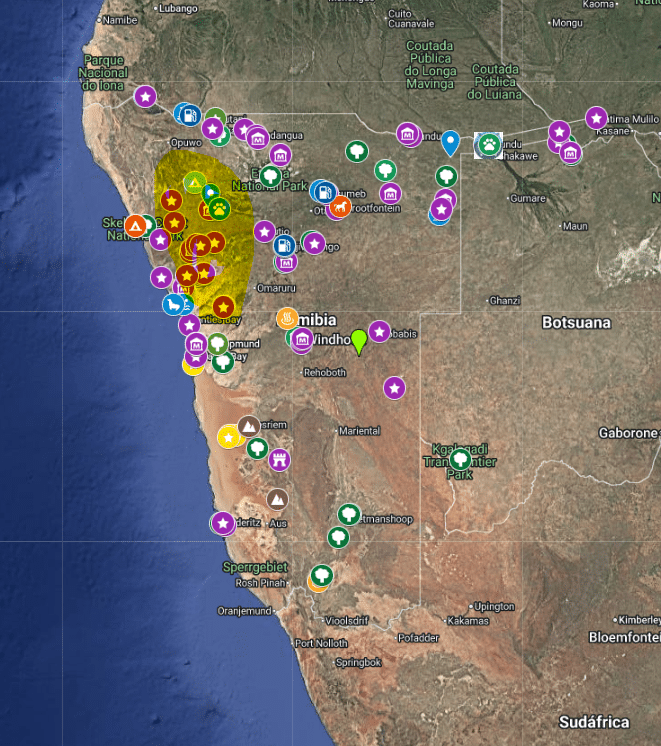
Damaraland is a vast region located in northwestern Namibia, within the present-day Kunene administrative region. It stretches between Etosha, Kaokoland, the Skeleton Coast, and the Brandberg area, encompassing some of the most arid and spectacular landscapes in the country.
Within this enormous region lies Twyfelfontein , the most famous and visited place in Damaraland.
Twyfelfontein — also known by its traditional name /Ui-//aes — is home to one of the largest concentrations of rock engravings in Africa and was declared a UNESCO World Heritage Site in 2007 thanks to the extraordinary preservation of its petroglyphs and their historical value in understanding the ancient hunter-gatherer societies of southern Africa.
Map of Damaraland and Twyfelfontein
Damaraland is one of Namibia's largest and least populated regions. It covers a vast area in the northwest of the country and boasts some of the most spectacular landscapes in all of southern Africa.
Although many people identify Damaraland solely with Twyfelfontein , the reality is that this region is home to numerous places of interest spread along hundreds of kilometers of gravel tracks and secondary roads.
On our tour of Namibia we visited Damaraland between Etosha National Park and the Skeleton Coast , a perfect location that makes this region a natural stop on any 4x4 road trip.
The main points of interest in Damaraland are:
| Place | Essential | recommended time |
| Twyfelfontein | ⭐⭐⭐⭐⭐ | 2-3 horas |
| Damara Living Museum | ⭐⭐⭐⭐⭐ | 1-2 horas |
| Organ Pipes | ⭐⭐⭐ | 60 -70 minutes |
| Burn Mountain | ⭐⭐⭐ | 60 -70 minutes |
| Desert Elephants | ⭐⭐⭐⭐ | Noon |
| brandberg | ⭐⭐⭐⭐ | Noon |
| White Lady | ⭐⭐⭐⭐ | 2-3 horas |
| Palmwag | ⭐⭐⭐⭐ | 1 day |
| Petrified Forest | ⭐⭐⭐ | 1 hour |
Damaraland's location within a route through Namibia
During most independent itineraries, Damaraland usually fits perfectly between two of the great destinations in the north of the country:
| Provenance | Approximate distance |
| Etosha National Park | 250-350 km |
| Kamanjab | 100 km |
| Swakopmund | 350-400 km |
| Skeleton Coast | 150-250 km |
| Spitzkoppe | 250 km |
We arrived from Etosha , leaving through Galton Gate and crossing the Kamanjab area before spending the night at Kaoko Bush Lodge , an accommodation that surprised us greatly due to the quality of its facilities, its huge swimming pool and the natural environment where it is located.
The next day we continued towards Twyfelfontein , traveling for several hours on perfectly maintained tracks. Along the way, we even picked up a Herero hitchhiker who worked at a local lodge and who explained what daily life is like in this remote part of Namibia—one of those conversations that makes travel even more special.
How many days should I spend in Damaraland?
Although it is possible to cross the region in a single day, we believe that would be a mistake.
Our recommendation is to dedicate at least two full days, within our 24-day Namibia itinerary , to be able to calmly visit some of the region's most outstanding points of interest:
- Twyfelfontein
- Damara Living Museum
- The White Lady
- The Brandberg mountain volcano
- Petrified forest
- Organ Pipes
- Burn Mountain
- A safari to observe desert-adapted elephants
- The landscapes of Palmwag and the territory of the black rhinoceros
We spent two days in this area, and even then, there were still places we wanted to visit on a future trip. To see the entire region, you would probably need 3-4 days.
Therefore, if you are planning a route similar to ours, Damaraland clearly deserves its own stop and not simply a place to pass through between Etosha and the Skeleton Coast.
Our Damaraland route in 2 days
Damaraland occupied days 9 and 10 of our trip through Namibia. We had arrived from Etosha National Park and our next destination was the spectacular Skeleton Coast , so this region became a perfect stop to discover a completely different side of Namibia.
For two days we traveled over 400 kilometers of gravel tracks, visited Twyfelfontein , learned about Damara culture, slept in two completely different campsites and discovered why this region is considered one of the most authentic in the country.
From Etosha to Kamanjab, the gateway to Damaraland
Our last day in Etosha began very early. Even before leaving the park, we made a visit that left us quite shocked: the Elephant Cull Memorial , a small interpretive center that explains one of the most controversial episodes in Namibian conservation.
In 1983, the park's elephant population exceeded 3.000, and the authorities deemed the pressure on the ecosystem excessive. The solution was to cull 525 elephants , whose meat was even canned. Some of the old infrastructure used during that process can still be seen today; a visit is quite somber but helps to understand the complexity of wildlife management in Namibia.
Before leaving for good through Galton Gate , we enjoyed one last safari where we continued to see numerous zebras, giraffes, and various antelope species around the waterholes. The lions, however, remained elusive.
At the park exit, the military conducted another vehicle check . They reviewed the 4x4's documentation, verified that we weren't transporting fresh meat out of Etosha, and also inspected the plastic bags. This check is completely routine and should be taken into account if you're planning a similar trip.
Our next stop was Kamanjab , one of the best places to refuel and do some shopping before venturing into Damaraland. We took the opportunity to buy food at a Spar supermarket and restock our supplies, as services become much more limited in the following days.
It was right here that we first saw several Himba women selling handicrafts and shopping at the supermarket. We bought some bracelets and small souvenirs because we believe that buying their products directly is one of the best ways to support the local economy while traveling.
The Himba, Namibia's most emblematic people
The Himba are one of Namibia's best-known indigenous peoples. They primarily inhabit the Kunene region in the northwest of the country, in towns such as Kamanjab, the gateway to Damaraland.
The first thing that strikes you is their distinctive appearance. The women cover their skin and hair with a mixture of fat, butter, and red ochre powder , known as otjize . This paste protects the skin from the intense sun, insects, and the dry climate, and also holds significant cultural and aesthetic meaning.
Another of their defining characteristics are the elaborate hairstyles, the handcrafted jewelry, and the minimal or nonexistent use of water for daily hygiene, as they traditionally replace water baths with smoke baths using aromatic herbs.
Although they maintain many of their ancestral customs, the current reality is much more complex than the tourist image often portrays. Many families combine traditional livestock farming with other economic activities, sell handicrafts, or work seasonally in lodges and tourism businesses in the region.
If you'd like to learn more about their culture, guided tours to the Himba village of Omusauna are organized near Kaoko Bush Lodge . This experience allows you to approach their way of life with greater context and respect. We weren't keen on going, as the reviews of the place weren't very positive. We preferred to respect their village and simply talk to them in the street and buy some handicrafts to help them. Entering their homes simply seemed rude and insensitive.
Our advice: if you decide to buy Himba crafts, try to buy them directly from the artisans or from community projects like the one in Kamanjab. Besides taking home an authentic souvenir, you'll be directly supporting the local economy.
Kaoko Bush Lodge, one of the best campsites on our trip
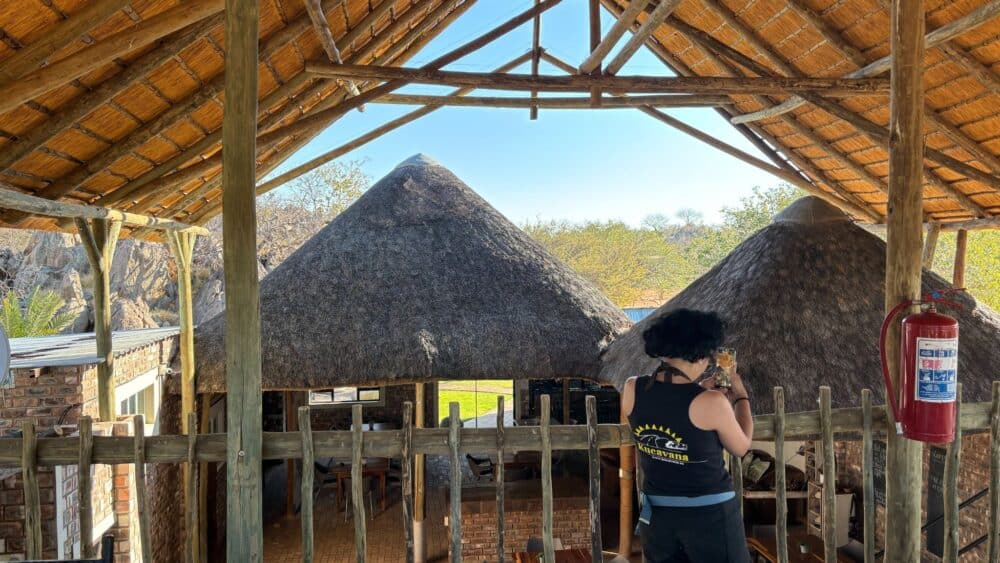
That night we slept at Kaoko Bush Lodge , very close to Palmwag, an accommodation that completely exceeded our expectations.
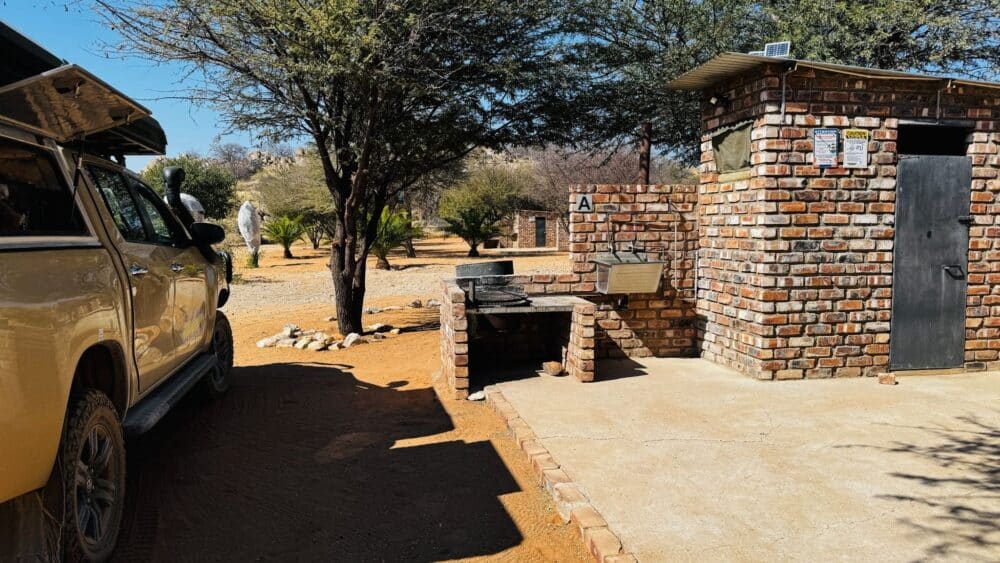
After several days of safari and simple camping in Etosha, arriving there was almost like a small oasis. We were greeted with a welcome juice, and our pitch even had a private toilet and shower , as well as a perfectly equipped barbecue area. However, if we had known, we would have booked one of the apartments to get a proper rest—they were lovely, and not too expensive either!
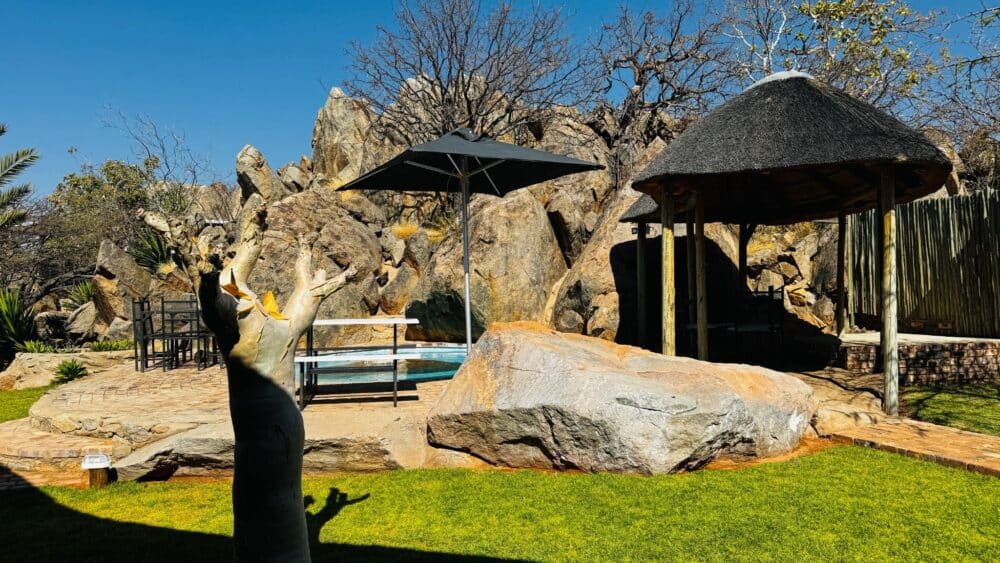
The communal facilities were spectacular: beautifully maintained gardens, a huge swimming pool surrounded by nature, a restaurant, sofas to relax on, and excellent WiFi which we used to download photos, review the plan for the following days, and catch up after several days practically disconnected.
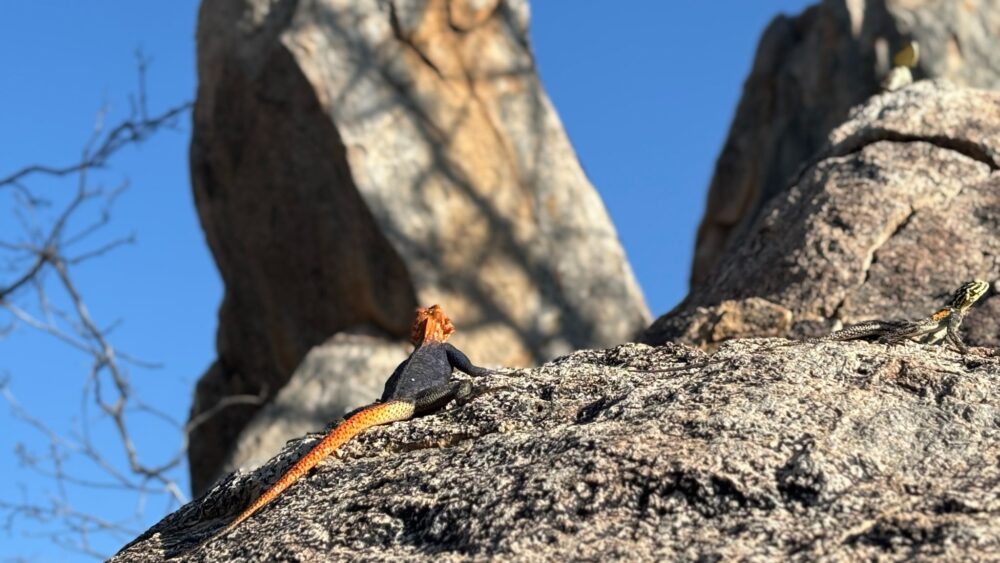
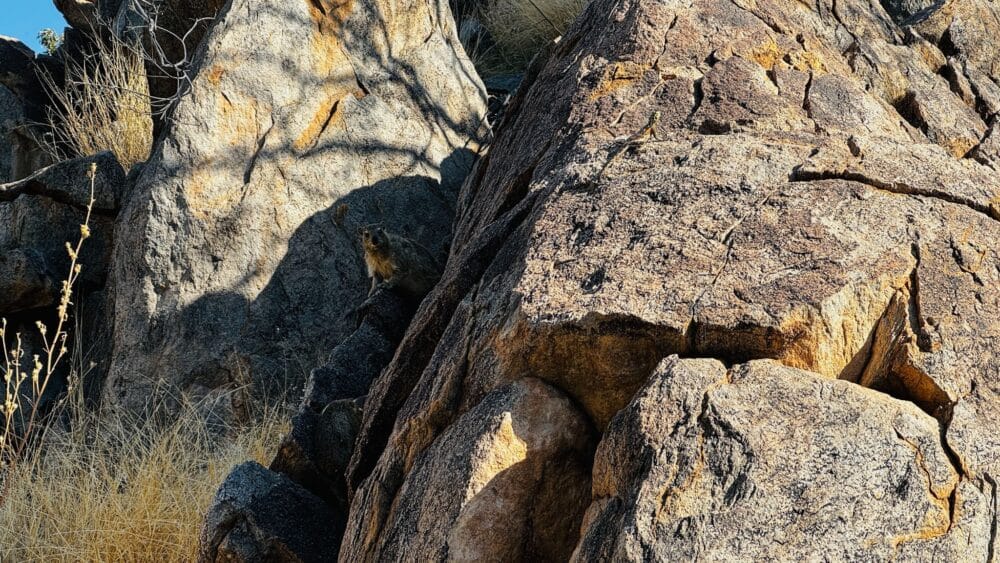
That afternoon we decided to simply relax. We did laundry, enjoyed the pool, and amused ourselves by watching the numerous Cape hyraxes that lived among the rocks by the pool, as well as the enormous, brightly colored lizards that constantly appeared around the campsite.
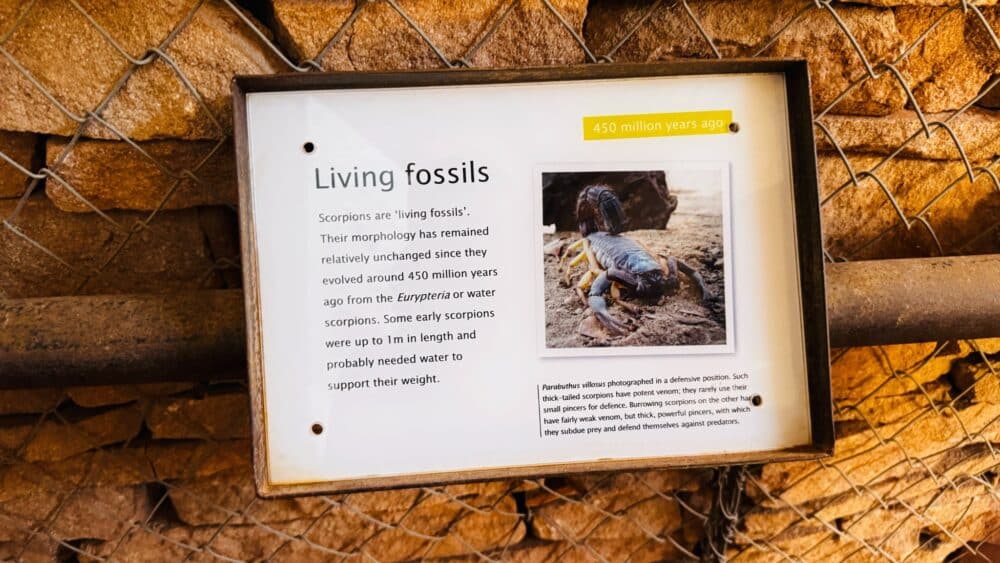
The only thing that commanded any respect were the numerous signs warning of the presence of snakes and scorpions . We even saw several scorpion tracks marked in the sand around our plot, although luckily we didn't encounter any.
If you have more time than we did, Kaoko Bush Lodge also organizes several very interesting activities:
- Visit to the Himba village of Omusauna.
- Rock engravings of Peet Alberts Koppie, one of the largest collections of San/Khoi rock art in the area.
- visit Otjitongwe Cheetah Farm, a sanctuary dedicated to the conservation of the cheetah.
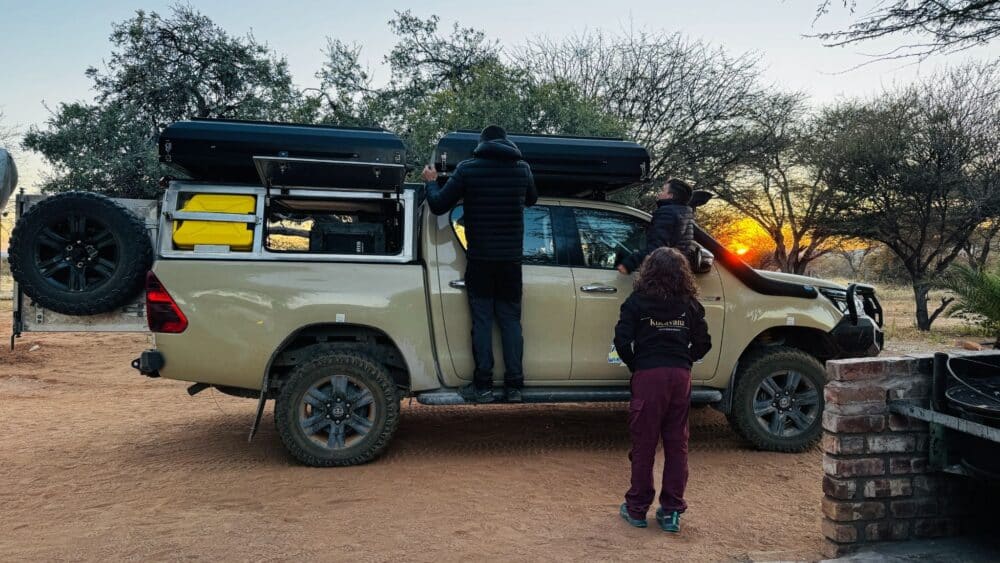
We preferred to take it easy that day, have dinner at the lodge restaurant, and enjoy a beautiful sunset before going to sleep. That night the thermometer read 1°C outside , although inside the rooftop tent we barely felt the cold thanks to the good insulation and our sleeping bags.
Heading to Twyfelfontein, the great archaeological treasure of Namibia
The next morning, we had almost three hours of driving ahead of us on Damaraland's characteristic gravel tracks. Although there was no asphalt, the surface was in very good condition, and we were able to maintain a constant speed of around 80 km/h , thanks to the continuous maintenance work we saw being carried out by several machines throughout the journey.
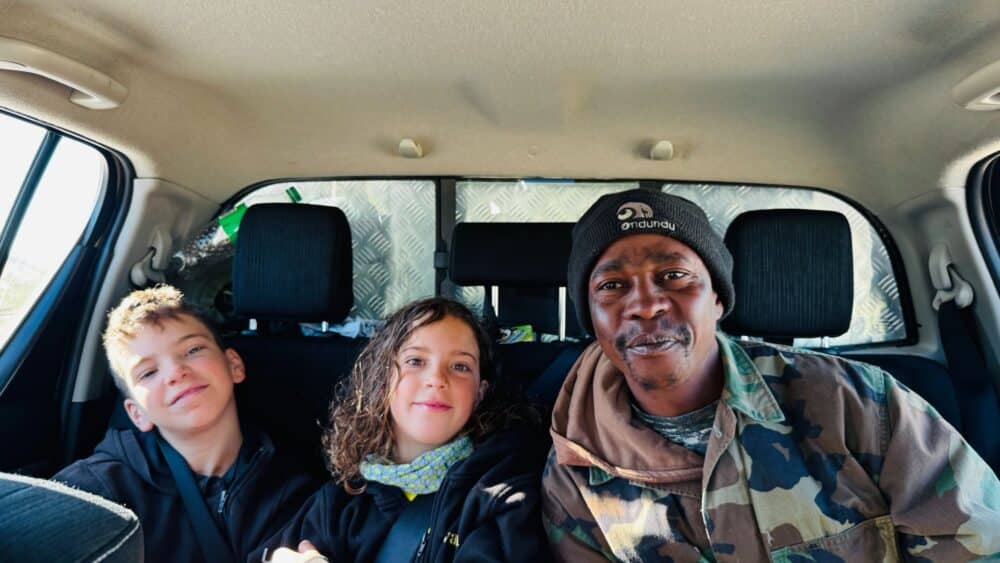
One of the most special moments of the day came when we picked up Jonos , a young Herero man who was hitchhiking from the lodge where he worked to the nearest town to do some shopping.
During the journey, he explained what life is like in this part of Namibia. He worked five days a week for about 350 euros a month , the average Namibian salary, living at the lodge with meals included. What impressed us most was learning that he could only see his two children during December and January, when the lodge closed for the low season; they were very far away.
He also told us about the drought that had plagued the country for the past few years, the rising cost of food, and how the rains that season were slowly bringing hope back to many families. Conversations like this are hard to forget and are among those small moments that make a trip so much more than just the scenery.
The Herero, a people marked by the history of Namibia
The Herero are one of Namibia's main ethnic groups and live mainly in the central and northern regions of the country.
One of the most striking features for travelers is the traditional dress of many Herero women . Their eye-catching, long, Victorian-style dresses , accompanied by a distinctive headdress shaped like cow horns , are a reminder of the importance cattle have always held in their culture. This attire, inherited from the German colonial era, has become one of the most important symbols of Herero identity.
Cattle continue to play a central role in their social organization. Traditionally, marriages involve the payment of a dowry in cattle by the groom's family, and when a man has enough cows to cover that dowry, he can have several wives, a practice that is still maintained in some Herero communities, although it is becoming less common.
Its history, however, is also marked by one of Africa's most tragic episodes. Between 1904 and 1908 , during German colonial rule, tens of thousands of Herero people were killed or driven into the desert in a conflict that many historians consider the first genocide of the 20th century . This episode remains very much alive in the country's collective memory and forms part of Namibia's contemporary history.
Today, many Herero people combine traditional activities with jobs related to tourism, livestock farming, commerce, or services. Thanks to conversations like the one we had with Jonos, we were able to discover a much more human side of Namibia, reminding us that one of the country's greatest attractions is also its people.
Visiting Twyfelfontein, Namibia's largest collection of petroglyphs
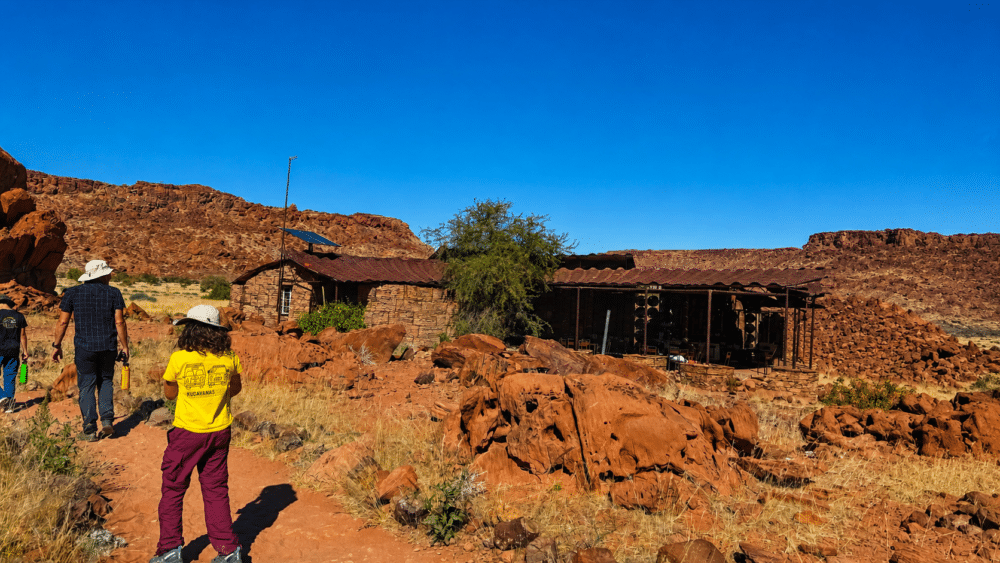
After almost three hours traveling the Damaraland tracks, we finally arrived at Twyfelfontein , one of the most important archaeological sites in Africa and, without a doubt, the must-see in the entire region.
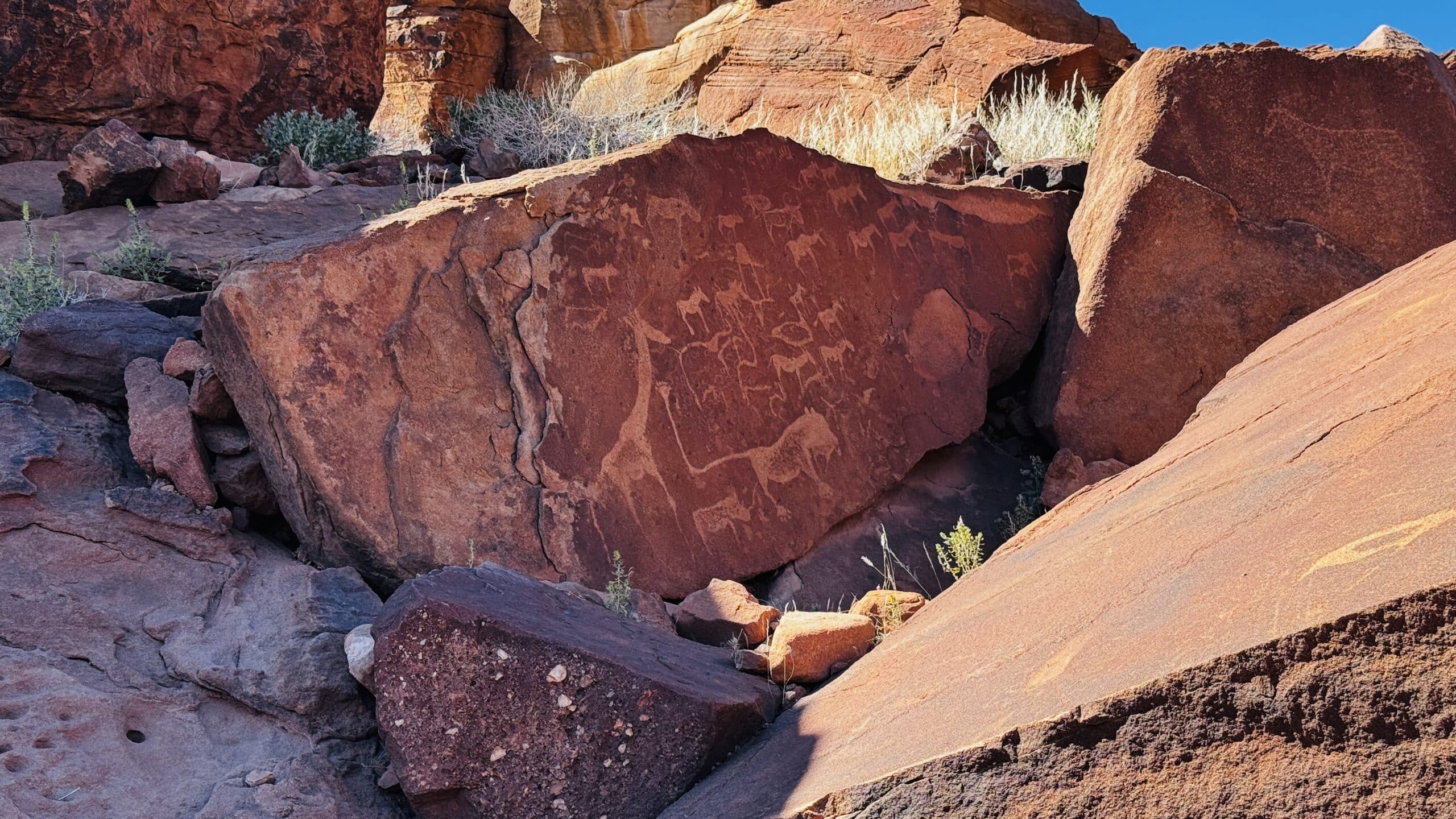
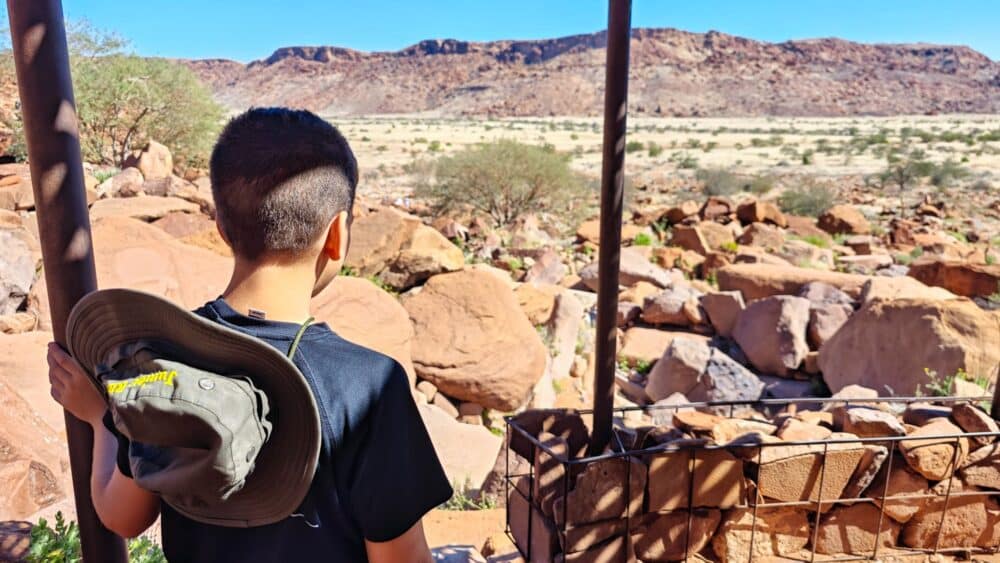
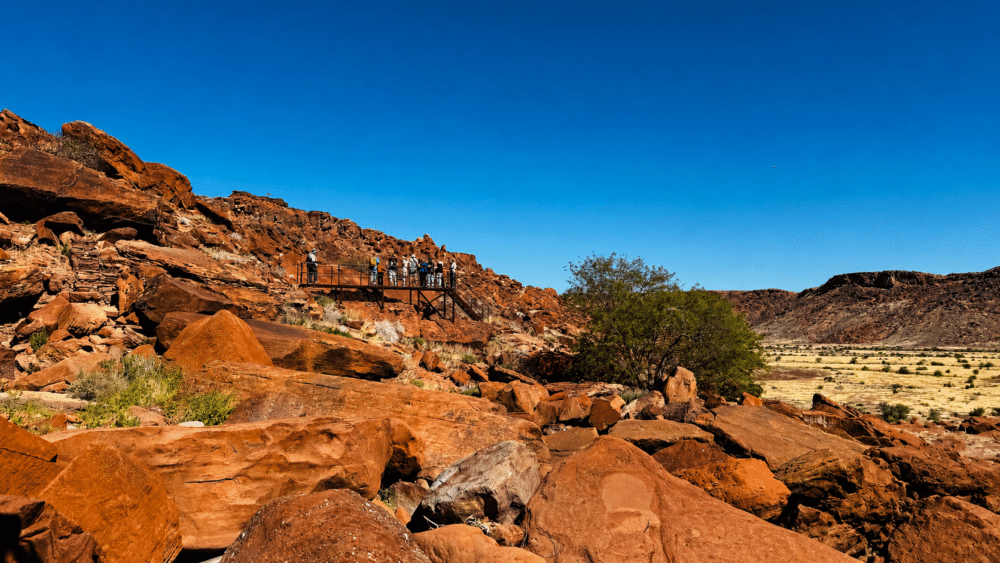
Access to the site is from the Twyfelfontein Visitor Centre , and visits are always conducted with an official guide. From there, a 45-minute walk begins among large sandstone blocks where more than 2.500 petroglyphs, created thousands of years ago by ancient hunter-gatherer peoples, are preserved.
Visitor Centre Location:
20°35’27.1″S 14°22’18.4″E
-20.590861, 14.371778
From the very beginning of our visit, we understood why Twyfelfontein was declared a World Heritage Site by UNESCO in 2007. It's not just about looking at ancient rock carvings , but about understanding how those first inhabitants used this place to communicate, find their way, and pass on knowledge from generation to generation.
Our guide explained that many of the petroglyphs depict rhinoceroses, giraffes, elephants, ostriches, lions, and various animal footprints , although their function went far beyond a simple artistic representation.
We learned that many of these engravings acted as veritable maps of the territory , indicating routes of movement, areas where water could be found, or places frequented by certain species. It was one of those moments when you begin to look at rocks with different eyes.
A highly recommended visit… with a few caveats if you come
The visit surprised us a lot and ended up being one of our favorites of the entire trip through Namibia.
The tour is very enjoyable thanks to the guide's explanations, but it's worth noting that it's not fully accessible . The path crosses several rocky areas with some slight inclines and declines, so we wouldn't recommend it for people with reduced mobility or families traveling with strollers.
We did it at midday, when the thermometer was already reading 28 °C , so bringing water, a hat and sun protection is practically essential.
Even so, we believe it's absolutely worthwhile. Beyond the enormous archaeological value of the site, the explanations allow you to understand the way of life of the ancient inhabitants of Damaraland and make the visit much more meaningful than simply observing the engravings on your own.
Damara Living Museum, one of Namibia's best cultural experiences
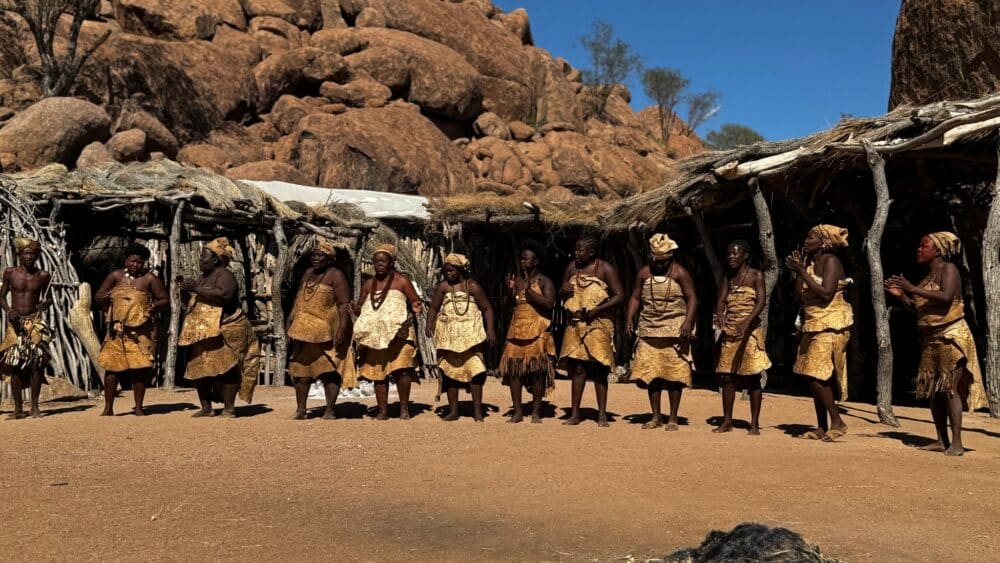
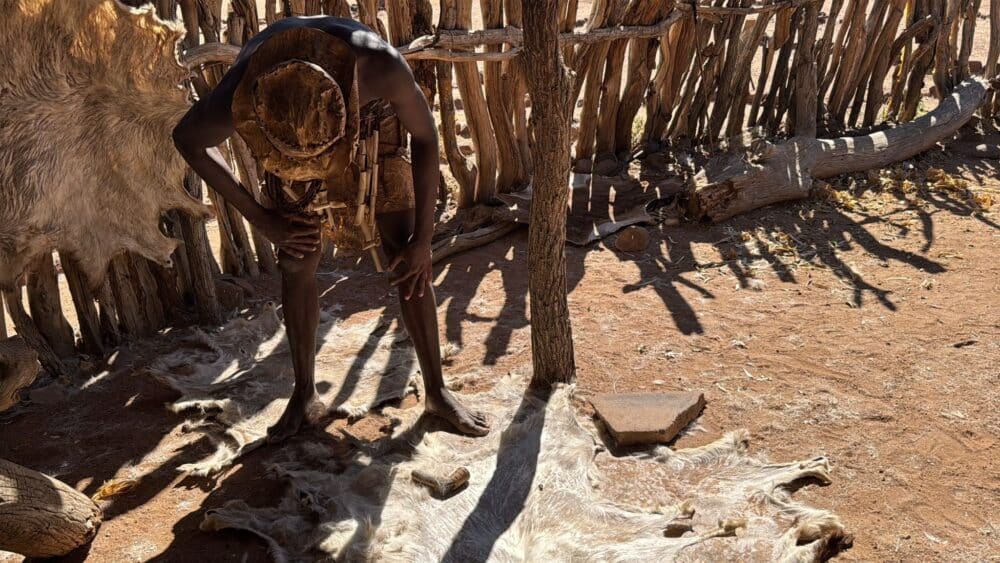
Very close to Twyfelfontein we visited the Damara Living Museum , an open-air ethnographic museum that recreates how the Damara people traditionally lived before Western influence.
Honestly, it was one of the biggest surprises of our entire trip to Namibia and one of the cultural experiences we enjoyed the most.
What we liked most was precisely the museum's approach. It's not about visiting a village where Damara families currently live, but rather a historical recreation created to respectfully teach about their customs, traditions, and way of life. At no point did we feel like we were invading anyone's privacy, something that made a big difference to us compared to other cultural visits we had considered during our trip.
During the tour we discovered how they built their tools, how they obtained fire using only a simple wooden utensil, what plants they used as traditional medicine and what some of their most commonly used natural remedies were.
We also learned several words in the Damara language , famous for its characteristic clicking sounds, listened to traditional songs, and learned more about the history of this people who give their name to the entire Damaraland region.
Before leaving, we took the opportunity to buy some handcrafted items made by them, a way to support the project and take home an authentic souvenir of one of the visits we most recommend from the entire trip.
Afternoon rest at Twyfelfontein Elephant Drives & Campsite
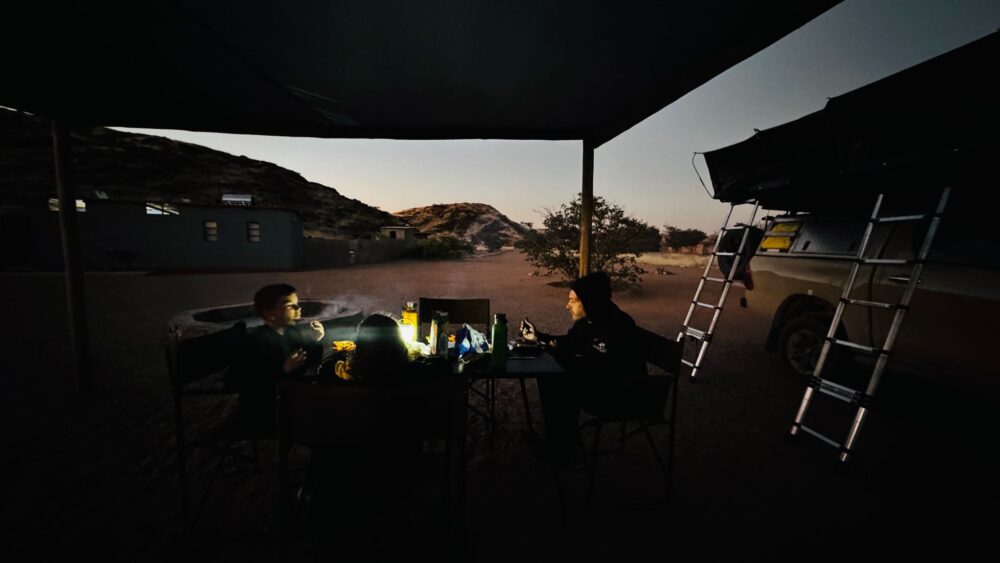
After such a full morning we headed to Twyfelfontein Elephant Drives & Campsite , where we would spend the night.
The campsite cost us approximately €67 for the four of us . Private campsites in Namibia aren't particularly cheap, but compared to some accommodations within Etosha National Park , where we saw prices exceeding €100 per pitch, we felt it was good value for money.
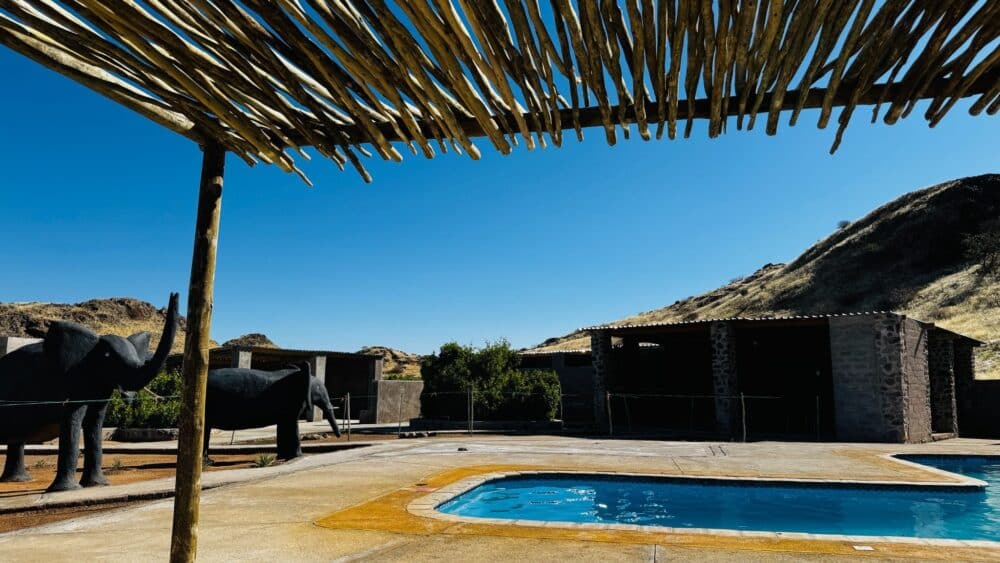
The facilities were very well maintained. The plot had water and a barbecue area, the bathrooms were practically new, and there was also a lovely swimming pool where we took the opportunity to have a dip after the heat of the day.
That afternoon we decided to swap sightseeing for rest. We did laundry, organized photos, enjoyed the campsite pool, and simply relaxed before continuing our journey to the Skeleton Coast.
The campsite wasn't bad, but we saw others closer to Twyfelfontein that we might have booked if we had known, so I recommend you look at these lodge-type accommodations in Twyfelfontein that don't just have camping pitches.
Is the desert elephant safari worth it?
One of the main attractions of this campsite, and of the entire area, are the safaris to observe the famous desert elephants , one of the most unique species in Namibia.
The excursions depart directly from the lodge and explore the dry riverbeds of nearby rivers, where these elephants roam in search of food and water. When we were there, the price was approximately 900 Namibian dollars per adult , while children between 6 and 11 years old paid half price, and children under six could participate for free.
We decided not to carry out this activity.
We had just spent several days in Etosha National Park , where we had enjoyed magnificent elephant sightings, so we preferred to take advantage of the afternoon to rest and arrive with energy for the next big stage of the trip: exploring the Skeleton Coast.
Interestingly, when we checked in, the campsite attendant gave us a walkie-talkie to contact reception in case of any problems during the night. We never had to use it, but it gave us a lot of peace of mind in such an isolated area of Damaraland.
The next morning promised one of the most anticipated days of the trip. With a temperature of barely 4°C at dawn, we had a breakfast bundled up, packed up our rooftop tents—an operation we could now do in just a few minutes—and set off for the Atlantic Ocean to explore the legendary Skeleton Coast , one of the most spectacular and remote roads in all of Namibia.
What to see in Damaraland: the must-see places
If you're wondering what to see in Damaraland , the short answer is that this region offers much more than just Twyfelfontein. While the famous UNESCO World Heritage petroglyphs are a major tourist attraction, Damaraland combines some of Namibia's most spectacular landscapes with unique cultural experiences, desert-adapted wildlife, and geological formations you won't find anywhere else in the country.
We dedicated two full days to exploring this region during our 24-day Namibian trip, and while it was enough to see its main attractions, there were still places we wanted to visit on a future trip. That's precisely why we believe it's worthwhile to plan this leg of your journey carefully and prioritize visits based on the time available.
Below you will find all the places that, in our opinion, you shouldn't miss.
Our Damaraland must-haves
After exploring Damaraland independently as a family, this would be our personal assessment of each of the main places of interest in the region.
| Place | Kucavana Rating | recommended time | Do we recommend it? |
| Twyfelfontein | ⭐⭐⭐⭐⭐ | 2-3 h | ✅ Essential |
| Damara Living Museum | ⭐⭐⭐⭐⭐ | 1,5-2 h | ✅ Essential |
| Desert Elephant Safari | ⭐⭐⭐⭐☆ | Noon | ✅ If you have time |
| Brandberg and White Lady | ⭐⭐⭐⭐☆ | Noon | ✅ Highly recommended |
| Palmwag | ⭐⭐⭐⭐☆ | Half day – 1 day | ✅ Highly recommended |
| Organ Pipes | ⭐⭐⭐☆☆ | 60 -70 minutes | ✔️ If you pass nearby |
| Burn Mountain | ⭐⭐⭐☆☆ | 60 -70 minutes | ✔️ If you pass nearby |
| Petrified Forest | ⭐⭐⭐☆☆ | 60 -70 minutes | ✔️ Recommended |
Our advice: if you only have one day to visit Damaraland, we would dedicate most of your time to Twyfelfontein and the Damara Living Museum . These are undoubtedly the two places that surprised us the most and best represent the history and culture of this fascinating region of Namibia.
1. Twyfelfontein, the greatest archaeological treasure in Namibia ⭐⭐⭐⭐⭐
If there is one place that alone justifies a visit to Damaraland, it is Twyfelfontein.
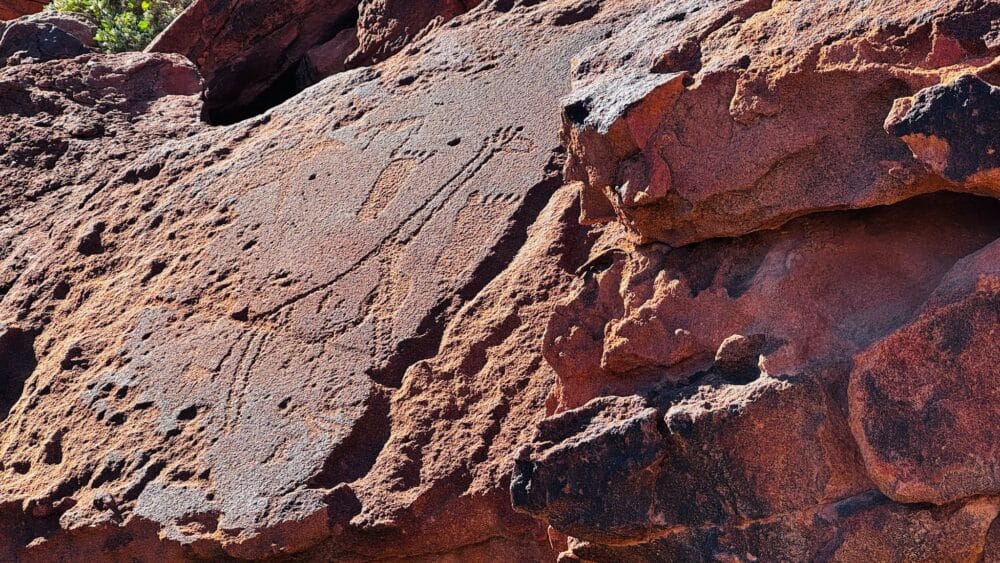
Declared a UNESCO World Heritage Site in 2007, it boasts one of the largest concentrations of petroglyphs in Africa and is Namibia's most important rock art site. Its sandstone outcrops bear over 2.500 engravings , created thousands of years ago by ancient hunter-gatherer groups who used this location as a meeting place, a hub for communication, and a center for knowledge exchange.
What surprised us most during the visit was discovering that these engravings were not simply decorative drawings. Many depict animals such as rhinoceroses, giraffes, elephants, ostriches, or lions, but also footprints and symbols that archaeologists interpret as authentic maps of the territory , used to indicate routes, locate water sources, or convey information about the area's fauna.
The tour can only be conducted with an official guide and lasts approximately 45 minutes . The route winds through large boulders, with some minor inclines, so we recommend wearing comfortable shoes, bringing water, and sun protection, especially during the midday hours.
The best of Twyfelfontein
- Declared UNESCO World Heritage.
- More than 2.500 petroglyphs perfectly preserved.
- A very educational and interesting guided tour.
- One of the most important historical sites in southern Africa.
Our rating: ⭐⭐⭐⭐⭐
Later in this guide we explain in detail what the visit is like, how much the entrance fee costs, which petroglyphs you shouldn't miss and all the tips to enjoy Twyfelfontein.
2. Damara Living Museum, the best cultural experience in Damaraland ⭐⭐⭐⭐⭐
If we had to recommend a single activity to understand Namibian culture, we would probably choose the Damara Living Museum.
Before traveling, we had some doubts about this visit. We were worried about finding an overly touristy village or feeling like we were invading the privacy of a local community. However, the exact opposite happened.
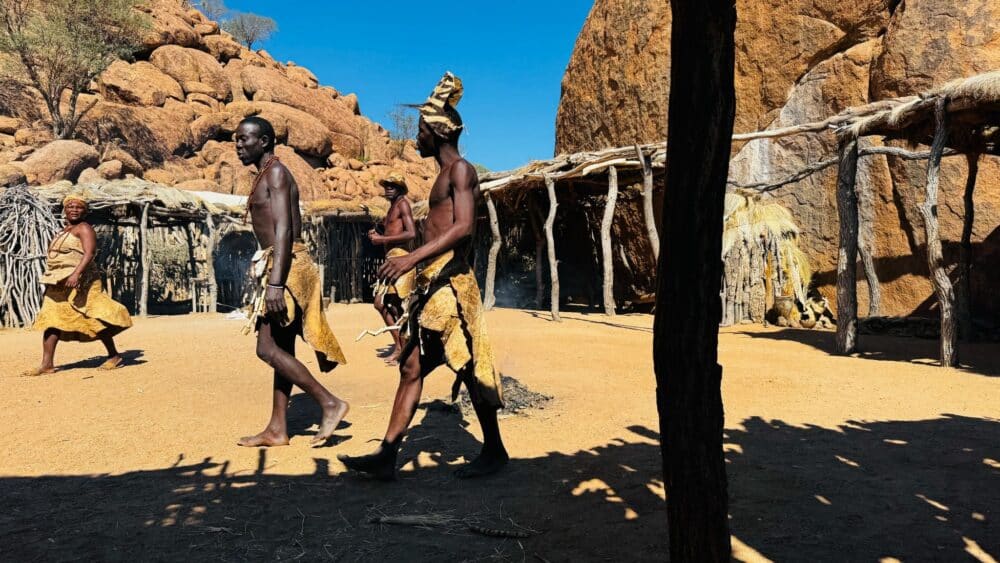
The Damara Living Museum is not a currently inhabited village, but rather an open-air ethnographic museum created by the Damara community itself to preserve and explain their traditional culture. Thanks to this approach, the visit is very respectful and allows visitors to learn about their way of life without interfering in the daily lives of any family.
For us, it was, without a doubt, one of the best cultural experiences of our entire trip through Namibia.
What can you see at the Damara Living Museum?
The visit is guided by members of the Damara community and allows you to discover how their ancestors lived long before the arrival of Western culture.
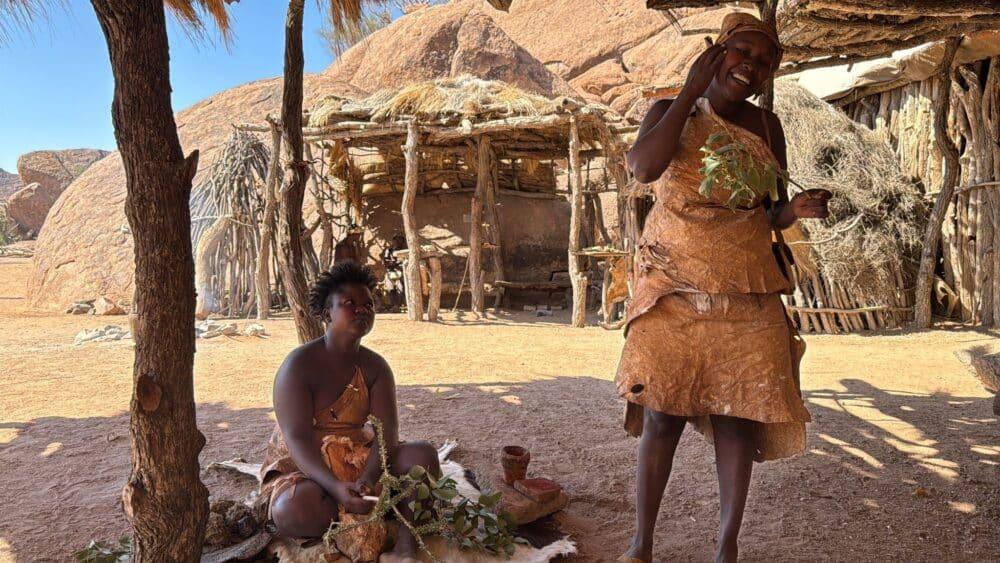
During the tour we learned how they built their tools, how they made fire using only a simple wooden utensil, and what plants they used as traditional medicine to treat different illnesses and ailments.
One of the most interesting moments was hearing their language, famous for its characteristic clicking sounds , which are still part of several languages in southern Africa today. We also enjoyed their traditional songs, dances, and explanations about the customs that have accompanied the Damara people for generations.
It was a very engaging and entertaining visit, perfectly suited for any traveler, including children.
A museum very different from other traditional villages
The fact that it was a museum was precisely what we valued most.
In other parts of Africa, visits to villages where families still live today can sometimes create a feeling of invading their privacy.
Here, the exact opposite happens.
The goal is to preserve and promote Damara culture , allowing community members to explain their traditions, earn income through responsible tourism, and sell their crafts directly.
We found it to be a much more respectful and sustainable model.
Authentic craftsmanship and a very special souvenir
At the end of the visit we took the opportunity to buy several pieces of handicrafts made by the Damara themselves.
Whenever we travel we try to make sure our memories have a story behind them, and in this case, in addition to taking away a nice memory, we felt that we were directly contributing to supporting a very interesting cultural project.
They also taught us a word that we still remember fondly.
"Aios" , which means thank you in the Damara language.
Since then, it's one of those little words that we always associate with one of the most hospitable towns we met during our trip.
Useful information
| Information | Facts & figures |
| 📍 Location | Very close to Twyfelfontein |
| ⏱️ Duration | 1,5-2 horas |
| 👨👩👧👦 Recommended for children | Yes |
| 🎟️ Guided tour | Yes |
| 🛍️ Local crafts | Yes |
| ⭐ Kucavana Rating | ⭐⭐⭐⭐⭐ |
Is the Damara Living Museum worth visiting?
Yes, without any doubt.
If Twyfelfontein allowed us to understand how the ancient inhabitants of this region lived thousands of years ago, the Damara Living Museum helped us to understand what daily life was like for the Damara people long before modernity.
We believe that both visits complement each other perfectly and, in fact, we recommend doing them on the same day, as they are only a few minutes apart by car.
Our advice: if you can only choose two visits in Damaraland, pick Twyfelfontein and the Damara Living Museum . Together they offer a unique insight into the history, culture, and traditions of this fascinating region of Namibia.
We arrived around midday, with temperatures near 28°C , and were truly impressed. We hadn't expected the visit to be so interesting, and it ended up being one of the highlights of our trip to Namibia.
3. Organ Pipes, a curious stone organ in the middle of Damaraland ⭐⭐⭐☆☆
Less than five minutes by car from Twyfelfontein is one of those places that many travelers visit almost by chance and that is worth including if you are already exploring the area.
Organ Pipes gets its name from the spectacular dolerite columns that resemble the pipes of a huge church organ.
These geological formations originated approximately 120 million years ago , when magma rose through cracks in the rock and, as it cooled slowly, gave rise to these practically hexagonal columns that can be seen perfectly aligned today.
The visit is very quick. From the small parking lot, it's just a few minutes' walk to the main viewpoint, making it a perfect stop to round off a day trip along with Twyfelfontein and Burnt Mountain.
We visited it after the Damara Living Museum and, although it probably wouldn't justify a trip to Damaraland on its own, we do think it's worth taking advantage of being so close.
Useful information
| Information | Facts & figures |
| ⏱️ Visit time | 20-30 minutes |
| 🚶 Difficulty | Very easy |
| 👨👩👧👦 With children | Yes |
| 📍 Very close to | Twyfelfontein |
| ⭐ Kucavana Rating | ⭐⭐⭐☆☆ |
4. Burnt Mountain, the mountain that changes color at sunset ⭐⭐⭐☆☆
Very close to Organ Pipes appears another geological curiosity of Damaraland: Burnt Mountain.
Its name, which could be translated as Burnt Mountain , is due to the reddish, black and violet tones that its rocks acquire, especially during the last hours of the day.
For many years it was thought that those colors were the result of ancient fires, although in reality they are due to complex geological processes and the oxidation of different minerals present in the mountain.
The visit simply consists of stopping at the small viewpoint set up next to the road to contemplate the landscape.
We thought it was an interesting stop because it's just a few minutes from Twyfelfontein, although, just like Organ Pipes, we think it's only worthwhile if you're already exploring this part of Damaraland.
Useful information
| Information | Facts & figures |
| ⏱️ Visit time | 15-20 minutes |
| 📸 Best moment | Late afternoon |
| 👨👩👧👦 With children | Yes |
| ⭐ Kucavana Rating | ⭐⭐⭐☆☆ |
5. Desert elephants, the great symbol of Damaraland ⭐⭐⭐⭐☆
If there is one animal that represents the essence of Damaraland, it is the desert-adapted elephant.
Although they belong to the same species as the African savanna elephant, these populations have developed extraordinary behaviors to survive in one of the driest environments on the continent.
They are capable of traveling enormous distances following the dry riverbeds in search of food and water, enduring long periods of drought and extreme temperatures.
The best areas to try to observe them are around Twyfelfontein , Palmwag , the Aba Huab and Huab rivers and some valleys near the Skeleton Coast.
Many accommodations in the area organize specific excursions to look for them.
We decided not to go on safari because we had just enjoyed magnificent elephant sightings for several days in Etosha National Park and preferred to spend the afternoon relaxing by the campsite pool before continuing our journey to the coast.
However, if it's your first time in Namibia or you haven't had much luck seeing elephants in Etosha, we think it can be a highly recommended activity.
However, it's important to remember that we're talking about completely wild animals. No sighting is guaranteed, and that very uncertainty is part of the charm of the experience.
Useful information
| Information | Facts & figures |
| 📍 Best areas | Twyfelfontein, Palmwag, Aba Huab and Huab |
| 🚙 Recommended | Guided Safari |
| ⏱️ Duration | Noon |
| 👨👩👧👦 Suitable for families | Yes |
| ⭐ Kucavana Rating | ⭐⭐⭐⭐☆ |
6. Brandberg, Namibia's highest mountain ⭐⭐⭐⭐☆
At 2.573 meters high , Brandberg is the highest mountain in Namibia and one of the great landscape icons of Damaraland.
Its name means Fire Mountain in German, since at dawn and dusk the granite takes on intense reddish hues that are truly spectacular. However, its true value lies not only in the landscape.
Brandberg is home to hundreds of rock art sites scattered throughout the mountain range, making it one of the most important archaeological sites in southern Africa.
Many travelers visit it solely to make the excursion to the famous White Lady , although the mountain offers numerous hiking trails, stunning landscapes and enormous biodiversity adapted to the arid climate of Damaraland.
We couldn't dedicate the time it deserves because we were continuing our route towards the Skeleton Coast, but it will undoubtedly be one of the first places we visit when we return to Namibia.
Useful information
| Information | Facts & figures |
| ⛰️ Altitude | 2.573 m |
| 🚶 Main activity | Hiking |
| ⏱️ Recommended time | Half day – 1 day |
| ⭐ Kucavana Rating | ⭐⭐⭐⭐☆ |
7. White Lady and the Bushman Paintings ⭐⭐⭐⭐☆
Within the Brandberg massif lies one of Namibia's most famous rock art sites: the renowned White Lady.
Despite its name, it is now known that the figure depicted probably does not correspond to a white woman , but to a shaman or hunter-gatherer painted with light pigments during some ritual.
The walk to the White Lady also allows you to see numerous panels with other Bushman Paintings , paintings made thousands of years ago by ancient San groups that show hunting scenes, animals and human figures.
The complete tour usually lasts between 2 and 3 hours , always accompanied by an authorized local guide, since in addition to protecting the heritage they help to interpret the meaning of many of the paintings.
Although we didn't do this excursion due to lack of time, we believe it is a highly recommended visit for those who have an extra day in Damaraland and enjoy hiking and archaeology.
Useful information
| Information | Facts & figures |
| 🚶 Guided tour | Yes |
| ⏱️ Duration | 2-3 horas |
| 💧 Bring water | Essential |
| ⭐ Kucavana Rating | ⭐⭐⭐⭐☆ |
8. Petrified Forest, trees turned to stone millions of years ago ⭐⭐⭐☆☆
Another of the most curious places you can visit in Damaraland is the Petrified Forest.
Here you can see enormous fossilized tree trunks that were buried approximately 280 million years ago and which, over time, slowly replaced their organic matter with minerals until they were completely transformed into stone.
Many of these trunks reach more than 30 meters in length , making it one of the most interesting paleontological sites in Namibia.
The visit is simple and is done through a guided tour of approximately one hour, during which specimens of the unique Welwitschia mirabilis are also usually shown , one of the oldest and most resistant plants on the planet, capable of surviving for centuries in the extreme conditions of the Namibian desert.
We decided not to include this stop in order to dedicate more time to Twyfelfontein and the Damara Living Museum, a decision we don't regret. However, if you have more days in Damaraland, we think it could be a very interesting visit to round out your experience.
Useful information
| Information | Facts & figures |
| 🌳 Age of fossils | Approximately 280 million years |
| ⏱️ Visit time | 45-60 minutes |
| 👨👩👧👦 With children | Yes |
| ⭐ Kucavana Rating | ⭐⭐⭐☆☆ |
9. Palmwag, the best place to look for black rhinos ⭐⭐⭐⭐☆
If there is one place that represents the wildest nature of Damaraland, it is Palmwag.
Located northwest of Twyfelfontein, this vast private concession is one of Namibia's most important conservation areas and one of the best places in the world to see black rhinos in the wild.
Besides rhinos, this area is also home to desert-adapted elephants, giraffes, mountain zebras, kudus, oryx, and even desert leopards and lions, although the latter are much harder to spot.
Unlike Etosha, here the safaris take place in much more remote landscapes and with very few vehicles, making the experience much more intimate and exclusive.
We didn't make it to Palmwag because we were continuing our route towards the Skeleton Coast , but if we ever return to Namibia it will be one of the areas to which we would dedicate at least one night.
Useful information
| Information | Facts & figures |
| 📍 Location | Northwest Damaraland |
| ⭐ Featured wildlife | Black rhinoceros, desert elephants |
| 🚙 Main activity | Guided Safari |
| ⏱️ Recommended time | 1 day |
| ⭐ Kucavana Rating | ⭐⭐⭐⭐☆ |
How to plan a route through Damaraland
One of the questions we get asked most often is how many days it's worth spending in Damaraland.
Our recommendation depends on the type of trip you are organizing, but if you are traveling independently in a 4x4, we believe that the ideal is to book between two and three days.
1-day route
If you have very little time, we would prioritize:
- Twyfelfontein.
- Damara Living Museum.
It's a perfectly viable route if you're coming from Etosha or Swakopmund and continuing on the same day.
2-day route (the one we did)
It is the option we recommend to most travelers.
Day 1
- Etosha Exit.
- Kamanjab.
- Kaoko Bush Lodge.
Day 2
- Twyfelfontein.
- Damara Living Museum.
- Overnight at Twyfelfontein Elephant Drives & Campsite.
The next day we continued towards the Skeleton Coast , one of the most spectacular stages of our trip.
3 day route
If you have an additional day available, we would add:
- Desert elephant safari.
- Brandberg.
- White Lady.
We believe this is the ideal duration to get to know Damaraland at a relaxed pace.
Where to sleep in Damaraland
Damaraland offers accommodations to suit virtually all budgets, from simple campsites to some of Namibia's most exclusive lodges.
We stayed at two very different private campsites and both left us with wonderful memories.
Kaoko Bush Lodge ⭐⭐⭐⭐⭐
The Kaoko Bush Lodge was one of the accommodations that surprised us the most during the entire trip.
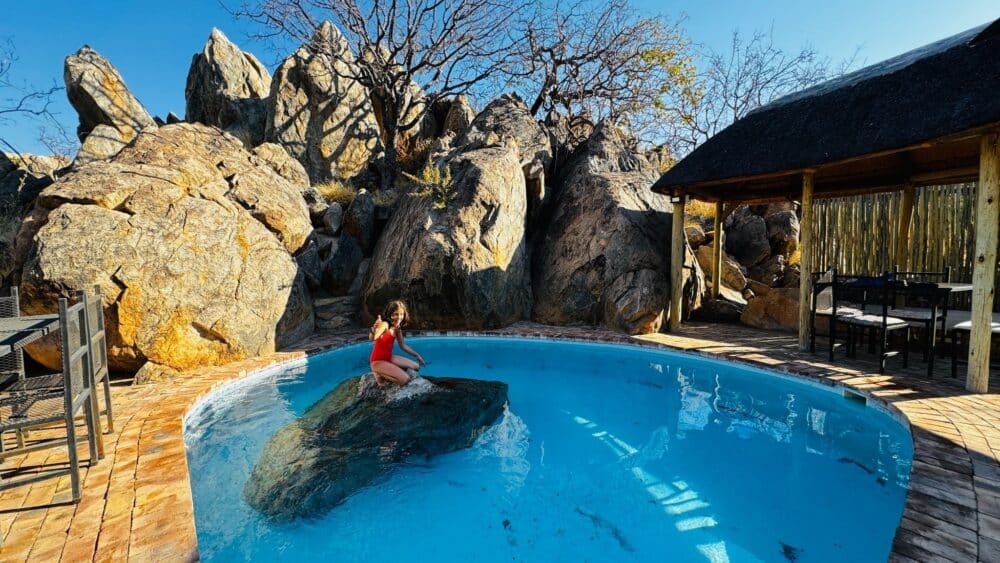
Although it is a lodge, it also has spacious camping pitches with private bathroom and shower, a barbecue area and access to spectacular communal facilities.
What we liked most was the pool surrounded by gardens, the restaurant and the tranquility of the place, perfect for resting after several days exploring Etosha.
Ideal for: relaxing before venturing into Damaraland.
Twyfelfontein Elephant Drives & Campsite ⭐⭐⭐⭐☆
This Elephant Drives campsite is perfectly located for visiting Twyfelfontein and the rest of the area's attractions.
The plots are spacious, the bathrooms are very well maintained, and there is a swimming pool, restaurant, and excursions to observe elephants adapted to the desert.
Furthermore, it was the only campsite on our entire trip where they gave us a walkie-talkie upon check-in in case we needed help during the night, a detail that gave us a lot of peace of mind.
Other recommended accommodations
If you're looking for different accommodation, you might also consider going to one of the lodge campsites on this list that we saw during our trip, which looked really good.
If you are traveling during peak season (July, August and September), we recommend booking several months in advance, especially if you want to stay near Twyfelfontein.
How many days should I spend in Damaraland?
One of the most common questions when preparing a trip to Namibia is how much time to set aside to explore Damaraland.
Our recommendation is clear: at least two full days.
It is true that many itineraries cross this region in a single day, usually between Etosha National Park and Swakopmund or the Skeleton Coast , but we believe that doing so means missing out on much of its charm.
We spent two days there and still had places like Brandberg , Palmwag or the Petrified Forest left to visit, which we hope to see on a future trip.
This would be our recommendation based on the time available:
| Available time | What we recommend visiting |
| 1 day | Twyfelfontein, Damara Living Museum, Organ Pipes and Burnt Mountain. |
| 2 days | The above plus sleeping in the area and enjoying the scenery at a leisurely pace. That's the option we chose and the one we recommend. |
| 3 days | Add Desert Elephant Safari, Palmwag, Brandberg, White Lady and Petrified Forest. |
If you are traveling independently in a 4x4, we believe that two nights in Damaraland allow you to enjoy the region at a leisurely pace and make the most of your visits.
Tips for visiting Damaraland independently
After exploring this region as a family during our trip to Namibia, these are the tips we think can help you the most.
✔ Refuel whenever you have the chance
Distances in Damaraland are enormous and gas stations are scarce.
We took the opportunity to fill up the tank and do some shopping in Kamanjab , before continuing on to Twyfelfontein.
✔ Don't underestimate the distances
Although they may seem like only a few kilometers on the map, most of the roads are gravel tracks.
The good news is that, when we traveled, they were in very good condition and we were able to drive normally between 70 and 90 km/h , although always with caution due to the frequent changes in gradient.
✔ Get up early
The early hours of the day are the best time to drive.
There is less heat, better light for photographing landscapes, and, in addition, the possibility of finding wildlife near dry riverbeds increases.
✔ Bring enough water
In July we went from 1°C at night to 28°C at midday on the same day.
The temperature differences are very pronounced, so it is advisable to always carry water, a hat, sunscreen and some warm clothing for the early morning hours.
✔ Book accommodation in advance
Damaraland does not have a wide range of accommodation options, and many campsites and lodges are fully booked during peak season.
If you're traveling between June and September , booking several months in advance can save you a lot of trouble.
Is Damaraland worth visiting?
Having traveled virtually all of Namibia, this is one of the questions we would answer most easily.
Yes. Very much so.
Before traveling we thought that Damaraland would simply be a transitional stage between Etosha National Park and the Skeleton Coast.
However, it ended up being one of the regions that surprised us the most during the entire trip.
Not only because of Twyfelfontein , but because of the whole experience we had: getting to know the Damara culture, talking with Jonos during the journey, discovering the first Himba villages, driving along endless tracks surrounded by volcanic mountains, and sleeping under one of the clearest skies we can remember.
Damaraland has something that's hard to explain.
It's not just impressive because of a grand monument or a spectacular safari. It's impressive because of the feeling of traveling through a much more authentic, peaceful, and wild Namibia, where it's still possible to drive for miles without seeing another soul.
If we were to return to Namibia tomorrow, Damaraland would definitely be part of our route again.
Because, although Twyfelfontein is the main tourist attraction, we believe that the true treasure of this region is everything that happens between one place and another: its landscapes, its people and that constant feeling of adventure that accompanied us throughout the entire stage.
Is a 4x4 necessary to visit Damaraland?
This is one of the most frequently asked questions when organizing a trip to Namibia.
The short answer is it depends on the route you want to take , although our recommendation is clear: yes, traveling in a 4x4 is well worth it.
We traveled all over Namibia in a Toyota Hilux equipped with two rooftop tents and it was, without a doubt, one of the best decisions of the trip.
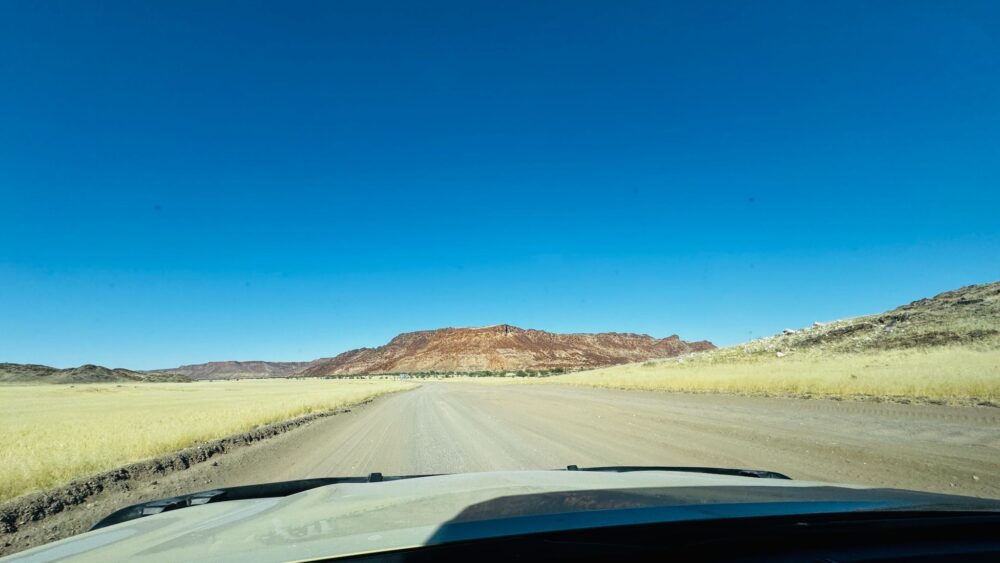
In Damaraland, most roads are gravel tracks. When we traveled there, they were in very good condition thanks to the continuous maintenance we saw being carried out throughout the route, so we were able to drive normally between 70 and 90 km/h.
However, having a 4x4 provides a lot of peace of mind if you want to detour to some accommodations, travel along secondary tracks or go on excursions to look for desert-adapted elephants.
To visit only Twyfelfontein , Damara Living Museum , Organ Pipes and Burnt Mountain , a high level of tourism may be sufficient depending on the condition of the slopes and the time of year.
But if you're going to explore Namibia independently, our recommendation is still to rent a 4x4 , as it will offer you much more freedom throughout the trip.
What is the best time to visit Damaraland?
Damaraland can be visited year-round, although conditions change considerably depending on the season.
We were there in early July , in the middle of the southern winter, and we think it was a fantastic time to explore the region.
During the day we enjoyed very pleasant temperatures, close to 25-28 °C , perfect for visiting and walking around Twyfelfontein.
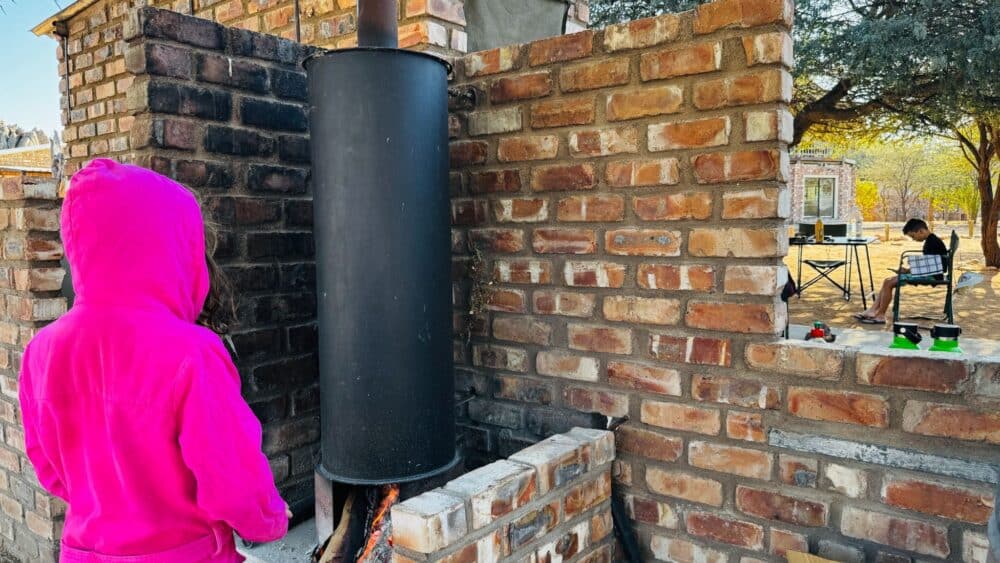
At night, however, the cold was much more intense. We recorded temperatures as low as 1°C at Kaoko Bush Lodge and 4°C at Twyfelfontein Elephant Drives & Campsite.
Fortunately, with a good sleeping bag we didn't get cold inside the rooftop tent.
If your main goal is to observe wildlife, the dry season (roughly May to October ) usually offers better opportunities, as animals congregate around the few available water sources.
If you want to learn more about the climate of each region of the country, we recommend also consulting our guide on the best time to travel to Namibia , where we analyze the weather conditions month by month.
Estimated budget for visiting Damaraland
One of the advantages of traveling independently in Damaraland is that you can adapt your budget considerably depending on the type of trip you are looking for.
These were approximately our expenses during this stage:
| Concept | Approximate price |
| Camping Kaoko Bush Lodge | 68 (4 people) |
| Twyfelfontein Elephant Drives Campsite | €67 (4 people) |
| Twyfelfontein Entrance | According to the current official rate |
| Damara Living Museum | According to the current official rate |
| Fuel Efficiency: | It will depend on the route |
| Desert elephant safari | Approximately 900 NAD per adult |
In our case, we were two adults and two children , cooking most of our meals at the campsite and combining private campsites with some lodges during the three-week trip.
We believe that Damaraland was not one of the most expensive regions of the trip, especially when compared to some accommodations in Etosha or certain activities on the coast.
If you want to know the complete budget for our trip, with all expenses broken down (vehicle, fuel, accommodations, entrance fees, food, flights and activities), you can consult our guide on how much it costs to travel to Namibia independently , where we detail the real cost of our 24 days traveling the country as a family.
Where to eat and shop in Damaraland
One of the main differences between Damaraland and other regions of Namibia is that services become considerably scarce here. Distances are vast, and between some towns, many kilometers can pass without finding a shop or a gas station.
Our advice is very simple: make your purchase before entering Damaraland.
We took advantage of our stop in Kamanjab to buy food at a Spar supermarket , refuel, and stock up on supplies for the following days. It was a very good decision, as the options are much more limited afterward and depend heavily on where you stay.
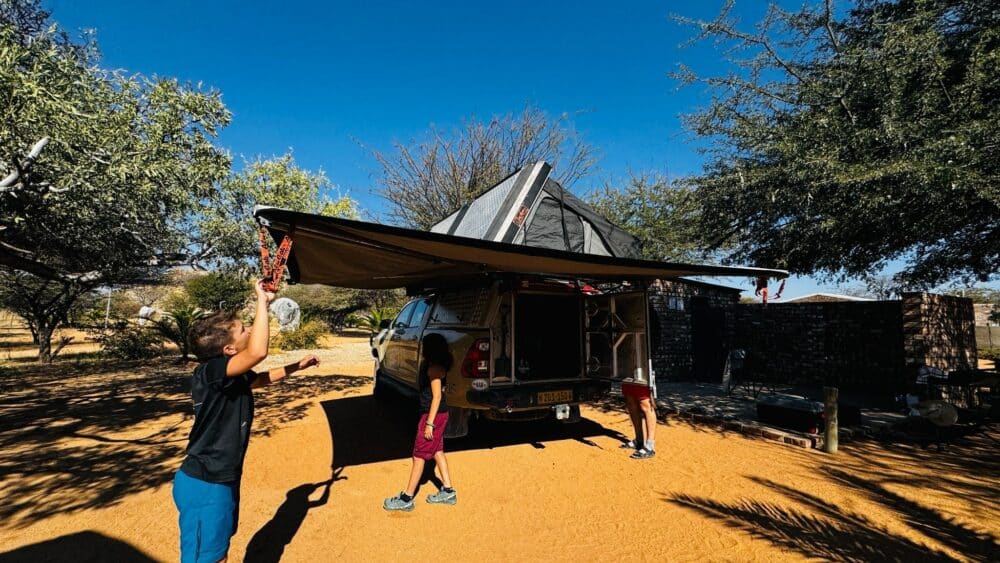
If you're traveling in a 4x4 with a rooftop tent like we were, most campsites have a barbecue area, making cooking very convenient and saving you a lot of money during your trip.
As for restaurants, both Kaoko Bush Lodge and Twyfelfontein Elephant Drives & Campsite have their own restaurants. We had dinner at Kaoko Bush Lodge, and it was a great choice for a relaxing evening after several days on safari.
Our advice: always keep some spare food and water in the vehicle. In Namibia, you never know when a small emergency might arise or when the next supermarket will be much further away than expected.
Mobile coverage, WiFi and electricity
One of the most surprising things when traveling through Damaraland is the enormous feeling of isolation.
For much of the route we found hardly any phone coverage and it is completely normal to drive for long kilometers without a mobile signal.
We did find WiFi at the accommodations where we stayed, especially in the common areas of Kaoko Bush Lodge , where we took the opportunity to download photos, review the trip plan and let the family know that everything was still going perfectly.
If you need to work during your trip or maintain frequent contact with home, it's always best to take advantage of times when you have a connection, as there can be many hours without coverage between stages.
We also recommend downloading Google Maps in offline mode beforehand or using apps like Maps.me or Tracks4Africa to navigate without relying on the internet.
For us, the best option is Holafly, which offers unlimited data to keep your social media updated and stay in touch with family and friends. It's undoubtedly the best option for price and data allowance . However, keep in mind that this option requires a latest-generation mobile phone that supports eSIMs.
If you don't have a state-of-the-art mobile phone, you may have problems, although we have found a solution to make e-sims work without having a state-of-the-art mobile phone like us: install an e-sim.me first.
You buy it online and the physical SIM card arrives at home and with its app you can now make the e-sim work by downloading it there. It makes the virtual card work for you without a problem, we have verified it on our trip. Read the QR that Holafly sends you in the app and you already have the e-sim installed and working on your mobile that is not the latest generation. And if it is of the latest generation, less hassle and it works super easily for you.
Finally, here's a 5% discount on your Holafly card that we've been given. Click the link below and enter the code Kucavana to get the discount. Using this link not only saves you money, but it also helps us maintain our blog with a small commission. And remember, we don't recommend anything we don't use ourselves, and we always recommend the best after extensive comparison and testing—it's our ethical code and our commitment to you.
Is it safe to travel through Damaraland?
After exploring this region independently for two days, we felt completely at ease.
The roads are not very busy, the people are very friendly and at no time did we feel unsafe.
As with any trip through remote areas, the main risk is not people, but the characteristics of the environment itself.
That's why we believe it's important to follow some basic recommendations:
- Avoid driving at night.
- Always carry enough drinking water.
- Refuel when you have the chance.
- Inform us of your itinerary if you plan to travel along less frequented trails.
- Always respect wildlife and do not leave the authorized trails.
In our case, we were also struck by the care some accommodations take in guest safety. At Twyfelfontein Elephant Drives & Campsite , for example, the staff gave us a walkie-talkie so we could contact reception during the night in case of any problems.
It was a detail that gave us a lot of confidence and reflects very well the professionalism with which many accommodations in this region work.
If you want to delve deeper into this topic, we have prepared a specific guide where we analyze in detail whether it is safe to travel to Namibia , including driving, wildlife, health, theft, and practical advice based on our experience traveling through the country for 24 days.
Damaraland with children: our family experience
One of the questions we get asked most often since we returned from Namibia is whether Damaraland is worth visiting with children.
Our answer is a resounding yes.
In fact, it was one of the regions where our children enjoyed themselves the most because every few hours the landscape changed completely and there was always something new to discover.
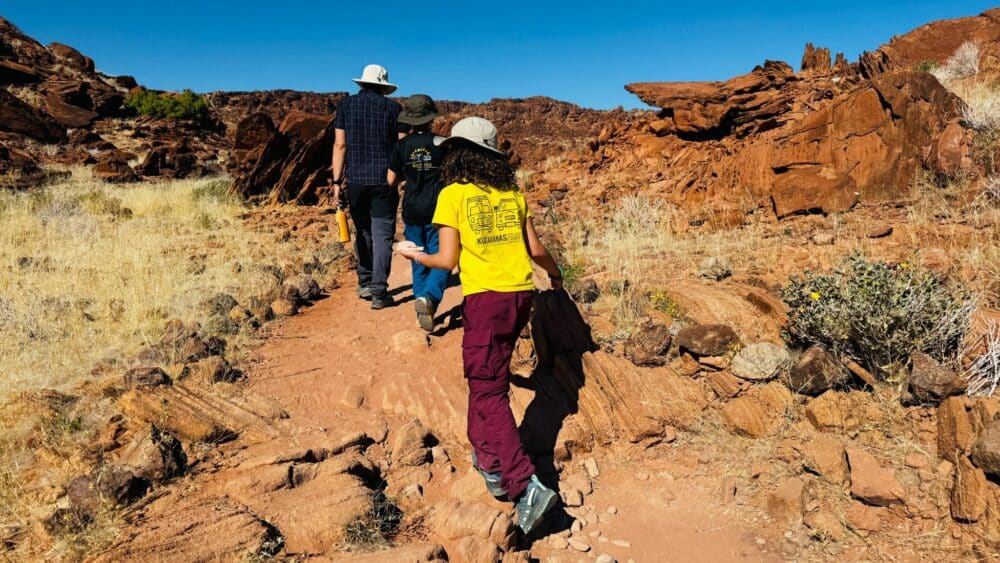
The petroglyphs of Twyfelfontein sparked a great deal of curiosity as visitors imagined how people lived thousands of years ago, while at the Damara Living Museum they were able to participate in traditional fire demonstrations, learn about medicinal plants, listen to the curious click language and discover customs completely different from our own.
The accommodations were also a big help. Both Kaoko Bush Lodge and Twyfelfontein Elephant Drives & Campsite had swimming pools, large outdoor areas, and plenty of space to play after spending several hours in the car.
Perhaps the only thing to keep in mind is the long distances on the road. We always tried to leave early, make several stops along the way, and avoid driving when the heat was at its most intense.
What our children liked the most
- Discover the rock engravings of Twyfelfontein.
- Learn to make fire at the Damara Living Museum.
- See Himba women up close in Kamanjab.
- Swimming in the pools at campsites.
- Sleeping every night in the rooftop tents of the 4x4.
If you are traveling as a family, we believe Damaraland offers a perfect balance between adventure, nature and learning.
If you want to know more about Namibia with children, I suggest you read our complete guide.
Our final assessment of Damaraland
After traveling through virtually all of Namibia, Damaraland ended up occupying a very special place among our travel memories.
It is not the region with the most animals, nor the one with the most spectacular dunes or the most beautiful cities.
And yet, it was one of the ones that moved us the most.
Here we find a much quieter, more authentic, and less crowded Namibia. A place where the history of the ancient San and Damara peoples coexists with volcanic landscapes, dry riverbeds traversed by desert-adapted elephants, and endless roads that invite you to drive without looking at the clock.
If we had to summarize Damaraland in a single sentence, it would be this:
The region where Namibia ceases to be a tourist destination and becomes a true adventure.
Our Kucavana note
| Appearance | Valuation |
| Landscapes | ⭐⭐⭐⭐⭐ |
| Culture | ⭐⭐⭐⭐⭐ |
| Fauna | ⭐⭐⭐⭐☆ |
| 4x4 Driving | ⭐⭐⭐⭐⭐ |
| Traveling with children | ⭐⭐⭐⭐⭐ |
| Massification | ⭐☆☆☆☆ |
| Overall experience | ⭐⭐⭐⭐⭐ |
If we were to return to Namibia tomorrow, we would repeat this exact stage… with one difference: we would add one more day to explore Brandberg , visit Palmwag and try to find the famous desert-adapted elephants.
Frequently Asked Questions about Twyfelfontein and Damaraland
Where is Damaraland?
Damaraland is located in northwestern Namibia , between Etosha National Park , the Skeleton Coast , Kaokoland, and the Brandberg region. It is one of the largest and least populated areas in the country.
Where is Twyfelfontein?
Twyfelfontein is located in the heart of Damaraland, about three hours by road from Kamanjab and approximately four hours from Swakopmund, depending on the condition of the tracks and the stops you make along the way.
Is Damaraland worth visiting?
Yes, without a doubt. For us, it was one of the biggest surprises of our trip to Namibia. It combines spectacular landscapes, traditional culture, desert-adapted wildlife, and one of the most important archaeological sites in Africa.
How many days are needed to visit Damaraland?
We recommend dedicating two full days . This is enough time to visit Twyfelfontein, the Damara Living Museum, Organ Pipes, and Burnt Mountain at a leisurely pace. If you have a third day, you can add Brandberg, Palmwag, or a safari to look for desert-adapted elephants.
Is it necessary to hire a guide to visit Twyfelfontein?
Yes. The visit to the petroglyph complex is conducted exclusively with an official guide, who also explains the historical and cultural significance of the main engravings.
Do you need a 4x4 to travel through Damaraland?
It's not essential to reach Twyfelfontein, but it's the option we recommend if you're traveling independently in Namibia. Many roads are gravel tracks, and a 4x4 offers greater safety and comfort.
Can you visit Damaraland with children?
Yes. We traveled through this entire region with our children, and it was one of the parts of our trip they enjoyed the most. The sights are very varied, and the accommodations are generally well-suited for families.
What is the best time to visit Damaraland?
The dry season, between May and October , is usually the best time to travel. We were there in July and enjoyed sunny days with very pleasant temperatures and quite cool nights.
Where can you see desert elephants?
The best areas are around Twyfelfontein , Palmwag , and some dry riverbeds of the Huab and Aba Huab rivers. The most common way to try to see them is through guided tours organized by local accommodations.
What is the must-see attraction in Damaraland?
If you only have a few hours, we recommend visiting Twyfelfontein and the Damara Living Museum . We believe that together they offer the best combination of heritage, history, and culture in the entire region.
Our journey continues: next stage, the Skeleton Coast
After two days exploring Damaraland, it was time to say goodbye to one of the regions that surprised us the most on the entire trip.
Early in the morning we packed up camp at Twyfelfontein Elephant Drives & Campsite and headed towards the Atlantic Ocean. Ahead of us lay several hours of driving through an increasingly arid landscape until we reached one of the places we were most excited to see: the Skeleton Coast.
That change of scenery was absolutely spectacular. We left behind volcanic mountains, petroglyphs, and ancient culture to venture into a wild coastline where the desert meets the ocean amidst mists, ancient shipwrecks, and miles of utter solitude.
Continue organizing your trip to Namibia
If you're planning a self-guided trip through Namibia, these are the guides that will best help you plan your journey:
🇳🇦 Complete guide to traveling to Namibia
All the information about visas, safety, budget, best time to go, 4x4 rentals, accommodations and planning.
👉 Trip to Namibia: a complete guide for independent travel
🗺️ What to see in Namibia
The must-see places in the country, our favorites and the corners that surprised us the most during 24 days of travel.
Latest posts from our blog
-
Definitive manual for traveling by motorhome【2024】
Super complete manual for traveling by motorhome with all the answers to your questions.
-
Namibia Trip: Complete Guide for Independent Travel (24-day Itinerary, What to See and Tips Based on Our Experience)
Are you thinking of planning a trip to Namibia on your own and don't know where to start? After traveling the country for 24 days as a family in a 4x4 with rooftop tents, we've put together this comprehensive guide with everything we wish we had known before our trip. Here you'll find information…
-

London with children: what to see and do as a family (royal guide with map) of the top 22 plans
If you're planning a trip to London with kids and don't know where to start, here you'll find the 22 best family-friendly activities, an optimized 3-day itinerary, money-saving tips, the best free museums, and an interactive map with all the must-see places. Basic summary: London with kids. Quick information. Recommended days: 3-5…
-
Guide to traveling to Canada: everything you need to know for a trip to Canada on your own
Welcome to a super guide for traveling to Canada from Spain or anywhere in Europe. One of our newest destinations in this wonderful world, where every trip continues to surprise us with its hidden gems. How lucky we are to have been born on Earth! How fortunate to be able to travel to Canada! Visiting Canada…
Ethical code:
On our blog you will find affiliate links. These are always placed with our highest ethics. We never publish any service or product that we have not used before and that we are sincerely happy with. That is why our recommendations are always ethical. In addition, there is no additional cost for you to book through our links and, on the other hand, it means a small commission for us that helps us maintain this blog so that you can continue enjoying it for free.