

Table of Contents
Exploring Namibia independently is one of the greatest adventures you can experience in Africa and, arguably, one of the best countries in the world for an authentic 4x4 road trip . Few destinations so perfectly combine the freedom of driving at your own pace, the opportunity for independent safaris , otherworldly landscapes, and the feeling of exploring some of the wildest and most spectacular corners of the continent.
If you're thinking about traveling to Namibia independently , you're probably asking yourself the same questions we did before starting to plan this adventure: Is it necessary to rent a 4x4? How many days are needed to travel around the country? How much does a trip to Namibia independently really cost ? Is there cell phone coverage? Where to sleep? How to plan the best route or what places are must-sees?
If you're still planning your trip, we recommend starting with our complete guide to traveling to Namibia , where you'll find all the information you need to organize your route.
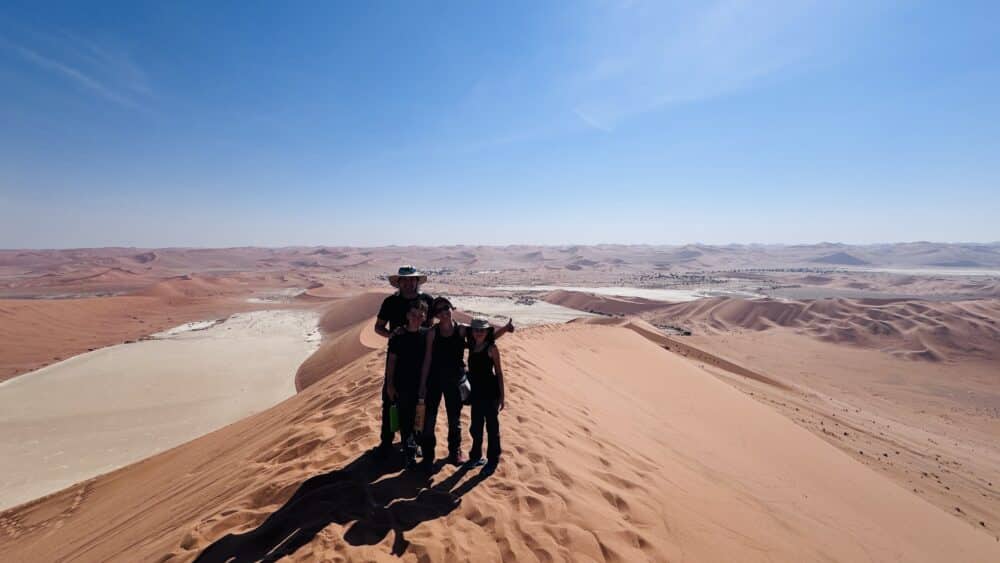
Our experience traveling independently through Namibia for 24 days
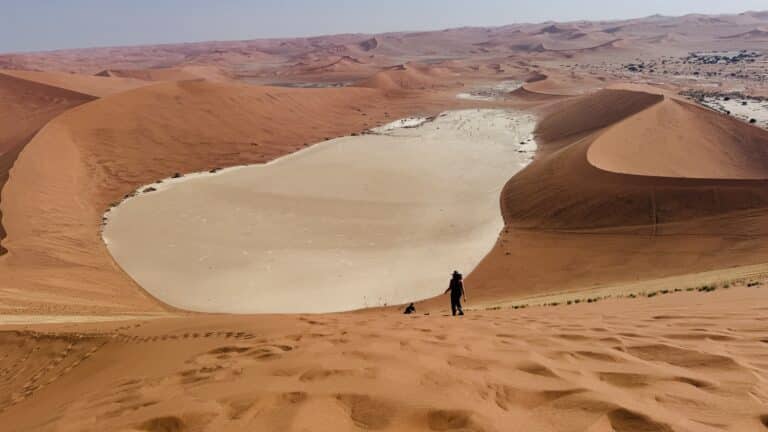
After traveling the country for 24 days in a 4x4 , as a family, and covering more than 5.000 kilometers in Namibia , we can say that this is one of the most breathtaking destinations we have ever visited. From the giant dunes of Sossusvlei to the safaris in Etosha, passing through the remote Caprivi Strip, the Skeleton Coast, and the endless landscapes of Damaraland, each stage confirmed that traveling independently in Namibia is a truly unique experience.
In this guide you will find everything we wish we had known before embarking on our independent trip through Namibia : how to plan your itinerary step by step, how to organize a 4x4 trip to Namibia , how much budget you need, where to stay, how to get around the country, how to pay, what coverage you will have during the trip and all the practical tips we learned on the ground after more than three weeks of adventure.
Yes, organizing a trip to Namibia independently requires a bit more planning than other destinations, but the reward is enormous: unforgettable sunrises in the desert, encounters with wildlife in its natural habitat, nights under some of the most starry skies on the planet, endless roads, and a sense of freedom that is hard to find anywhere else in the world.
If you dream of taking a road trip through Namibia , discovering the country at your own pace and experiencing an adventure you'll remember for a lifetime, here you'll find all the information you need to prepare for the trip and make the most of every kilometer traveled.
Namibia on your own: a quick summary of our independent trip to Namibia, an experience that inspired this post
| Appearance | Our experience |
| Duration | 24 days |
| Vehicle | Toyota Hilux 4x4 |
| kilometers | More than 5.000 km |
| Travellers | 2 adults + 2 children |
| Security | Very high |
| Mobile coverage | Limited outside of cities and paved roads |
| Best advice | The most dangerous thing about Namibia: driving. Don't drive at night or overtake on undulating roads. |
| Insurance | IATI Star unlimited coverage |
| Best time | June to September |
| Accommodation | Public NWR campsites within some national parks and private campsites and lodges with online booking with this platform much better and cheaper than public ones |
How to organize a trip to Namibia independently, step by step
Organizing a trip to Namibia independently may seem complicated at first, but after traveling the country for 24 days in a 4x4 with our children, we can say that it is much simpler than it seems.
The first thing to do is book your international flights . We flew with Lufthansa, making a single stop in Munich, and arrived in Windhoek the next morning, ready to start our adventure.
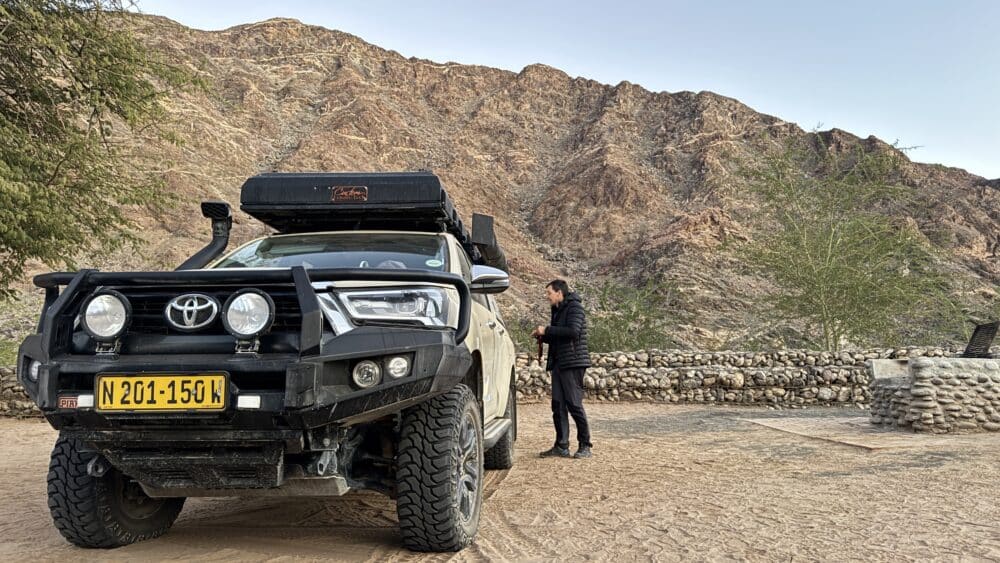
The second step, and probably the most important, is to book your 4x4. If you're traveling during peak season (June, July, August, or September), it's best to do this several months in advance. We rented an automatic Toyota Hilux equipped with two rooftop tents, a kitchen, a refrigerator, and all the camping gear we needed to explore Namibia independently. The earlier you book, the more you'll save.
From the most material to the route
Next comes defining the route . Namibia is enormous, and distances can be deceiving. We invested a considerable amount of time planning the stages to avoid driving at night and make the most of places like Etosha, Bwabwata, Spitzkoppe, Swakopmund, Sossusvlei, and Fish River Canyon.
We also recommend booking accommodations and campsites well in advance, especially within national parks , where spaces can sell out months ahead of time. Honestly, this is the most tedious part of the whole trip planning process. You have to stay in campsites for your own safety, and there are few and very small ones available, so you need to book well in advance and be patient with emails and bank transfers… it's not like here where you can book online with a single click…
Finally, don't forget to get good travel insurance , apply for your visa, obtain your international driving permit, and download offline maps before you leave.
The reward is enormous: once you land in Namibia, the feeling of freedom that comes with exploring the country independently is hard to describe.

Is a 4x4 necessary to travel independently in Namibia?
This is one of the questions we were asked most before our trip and the short answer is: it depends.
If you're only planning to visit popular tourist destinations like Windhoek, Swakopmund, Sossusvlei, or even Etosha National Park, you could do part of the trip in a regular car . In fact, we saw quite a few regular cars driving on some of the main roads.
However, if you want to enjoy an authentic Namibian experience on your own , explore less touristy areas and have total freedom of movement, our recommendation is clear: rent a 4x4.
We traveled over 5.000 kilometers through Namibia in a Toyota Hilux equipped with two rooftop tents. Thanks to this, we were able to move around with ease through Etosha, Bwabwata, Damaraland, the Skeleton Coast, and the tracks leading to some of the most spectacular places in the country.
IMPORTANT TIP: If you're traveling to Namibia, rent a 4x4 with a rooftop tent; it's undoubtedly the best option for independent travel. Asco Car, with whom we rented without any issues and highly recommend, has given us a 5% discount that you can all use by booking with them on their website and adding the discount code @KUCAVANA.
Furthermore, the 4x4 doesn't just provide comfort. It also provides safety. During our route, we encountered deep sand, long gravel tracks, bumpy roads, and situations where having all-wheel drive made all the difference.
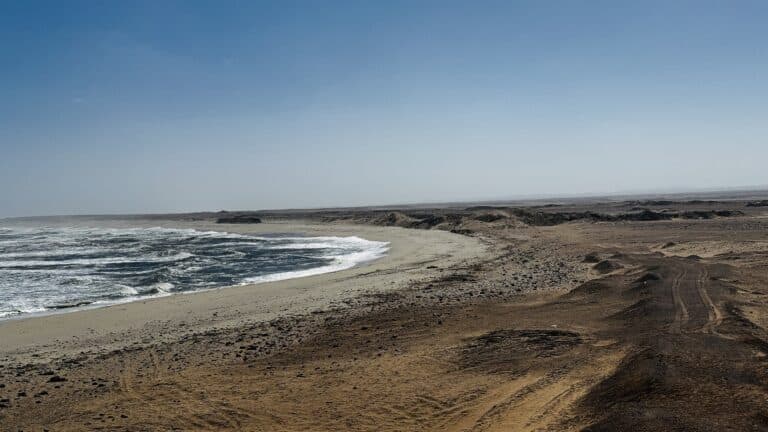
I particularly remember a day on the Skeleton Coast where we saw some South African travelers completely stuck in a small SUV, but without 4x4 capability, on a dune. We managed to get through thanks to the advice of a local guide and the capabilities of our vehicle.
We rented our vehicle fully equipped for camping and would repeat exactly the same choice.
Our advice on renting a 4x4 in Namibia
Book well in advance, especially if you're traveling between June and September.
The best vehicles sell out quickly and prices tend to rise considerably as the travel date approaches.
We also recommend taking out comprehensive insurance. The gravel roads are constantly littered with stones, and we saw several vehicles with damage to their windows and bodies during our trip through Namibia.
Read our guide to Namibia by 4x4 to discover what you should consider when renting a 4x4 in Namibia, what prices it has, driving and safety tips behind the wheel and much more.
Internet and mobile coverage in Namibia
One of the things that worried us most before traveling to Namibia independently was connectivity.
Would we have internet? Would Google Maps work? Would we be cut off from communication for days?
After traveling through Namibia for 24 days, we can say that the answer depends a lot on the area.
In cities like Windhoek, Swakopmund, Walvis Bay, and Lüderitz, we had coverage almost constantly. However, in remote locations such as Bwabwata, Damaraland, the Skeleton Coast, and parts of Caprivi, communications disappear completely for long periods.
The best place to get coverage and data in Namibia is on the country's paved roads, which are few but do exist.
Our experience with internet in Namibia
We mainly used the WiFi in accommodations, campsites and apartments , which worked reasonably well most of the time.
Apart from taking advantage of data and coverage on the paved roads , which was where there was always the most coverage, and in fact the local people are around with their mobile phones.
In addition, we had Google Maps downloaded offline and it was one of the most useful tools of the entire trip.
Thanks to this, we were able to continue our route through Namibia independently, even in places where there was absolutely no coverage.
Is it worth buying an eSIM for Namibia?
Yes.
If you want internet access from the moment you land, an eSIM like Holafly, with the 5% discount we're offering here for unlimited data in Africa, can be a very convenient option to stay connected in the country's main cities and tourist areas. You can buy it before you leave and have everything ready.
However, it's important to understand that no SIM card will solve the lack of coverage in some of Namibia's more remote regions.
Is a satellite phone necessary?
For most travelers, it's probably not essential.
We decided to rent one along with the 4x4, and although we didn't have to use it, it gave us a lot of peace of mind during stretches where we could go for hours without seeing another soul. Although, to be honest, if you go between June and September, I think you'll always come across someone without any problem.
If you're planning to travel around Namibia independently, especially with family or in very isolated areas, we believe it's a highly recommended investment.
Our summary after more than three weeks traveling through Namibia is simple: download offline maps, bring a portable charger for your phone, and don't assume you'll always have cell service. Namibia is a vast country, and part of its magic lies in disconnecting from the world for a few days.
Is it safe to travel independently to Namibia?
One of the questions we were asked most before our trip was whether Namibia is a safe country to travel independently in a 4x4.
After traveling over 5.000 kilometers in 24 days as a family, our experience was very positive. In fact, Namibia seemed to us to be one of the safest countries in Africa for a self-drive road trip.
Throughout the trip we passed through cities like Windhoek, Swakopmund or Lüderitz, explored national parks like Etosha and Bwabwata and went through some of the most remote regions of the country without suffering any crime-related incidents.
However, that doesn't mean there are no risks.
Interestingly, the main danger we encountered in Namibia was not people, but the conditions of the journey itself: the enormous distances, the gravel roads, driving on sand, animals crossing the tracks, or the temptation to drive at night.
Therefore, although Namibia is a very safe destination for independent travel, it is advisable to plan your route well, drive carefully, and always respect local recommendations.
In our comprehensive guide to safety in Namibia , we tell you in detail about our experience, the real risks we encountered, the safest areas of the country, the mistakes we would avoid, and all the practical tips we learned while traveling around Namibia for 24 days in a 4x4.
Travel insurance: mandatory for entry into the country and essential in Namibia
If there's one thing we don't recommend skimping on during a trip to Namibia, it's travel insurance.
We traveled the country independently for 24 days in a 4x4 , passing through remote places like Bwabwata, the Skeleton Coast, Damaraland, and Fish River Canyon. In many of these areas, you can go for hours without seeing another vehicle, and the nearest medical centers can be hundreds of kilometers away.
That's why we opted for IATI Estrella , the insurance we usually use for big family trips and which we consider one of the most comprehensive options on the market today, since the coverage amount they give you is unlimited.
Best travel insurance for Namibia: our experience with IATI Estrella. Why did we choose it?
These were the main reasons:
- Unlimited medical assistance (no limit on millions of euros!) outside of Europe, something that gave us a lot of peace of mind while traveling with children.
- Repatriation and medical transport covered 100% in case of accident or serious illness.
- Baggage coverage up to €4.000including cameras, mobile phones and electronic devices, which is important when you travel with so much photographic equipment.
- 24-hour medical chat from the app, very useful if you are traveling as a family and any medical questions arise during the trip.
- Coverage for 4x4 routes and regular adventure activities, something very interesting in a destination like Namibia.
In addition, there is the option to add travel cancellation insurance to recover expenses if you are ultimately unable to travel for any of the reasons covered by the policy.
Our recommendation
Fortunately, we didn't have to use the insurance during the trip, which is precisely what we all hope for when we purchase it. But after driving over 5.000 kilometers through some of the most isolated areas of Africa, we can say that traveling with good coverage allowed us to enjoy the adventure with much greater peace of mind.
If you're planning your trip, you can get the same insurance we use with a 5% discount through this link :
IATI Estrella insurance with a 5% discount
In a destination like Namibia, where distances are enormous and medical assistance can be very far away, for us it was one of the best investments of the whole trip; luckily we didn't have to use it, but it was a peace of mind.
Paying by card and carrying cash in Namibia: our real experience
One of our biggest questions before traveling was whether we needed to carry a lot of cash or if we could pay by card in Namibia. After exploring the country independently for over three weeks, going on safaris, staying in campsites and lodges, and covering thousands of kilometers in a 4x4, our conclusion is clear: in Namibia, you can pay for practically everything by card.
During our trip, we paid by card for accommodations, restaurants, supermarkets, gas stations, activities, and most tourist services without any problems. In fact, we were surprised by how widespread card payments are, even in quite remote places.
However, that doesn't mean you shouldn't carry some cash.
In our experience, cash was primarily needed for:
- Tips.
- Buy local crafts, don't forget to do this because it's the only way you can help local people.
- Small markets or stalls managed by local communities.
- Specific situations arising from power outages, which are quite common there.
And here's an anecdote that demonstrates why we always recommend carrying some cash.
During our stay at Ngepi Camp, in the Bwabwata and Caprivi Strip area, we experienced a power outage that lasted almost the entire two days we were there. We had already paid for our accommodation with the booking, but we couldn't pay by card for meals or activities because the terminals weren't working. The staff explained that these kinds of widespread power outages are relatively common in some parts of the country. The good thing is that they gave us the bill and said we could pay it by bank transfer when we could; they're clearly used to this happening.
Imagine the situation. Here in Spain, if the power goes out for eight hours, it feels like the end of the world. There, they lived with it with admirable tranquility.
Therefore, although Namibia is a country where the card works very well, we always recommend carrying an emergency cash fund.
How much cash should I bring to Namibia?
For a route similar to ours, of between 20 and 25 days traveling the country independently, our recommendation would be to exchange approximately 300 euros per person for Namibian dollars.
It doesn't mean you're going to spend it all, but it will allow you to deal with unexpected expenses, tips, local purchases, or situations like the one we experienced in Caprivi without worries.
Where can I exchange money in Namibia?
Our recommendation is simple: bring euros from Spain and exchange them upon arrival at Windhoek International Airport.
Airport currency exchange offices are usually one of the safest, most transparent, and most convenient options to start your trip with enough cash.
Halfway through our trip, we also withdrew money from an ATM in Swakopmund. The exchange rate was slightly worse than at the airport, but it proved to be a convenient and safe solution.
Conversely, we do not recommend using small ATMs located in supermarkets or shops in remote villages. They are known for offering worse exchange rates, higher fees, and, according to both travelers and locals, more frequent card issues.
The Namibian dollar and the exchange rate
The official currency is the Namibian dollar (NAD).
An interesting feature is that it maintains a virtually identical parity with the South African rand (ZAR), so both currencies are often accepted interchangeably in many parts of the country.
Before traveling, it is advisable to check the updated euro-Namibian dollar exchange rate, although the daily variation usually has little influence on the total trip budget.
Our advice for paying by card in Namibia
Whenever possible, pay by card.
Besides being more convenient and safer, you'll usually get a better exchange rate than by exchanging cash multiple times during your trip.
However, there is an important trick: when the terminal asks you if you want to pay in euros or Namibian dollars, always select Namibian dollars (NAD).
This way, your bank will apply the currency exchange and you will avoid the extra costs of the dynamic conversion that stores usually offer.
And one last piece of advice: before you travel, look for a card with low currency exchange fees.
That said, don't get too hung up on it. After comparing many options, we've come to a rather amusing conclusion: when a card doesn't charge fees, it usually offers a slightly less favorable exchange rate. In the end, one way or another… the bank almost always wins.

How much does it cost to travel to Namibia independently?
One of the questions we were asked most before traveling was how much it really costs to travel independently in Namibia.
The answer depends a lot on the type of trip, but in our case, a 24-day route for a family of four had a total cost of €13.313 , including flights, 4x4 rental, gasoline, accommodations, national park entrance fees, activities, visas, food and travel insurance.
Most of the budget went towards renting the 4x4 and international flights. However, once there, we discovered that sleeping in campsites, cooking many of our meals, and doing our own safaris allowed us to keep costs under control.
Compared to other African destinations where organized safaris are practically mandatory, Namibia offers excellent value for money for those who enjoy independent travel and adventure.
We don't consider it a cheap destination, but we do believe that the cost is fully justified by the experience it offers: unique landscapes, wildlife, absolute freedom, and some of the best road trips in the world.
You can find our full budget in the guide on how much a trip to Namibia costs , where we detail flights, 4x4 rental, fuel, campsites and activities.
Booking accommodation independently in Namibia: public and private campsites and exhausting reservations
If there's one thing we would do exactly the same on our next trip to Namibia, it's to book as much accommodation as possible through this platform.
During the planning process, we encountered accommodations that took weeks to respond, others that never replied at all, unclear booking systems, and international bank transfers with quite high currency exchange fees. In some cases, we even had to pay significant amounts upfront without any platform to automatically confirm that everything was correctly booked.
However, I should also warn you about one thing: if you want to sleep inside some national parks, especially in Etosha, you will have no choice but to deal with NWR (Namibia Wildlife Resorts) , the public company that manages many of the campsites and lodges in Namibia's national parks.
And here comes one of the things that surprised us most about the trip.
Public versus private campsites
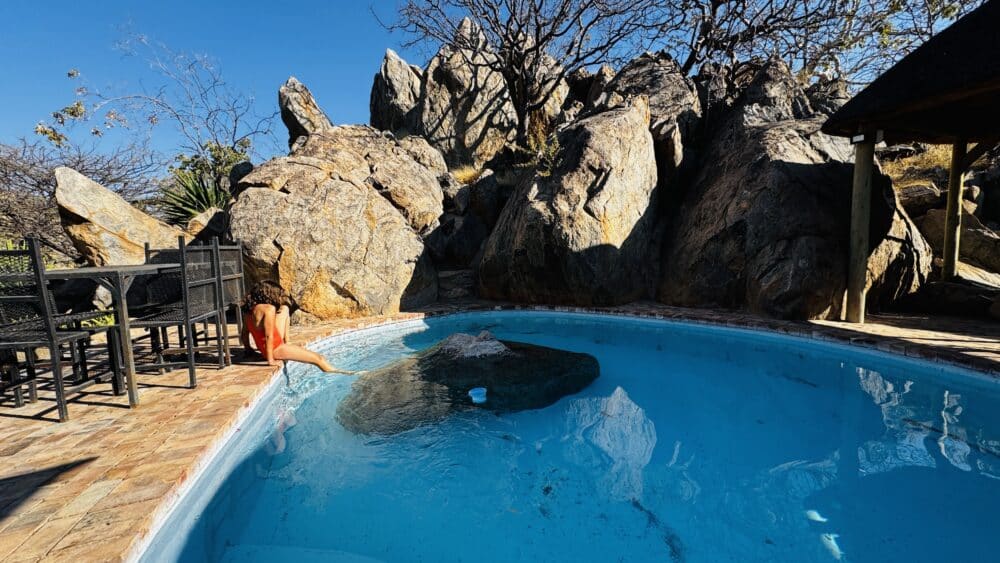
Public campsites within parks are usually considerably more expensive than many private campsites in Namibia and, at least in our experience, generally offer worse facilities and services, although obviously the locations are the best.
To give you an idea, we ended up paying around €120 for a camping pitch inside Etosha , while outside the park we found more modern private campsites with even exclusive bathrooms within the same pitch, a swimming pool, better maintained pitches and much lower prices, sometimes half the price.
With everything we booked online through the platform I mentioned earlier, everything was much simpler. We were able to compare options, read up-to-date reviews, manage date changes, cancel some reservations when we modified our route, and have all the confirmations centralized on a single platform.
Furthermore, during a trip as long as ours, with 24 days exploring Namibia in a 4x4, last-minute changes are more common than you might think. Having flexible bookings gave us a lot of peace of mind. I booked most of them with free cancellation, for example.
In this link you can check the accommodations we used during our trip through Namibia , many of which we would book exactly the same if we went back tomorrow.
Honestly, the few euros you might save by booking directly with accommodation don't compensate for the hours spent sending emails, chasing replies, making international transfers, or trying to clarify if the booking has actually gone through.
Our 24-day independent route through Namibia
For us, one of the great advantages of traveling to Namibia independently is being able to design a route completely tailored to your interests and travel pace.
For 24 days we traveled over 5.000 kilometers in a 4x4, crossing some of the most spectacular places in the country. Our route began in Waterberg, continued to the Caprivi Strip and Bwabwata National Park, then on to Etosha, Damaraland, the Skeleton Coast, Swakopmund and Walvis Bay, before venturing into the Namib Desert, Sossusvlei, Lüderitz and Fish River Canyon, finally returning to Windhoek.
It was a very complete route that combined self-drive safaris, desert landscapes, local culture, wildlife and some of the best road trips we have ever done as a family.
If you have three or four weeks, we believe this itinerary allows you to discover the best of Namibia at a leisurely pace and truly enjoy each stage.
👉 You can check our complete itinerary, day by day, accommodations, kilometers, budget and experiences in our 24-day Namibia 4x4 route guide.
What to see independently in Namibia?
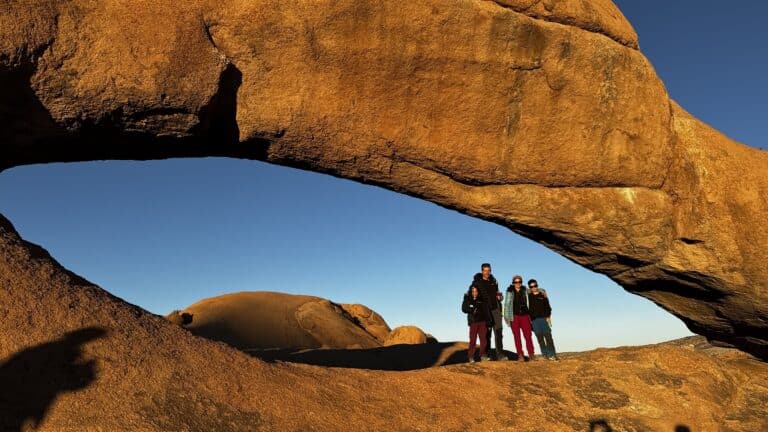
Namibia is one of those countries where every few days it feels like you're traveling through a completely different place. During our trip, we encountered deserts with giant dunes, coastal cities with German influence, spectacular safaris, immense canyons, and some of the most beautiful roads we've ever driven.
Among the must-see places that we would include in any trip are Etosha National Park , the Sossusvlei and Deadvlei dunes , the coastal area of Swakopmund and Walvis Bay , the wild Skeleton Coast , or the amazing Caprivi region and Bwabwata National Park.
However, Namibia is much more than these places. During our trip, we discovered lesser-known corners that ended up being some of the biggest surprises of the journey.
👉 In our complete guide to What to See in Namibia you will find all the must-see places, a map, recommendations and tips to design your ideal itinerary according to the number of days of travel available.
Checklist for traveling independently to Namibia
After our experience touring Namibia in a 4x4 for 24 days, this is the list we would take again without hesitation.
Essential documentation
✅ Passport with at least 6 months validity.
✅ Visa for Namibia.
✅ International driving permit.
✅ Accommodation bookings and 4x4 rental.
✅ Travel insurance with comprehensive medical coverage.
✅Birth certificates with sworn translation for minors
✅ Digital copies of all documentation.
Luggage we actually use
✅ Cool and technical clothing for the day, but always long trousers for safety, but thin ones.
✅ Fleece or winter coat jacket for cold mornings and evenings.
✅ Sunglasses and a cap.
✅ High protection sunscreen.
✅ Empty hair mask pot (for girls) and small Aquarius bottle as urinals for the nights so you don't have to go down to the shops with wild animals.
✅ Headlamp for the nights.
✅ Binoculars for safaris.
✅ Basic and not-so-basic first aid kit of medicines (antihistamines, antibiotics…)
Essential for the 4x4
✅ Google Maps downloaded offline.
✅ Car charger with USB ports and power bank.
✅ Water and some emergency food.
✅ Cash for small expenses or tips.
✅ Always check the spare tire and tools before leaving, and have a tire inflator ready when you need to lower the pressure for driving on sand.
Health and Safety
✅ Recommended vaccines up to date, after visiting the international vaccination center in Spain.
✅ Malaria prophylaxis if you visit Caprivi or Bwabwata or Etosha or northern Namibia, which you can get at the international vaccination center.
✅ Traveler Registration of the Ministry of Foreign Affairs.
✅ List of emergency phone numbers and health insurance information always at hand.
✅ Never drive at night or overtake on undulating roads with continuous slight changes in gradient.
✅ Satellite phone that we rented where the car was (highly recommended in remote areas).
Our most important advice
If we could only give one recommendation, it would be this: plan your stages well and always arrive at your accommodation before sunset.
It's the advice we heard most often in Namibia and probably the one that contributed most to our trip going smoothly.
Why do we recommend traveling independently to Namibia?
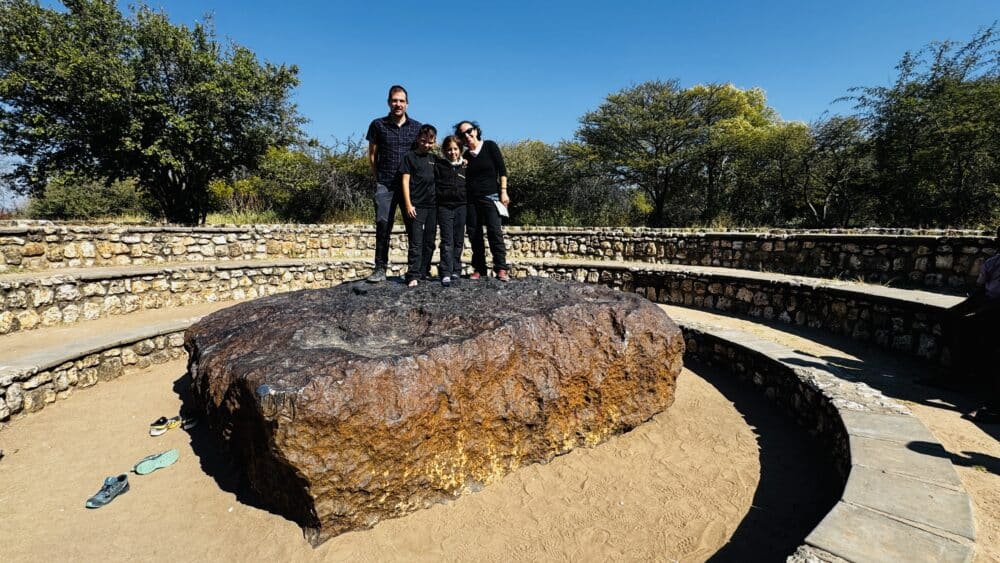
After traveling through Namibia for 24 days in a 4x4, we can say that it is one of the world's destinations that makes the most sense to visit independently.
Unlike other African countries where you constantly depend on guides, drivers, or organized safaris, in Namibia you set the pace for your adventure . You can stop when a giraffe appears by the side of the road, change your route on the fly because you fall in love with a place, or spend an hour gazing at a waterhole in Etosha, waiting for animals to appear.
Furthermore, traveling independently in Namibia is usually cheaper than going through an organized tour. Safaris in Etosha or Bwabwata can be done in your own vehicle, the campsites are very well-equipped, and you have complete freedom to tailor your budget to your travel style.
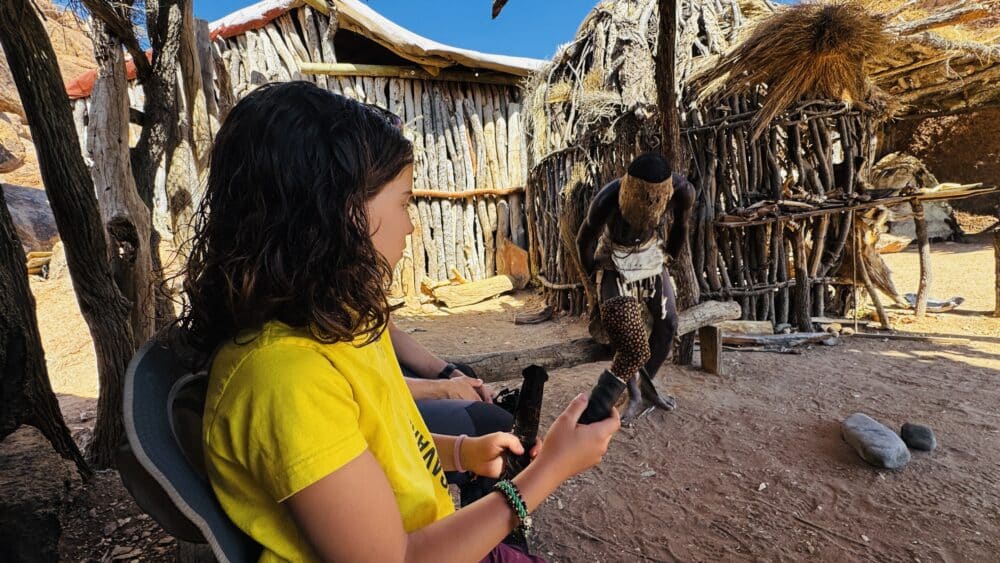
But for us, the biggest difference was the feeling of adventure while feeling very safe at all times . Sleeping under one of the most star-filled skies on the planet, listening to hippos from our treehouse at Ngepi Camp, driving along the Skeleton Coast, or traversing the immense landscapes of Damaraland are experiences we enjoyed at our own pace and without depending on anyone.
It's also an ideal destination for families experiencing Africa for the first time . We traveled with our children and never felt unsafe. On the contrary, Namibia struck us as a peaceful, well-organized country, perfect for introducing children to the world of safaris, nature, and long journeys.
If you ask us today whether it's worth organizing a trip to Namibia independently, our answer is a resounding yes. It requires a bit more planning than other destinations, but in return it offers a freedom, a connection with nature, and a sense of adventure that are hard to find anywhere else in the world.
Who do we recommend Namibia for when traveling independently?
After our experience touring Namibia for 24 days in a 4x4, we believe it is a perfect destination for many types of travelers, but especially for those who enjoy freedom and adventure.
We recommend independent travel to Namibia for families who want to experience a unique connection with nature , couples looking for a great adventure trip, and independent travelers who enjoy designing their own routes.
It is also a spectacular destination for safari lovers, as it allows you to observe wildlife independently in places like Etosha or Bwabwata without having to hire expensive organized safaris.
And if you're passionate about road trips, Namibia is probably one of the best countries in the world to drive through and explore at your own pace. Endless deserts, lonely roads, spectacular landscapes, and the constant feeling of living a true adventure make traveling independently in Namibia an unforgettable experience.
On the other hand, if you're looking for an urban trip, with little driving time or a fully organized trip, there are probably more suitable destinations for you.
Frequently asked questions about traveling independently in Namibia
Do I need vaccinations to travel to Namibia?
There are no mandatory vaccinations for most travelers from Spain. We recommend always consulting with an International Vaccination Center before your trip, especially if you are visiting malaria-risk areas such as Caprivi or Bwabwata.
Do you need an international driving permit in Namibia?
Yes. Although many companies also accept a Spanish driving license accompanied by a sworn translation, it is highly recommended to travel with an international driving permit to avoid problems during vehicle rental or potential checks.
Is it easy to rent a 4x4 in Namibia?
It's very easy. Most travelers who take a self-guided trip through Namibia rent a 4x4 in Windhoek. We consider it the best option for exploring the country with complete freedom and easily accessing places like Etosha, Damaraland, Sossusvlei, or Bwabwata.
Is a 4x4 essential for traveling through Namibia?
It depends on the route. To visit only the most touristy places, you could use a conventional car, but if you want to do a complete tour of Namibia and enjoy the experience to the fullest, we definitely recommend a 4x4.
What is the biggest danger when traveling through Namibia?
Without a doubt, avoid driving at night. Wild animals constantly cross the roads, and many roads lack lighting. It's the safety advice we hear most often during our travels, and also the most important one we can give you.
How many days does it take to travel around Namibia independently?
Although it's possible to visit the main attractions in 10 or 15 days, we believe that 3 to 4 weeks is ideal. We spent 24 days on our trip and still had places left to visit on a future trip.
Is it expensive to travel independently to Namibia?
Namibia isn't a cheap destination, but it's usually considerably more affordable than other African safaris. By traveling independently, staying in campsites, and using your own vehicle for safaris, you can much better control your budget.
What is the best route through Namibia?
It depends on the time available, but a classic route usually includes Windhoek, Etosha, Damaraland, Swakopmund, Walvis Bay, Sossusvlei, and Fish River Canyon. If you have more days, we recommend adding Caprivi and Bwabwata, two of the areas that surprised us the most.
How much does it cost to rent a 4x4 in Namibia?
The price depends on the season, the model, and the equipment. In our case, renting a Toyota Hilux with two rooftop tents, full insurance, and camping equipment for 22 days was one of the largest expenses in our trip budget.
Conclusion about traveling independently in Namibia
Traveling to Namibia independently has been one of the most incredible adventures we have experienced as a family.
We took away memories of sunrises in the desert, unforgettable safaris in Etosha, nights listening to hippos from our tree house in Caprivi, rhinos walking alongside the vehicle in Waterberg, and some of the most spectacular landscapes we have ever seen.
But we also took away a feeling that we don't always find in other destinations: the absolute freedom to travel through a country at our own pace.
If you're thinking of organizing a trip to Namibia independently, our advice is simple: prepare well, rent a good 4x4, don't drive at night, and let yourself be surprised.
Because Namibia is not just a destination. It's an adventure that will stay with you forever.
Continue organizing your trip to Namibia
If you're planning a self-guided trip through Namibia, these are the guides that will best help you organize your journey step by step:
🇳🇦 Complete guide to traveling to Namibia
The main travel guide, where you will find all the information on visas, safety, budget, best time to travel, 4x4 rental, accommodations and route planning.
Read the complete guide to traveling to Namibia
🚙 24-day Namibia 4x4 road trip
Our complete day-by-day itinerary for a 24-day family trip through Namibia, with map, accommodations, distances and practical tips.
💰 How much does a trip to Namibia cost?
The actual budget for our trip with all expenses detailed: flights, 4x4 rental, gasoline, campsites, activities, national parks and restaurants.
⚠️ Is it safe to travel to Namibia?
Everything we learned about safety during our trip: driving, crime, health, vaccines, malaria, mistakes we made, and tips for traveling with peace of mind.
Read the safety guide for Namibia
🦁 Namibia in 4x4: complete guide
Everything you need to know to rent a Toyota Hilux, drive on gravel tracks, choose the best insurance, sleep in campsites and explore Namibia independently.
See the complete guide to Namibia by 4x4
Latest posts from our blog
-

Definitive manual for traveling by motorhome【2026】
Super complete manual for traveling by motorhome with all the answers to your questions.
-

Switzerland at Christmas: our family adventure between lights, snow and hot chocolate
If you're thinking of spending a magical Christmas in a fairytale destination, Switzerland at Christmas should be on your list. This year we took the plunge (and skis) and set off to explore Switzerland at Christmas with the kids, a plan we knew couldn't fail. Spoiler alert: everything we…
-
Guide to traveling to Alsace at Christmas: costs, map, route, tips and the 20 essential plans
Enjoy our guide to travelling to Alsace at Christmas. With this post we want to share our experience and learnings at the destination and help you prepare your next trip to Alsace at Christmas on your own. We are Kucavana, a family with two children and two dogs who love to travel. And if you want…
-

Guide to traveling to Iceland by motorhome
Traveling to Iceland in a campervan is a dream. If you're looking for everything about traveling to Iceland by campervan, stay tuned to this article because we'll tell you everything! Iceland is a country that seems straight out of a fairy tale, with breathtaking landscapes, majestic waterfalls, imposing glaciers, and active volcanoes. For many travelers, exploring this unique island…

Ethical code:
On our blog you will find affiliate links. These are always placed with our highest ethics. We never publish any service or product that we have not used before and that we are sincerely happy with. That is why our recommendations are always ethical. In addition, there is no additional cost for you to book through our links and, on the other hand, it means a small commission for us that helps us maintain this blog so that you can continue enjoying it for free.